Everything is in this weird hundreds of millimeters or thousands of inch tolerances, and it just baffles me. Why .308 instead of .300? 5.56mm? Why not 5mm or 6mm? And, I know it's the same size as .223, but still, why not .25? It's all this weird mishmash of calibers, and that's not even discussing the weirdness of round length.
I asked this question a while ago, the best answer I got was:
I think originally the reason for these odd sizes is because bullets were ball shaped and were measured not by caliber but by the pound. Early muskets and flintlocks used spherical lead balls, which were measured by how many equal sized balls you could make with a pound of lead, much the same way buckshot or birdshot is measured today.
So, for example, a 2 oz ball (8 to the pound) is 8 gauge, or 0.835" in diameter, or a 1 oz ball (16 to the pound) is 16 gauge, or 0.662" diameter. When you get to smaller diameters, you are in the realm of buckshot or birdshot. For example, 0000 buckshot is 0.38", 0 buckshot is 0.32", #4 buckshot is 0.24", to name some common diameters for bullets used today.
Such spherical balls were used through the early centuries of firearms, in fact up to the early 1820's, when conical bullets were invented. But even much later, spherical bullets continued to be very common, such as in the widely used ball-and-cap pistols in the Civil War.
These early guns were not very precisely bored, so it can be deceptive looking at very precise numbers like 0.662" and thinking "wow, that must have fit a gun with a 0.662" bore". In fact, bore size only roughly approximated the bullet and accuracy was low at large distances.
After conical bullets were invented, there was no reason to stick to the old "how many balls per pound" method of sizing bullets. Some of the variation is for historical reasons. For example, there was originally the .38" bullet, that was designed for use in a black powder cartridge. Since black powder is weak, the manufacturers tried to squeeze in as much as they could, which they did by giving the bullet a very short "heel" or narrowed section that fit inside the brass. This left the bulk of the brass free to cram in lots of black powder. But later when smokeless powder was invented, this was no longer needed, so they seated the bullet more deeply in the brass - in fact, the whole bullet became the "heel". And it so happens that when you reduce a .38 bullet by the thickness of the brass, it becomes .357, which is a popular caliber today.
In the same way, a .44 magnum is really a .429" bullet that also reduced its size during the switch from black powder to smokeless powder. So it's not that someone decided "we're going to specify this bullet with 3 digits of precision because that makes for a great bullet", but rather, it was just a historical artifact of a change in process/materials.
Another thing to remember is that sometimes bullets were deliberately bigger or smaller than the designed bore for other reasons. For example, for a patched round ball the ball may actually be smaller than the bore, with the idea being that the patch makes up the difference. In other cases, the bullet may be slightly bigger than the bore, again with the idea that chambering it slices off a sliver of lead and ensures a tight fit. So you may have a bullet that's .002" bigger or smaller than the bore, and you wonder why it needs a 3rd digit of precision, did the manufacturers hate round numbers? But it has to do with the fact that the bore is already specified in round numbers, and now you are adjusting up or down from that for particular reasons.
I don't think there is any single answer for why such weird numbers for bullet calibers. It's basically a matter of long histories and the various changes that have happened during that time to manufacture, materials and technology, which have resulted in the actual calibers that are popular today.
credit to /u/EvanRWT for knowing his shit
This is a question that's not very related to history, perhaps it would be more suited to /r/askengineers.
Several of these calibers come from converting imperial dimensions to millimeters.
152 mm = 6"
6.35 mm = 1/4"
5.56 mm = 0.22"
7.62 mm = 0.30"
And several others.
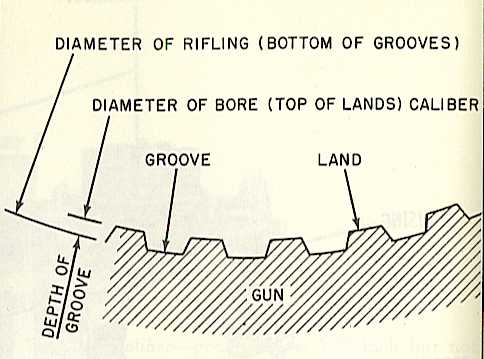
However, note that these aren't necessarily the exact diameter of the barrel. Even if you used the exact value, where would you measure it, a rifled barrel has lands and grooves.
In the end, there's no true need for round numbers. If you check engineering specifications of any machines, not necessarily guns, you'll find a lot of odd-sized dimensions.
fyi, you may be interested in some previous posts
A dizzying array of calibers were made in the past, and the ones that survived were simply the ones that the public liked. A LOT started with the rimfire .22 .32 .38 .44 (dont ask me why). I think Smith & Wesson created those. The .22 still exists today as the .22 short. When customers wanted a .22 with more power, they elongated the brass case to allow more powder, so instead of the just the .22, they re-named the original the .22 short, and the new one was the .22 long. You can shoot a .22 short in a revolver and some lever-action rifles, but they will not interchangeable in semi-auto pistols and rifles.
The other rimfires fell by the wayside, more powder meant that the copper case might split at any place in the case, and sometimes some of the blast would be directed back through the cracks in the weapon to burn your hand or face. The entire case was extruded and formed from a single piece of copper alloy, so for the rim to be able to be crushed by the hammer (igniting the priming crystals, mercury fulminate [see breaking bad/Tuco]), the rest of the case was also weak.
However, there was significant expensive tooling at the factory for cutting .32 .38 .44 cylinders and barrels. Colt had patented the .36, .41 and .45 calibers (for a short time), so even after buying the pistol, you couldn't buy ammo from anyone else (for at least a few years, until the patent expired).
By combining the primer cap (made from crushable copper alloy) from the existing cap-and-ball firearms, but with the stronger brass material in a case similar to the new and popular rimfires, you could have a more powerful cartridge. Whether for a pistol or rifle, the new brass cases were immediately popular.
Smith & Wesson got the huge and desirable Russian army pistol contract, so their .38/.44 "top break" pistols production was pretty much spoken for. When the US Army put out a bid for a pistol, the Colt "Single Action Army" (SAA) won the contract. However, several years later, customers asked for a Colt in the most popular rifle cartridge (1873 Winchester .44 centerfire), which would allow someone with a pistol and rifle to only need one caliber, so as soon as the S&W patents expired, Colt made the "Frontier" model (an SAA in .44 instead of .45).
The bullets were lead, with no copper jacket. Frontiersmen could dig out a bullet from a deer and re-melt it into a mold to re-load new cartridges. The lead would build up inside the barrel and need to be cleaned out. The .22 rimfire had a recessed base so that the slug walls were the same diameter as the copper case, and thats when ridges and grease were added to the slug-sides to reduce lead build-up as the slug passed through the barrel.
When brass cases were introduced, the case diameters were kept the same to continue to use the same machines, but...the bullet slug diameters were reduced (along with the barrel IDs to fit), and the greased ridges on the newer smaller-diameter slugs was placed at its base, so the ridges and grease were inside the brass case, to prevent dust and sand from sticking to the slugs when traveling.
The bases of the bullets are what expanded into the barrel rifling to grip the grooves (like a hammer mushrooming a spike head), so having only the base greased worked well enough. Traveled well, clean and dry, didn't build up much lead in the barrel when shot.
If the cases were still .38 and .44...the new bullet sizes (slug outside diameters to match the IDs of the cases) turned out to be .357 and .429
Part of the weirdness is from the fact that rifled guns have three different diameters that are important to the functioning of the rifling, and while one might be a nice round number the other two might not be. The three diameters are the diameter of the bore, the diameter of the rifling, and the diameter of the bullet. For large artillery caliber is given in bore diameter because a driving band is used to fill the rifling, but in small arms the bullet itself deforms to fill the rifling. Usually a caliber for a rifled gun is done a nice even bore diameter in metric, imperial, or customary and then the bullet is slightly larger to fill the rifling when it deforms, but because there are only so many useful even bore diameters there are multiple different cartridges at that bore diameter. So to differentiate between these cartridges the length of the cartridge or whether it is rimed or not is used, but sometimes the actual diameter of the bullet is used. For example using five similar cartridges all of which use a .3 inch diameter bore: .308 Winchester, .300 Winchester Magnum, 7.62×51mm NATO, 7.62×54mmR, 7.62×39mm. If you look at the .308 Winchester and the .300 Winchester Magnum the actual bullet diameter and bore diameter is the same even though they have different numbers is the name. The .308 Winchester and 7.62×51mm NATO even have the same exterior physical dimensions. For 7.62×51mm NATO, 7.62×54mmR, and 7.62×39mm you can see how two cartridges that have the same nominal diameter can have different bullet dimensions and cartridge length and rims.
And your nice round bore diameter might not be nice and round in another unit system as /u/MasterFubar mentioned in his comment about converting from one to another, such as:
152 mm = 6"
6.35 mm = 1/4"
5.56 mm = 0.22"
7.62 mm = 0.30"
Edit: Forgot to mention but the length of the bullet determine how heavy the bullet will be and the length of the whole cartridge determine how much gunpowder there will be, usually also done in nice round numbers subject to the same change in unit system problems at the bore and bullet diameter.
Edit2: After reading the comments by /u/spinningmagnets and /u/CherrySlurpee I am wondering if some of the large number of weird calibers were based off of fractions of a pound and whatever kind of bullet could be made with X amount of lead was done, because the .22, .32, .36, .38, and .41 calibers are not really logical even in customary. My searched turned up nothing but .44-40 Winchester started as a 200 grain bullet with 40 grains of black powder, giving nice even numbers, which is why I am wondering.