So as I understand it Germany's main reason for fighting WWI was that they wanted to launch a pre-emptive attack against a potentially very powerful Russia (the Schlieffen Plan existing just to prevent a lengthy two-front war) and generally to become a European superpower; Austria-Hungary wanted to further subjugate the Balkans; and the Ottomans were just busy being Turkish nationalists (maybe something to do with retaking land lost in the Italo-Turkish and Balkan wars?).
However, most of these objectives seem to be generally based in the idea of "exerting power" and other nebulous concepts. Were there any specific territorial objectives for these powers? What borders might they have settled for as a peace agreement in a realistic Central Powers Win the War scenario?
P.S. I'm not sure if that last question is appropriate here because /r/HistoryWhatIf. I don't mean for the question to be too much of a hypothetical, I'm just wondering about their objectives for if they won.
TL;DR:
Wanted to absolutely crush and make the French a second rate power that could never contest them again through crippling them economically and militarily. Wanted to absorb Belgium and Luxembourg. Wanted to absorb parts of Poland and the Baltics states, directly or indirectly, along with creating a puppet Ukraine to, most of all, provide much needed grain for a dime on the dollar. Also intended to build a Berlin -> Baghdad railroad to connect Germany to Asia and Asia to Germany for mutual economic benefit.
Wanted to annex Serbia. Pretty much the end. The Austro-Hungarians were similar in the boat the Ottomans were in in that they were fighting for survival. The Croats, Bosnians, and Slovenes all wanted more autonomy and independent will in the Empire and right out of Hungary would come suppression and oppression to keep them down. This would escalate until a movement would begin (with the support of Serbia to some extent) for a pan-Slavic Union of the Bosnians, Serbs, Croats, and Slovenes under "Greater Serbia" -- which obviously carve the Austro-Hungarians apart and deprive them of all their coastal land. With Russia seeing itself as protector of the Slavic people this kind of endeavor would have inevitably called Russia into war in support and thus Austria-Hungary's very existence was threatened by an independence movement that covered about half of its territory. This would, by the way, be precisely what happened after the wars end; Slovenia, Croatia, Bosnia-Herzegovina, Serbia, Macedonia, and Montenegro would unify into a greater Slavic state -- Yugoslavia.
Was, as mentioned above, fighting for its very survival. It was little more than a state propped up by European powers who felt its collapse was more disastrous than keeping them alive. The aforementioned Berlin-Baghdad railroad would have been very beneficial to them but really they got in on the action for territory. Over the past 100 or so years they lost Crimea, territory in the Caucuses, almost all their European territory in the form of the Balkans with the loss of Rumania, Bulgaria, Albania, Serbia, Montenegro, and Greece. Italy took Libya as the remainder of North-African land from them as well in 1911.
Right so there's two ways to approach this problem. Numero uno is the fact that "objectives" necessitates the question "when are you asking"; I think it's pretty clear that you and most people who ask this question mean when they set off to war. However I do feel it, again, is necessary to clarify that the goals of Germany in 1914 was very separate from their goals in 1917. Heck, their goals in January 1916 were totally different than their ones in December 1916.
However let's assume you mean when they went off to war. Here we have a lot less issues actually because 1. Russia did actually lose, as did Serbia, so we can clearly see what they seized from these respective powers and 2. Germany was nice enough to draft a shopping list of sorts in September 1914 of what they wanted w.r.t. the West.
So, let's start with numero dos. Now obviously we need to point out the fact that this was drafted after the wars beginning when everything was going (seemingly) magnificently for them so we can't take it at face value as some objective truth. However it gives us an idea of what they wanted, it aligns more or less with what they did in the East, and most importantly it aligns heavily with what their general attitude was leaning toward pre-war. The Septemberprogramme, as it is called, in short stated (highlighting territorial claims):
All fortifications from Dunkirk to Boulogne will be destroyed.
The ore rich area of Briey will be annexed outright. Coastal strips in the North would also fall under German control.
War debts shall be imposed on France so large that she is incapable of rearming herself for 15-20 years
The French will cease all trade with Great Britain and will be reliant on the Germans economically.
Either the outright annexation of Belgium or the seizure of lands up to Antwerp and making the rest a "vassal state"
Luxemburg integrated into the empire as a "Germanic State" (think how Prussia, Bavaria, Wurttemburg, and Saxony were quasi-independent states in the Empire)
The creation of a Central European economic sphere (think the Continental System of Napoleon and you're almost there) of the German client states in the West and the newly formed states created in the East from a supposed Russian defeat as well. All client/buffer states of Germany, of course. Translated it states " including France, Belgium, Holland, Denmark, Austria-Hungary, Poland and tolls. Italy, Sweden and Norway. This association will not have no common constitutional supreme superficial equality of its members, but actually under German leadership, must the economic dominance over Central Europe stabilize. "
The annexation of all Central African colonies controlled by Belgium and France -- basically creating a continuous state across the continent.
In short, with respect to the West, Germany ideally wanted to bring Luxembourg and Belgium into the fold, destroy the industriously wealthy and heavily fortified Northeast of the French along with economically subverting them and economic isolation of Britain. They wanted total domination of the African colonies, notably the raw goods that came with it, and France/Belgium had a crap load of very wealthy real estate.
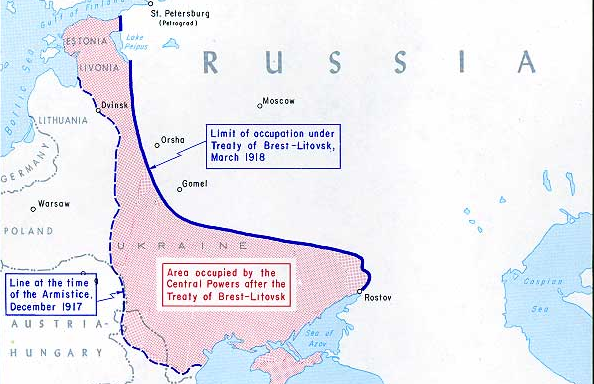
With respect to the East? Again, we know precisely what they wanted because they got it in the short lived Treaty of Brest-Litovsk; if you want to know why Versailles was so harsh it was because the Entente powers absolutely had a conniption at the blatant expansionism that was Brest-Litovsk. Basically a crap load of land was taken; I use that map to show the scale but in reality a large swathe of that was "independent" Ukraine with the heaviest air quotes of all time. These two maps also don't show Kars-Oblast which was ceded to the Turks as well along with the remaining "free" Baltic states which were to be little more than German vassals.
Chancellor Theobald von Bethmann-Hollweg distilled in essence what Germany's war aims were with his 'September Programme' in September, 1914; German war aims gravitated around it throughout the war. Security for the Reich, "in the East and West for all foreseeable time," which would involve crippling France and Russia, and attaining Hegemony in Europe.
Germany's growing economic power, combined with the neutering of it's rivals, would facilitate the creation of 'Mitteleuropa', a Central European Customs Union, which would essentially include all the states of Europe, and would serve as the vehicle of German dominance. With dominance of Europe, Germany's ambitions of 'Weltmacht' (World Power) could be realized.
http://www.alternatehistory.com/discussion/attachment.php?attachmentid=37325&stc=1&d=1193933065
http://www.alternatehistory.com/discussion/attachment.php?attachmentid=182835&stc=1&d=1344892050
The above maps illustrate the gist of German war aims. A series of satellite states in eastern Europe were established following Brest-Litovsk, and Romania would have joined them.
Austria-Hungary's war aims are less familiar; notably, they used promises of Polish independence as a carrot for Josef Pilsudski's Polish Legions. Congress Poland, and potentially Galicia, might be given independence as a Polish satellite state, or be brought into the empire as a third party. Serbia and Montenegro were to be brought into Austrian orbit, with Montenegro's coast preferably being annexed, to ensure Austrian dominance of the Adriatic, and Serbian isolation. Albania was also part of this, envisioned as a satellite that would secure Austrian access to the Mediterranean. Somewhat more disturbing, there was offhand talk, notably from Conrad von Hotzendorff, of Austrian settlement in areas of Serbia; many Serbian civilians were subject to massacres and expulsions during the Occupation of their country, often in the aim of their NOT returning. Some sort of 'Ethnic Cleansing' could have been in the cards; the Germans were planning for it in Poland (the 'border strip'), and even discussed settling veterans in Belgium and the Pas-de-Calais region. The Turks were CERTAINLY carrying such actions out against the Armenians, and likely would have continued against the Pontic Greeks, Assyrians, and Yezidis, who were all subjected to massacres and deportations by the Turks before, during and after the war.
The Turks seem to have had their eyes on the Russian Caucasus territories, as they sent troops along with the Germans to occupy some of these areas briefly in 1918, after Brest-Litovsk.
Bulgaria largely achieved it's war aims during the war; Vardar Macedonia, the left bank of the Morava River, Adrianople and Dobruja were all promised and occupied throughout the war by their armies. They were also promised the territories lost to Greece in the Balkan Wars, but by the time Greece entered the war, the Bulgarians, and the Central Powers, were losing it.
David Stevenson has an excellent section on war aims in 1914-1918, but the classic work on German War Aims in WWI is Fritz Fischer's Graff Nach Der Weltmacht ("Grab for World Power").
Hope that gives you some idea!