I actually answered this question a few weeks back, I'll repost my answer here.
I'm going to tackle your question in two parts. The first part, I'll go into the types of war crimes that were carried out by Western Allies (I'm assuming from your question, that's chiefly what you're interested in, but if you're seeking an answer inclusive of war crimes committed by the Soviets, I can tackle that later). The second part I'll address the Telegraph article discussing the professor who speculates that there were hundreds of thousands of rapes.
Now, in regards to war crimes committed by the Western Allies, they did happen. As much as I've seen some people pretend that some of the actions committed by western troops weren't really war crimes when compared to the actions taken by the Germans or Soviets, it doesn't change what those actions were. The majority of war crimes attributable to Western Allies (particularly the Americans and British) are incidents usually surrounding summary executions of prisoners of war shortly after their capture. These kinds of incidents usually occurred in the aftermath of a traumatic or catastrophic event (usually after a particularly intense firefight or battle where high losses may have occurred) for the offending unit. One example, is a written order that was issued shortly after the start of the German offensive in the Ardennes in December 1944, that stated no SS or German Paratroopers were to be taken prisoner and should be shot upon capture. Another example is the reprisals carried out by American GIs at the liberation of Dachau. Numbers between 30 and 500 are given by various sources for the number of guards and SS personal executed shortly after the camps capture by American forces.
Both of these actions fall under the definition of a war crime. Primarily due to the fact that regardless of how reprehensible or terrible the actions of the captured guards or soldiers were towards the prisoners in Dachau or others, the articles of war that American forces were operating under called for these guards or soldiers to be detained so that they could later be tried for any crimes they committed, not summarily executed upon being captured.
Other examples include summary executions of captured soldiers shortly after fighting had taken place. This was something that more commonly happened during major operations, like the Normandy invasions, and the Battle of the Bulge.
There are a small number of incidents recorded of civilians being purposefully killed by Western troops. There is particularly one known as the Canicatti massacre, in which eight (estimated) Italian civilians were killed in an attempt to disperse a crowd that was looting a recently liberated town. Other smaller scale incidents did occur in the North African theater as well as Western Europe, but nothing so large in comparison to Soviet or German war crimes.
Now, as far as the Telegraph article and Professor Gerhardt's claim that there were "hundreds of thousands of rapes of German woman", at the hands of both American, as well as Soviet soldiers, this is where it gets tricky.
There were certainly rapes that occurred both within the American and Soviet zones of occupation (as well as during the invasion of Germany) by their respective forces. As far as that number being in the hundreds of thousands, that is possibly true for the Soviets, but not for the Americans and other Western Allies. For the Western Allies, particularly the Americans, the generally agreed upon estimate for the number of rapes committed by those forces is somewhere between 11-14,000.
If you read in in the article, you'll notice that Antony Beevor chimes in to say that even he finds those estimates given by Prof. Gerhardt to be quite high (in regards to the Americans number) and very likely incorrect, primarily due to both her methodology as well as her source for that number, the records or diaries of Bavarian priests. Those records are great primary sources by the way, but not necessarily the most reliable or accurate sources if you want to establish the number of rapes that occurred. An important thing to remember here is that one must compare multiple primary sources to make a solid claim like the one she is making here, otherwise your data/claim is too susceptible to bias or inaccuracy.
Beevor, has written extensively on the Eastern Front and the subsequent Soviet occupation of Germany. His own estimates, state the the number of rapes that occurred under the Soviet occupation is somewhere around 1.4 million (which seems high but keep in mind, this is over a multi-year period where a very large number of Soviet troops were in Germany and other Baltic states). Beevor's sources ranged from NKVD reports to documentation on the number of abortions that were carried out by German woman in the immediate aftermath of the Soviet invasion and occupation.
So in summary, there were certainly a high number of rapes in Germany that were carried out by Allied soldiers, but the overwhelming majority of those rapes were carried out by Soviet soldiers, who were often encouraged and rarely disciplined for those rapes. Where the Western Allies certainly did have rapes occur under their watch, though the numbers were far far lower, and more often than not, the offending parties when caught, faced prosecution.
Sources:
From: https://www.reddit.com/r/AskHistorians/comments/32wqjr/what_types_of_war_crimes_were_committed_by/
The rapes committed by American soldiers alone in the European theatre are potentially very large, though are rarely researched. The one book I know of dedicated to the subject, Lilly's La face cachée des GIs, estimates total rapes at 14,000 in the UK, liberated France and Germany, after having accounted for underreporting and a reluctance to prosecute on the part of the military police. Notable is that those who were prosecuted were usually black, and they received harsher sentences in general, including execution.
The definition of "war crimes" was not an accepted or agreed upon international law until after the Nuremberg Trials. The prosecuting forces at the Nuremberg trial drew upon various treaties and agreements signed by multiple powers and sometimes in relation to the Hague. I think this is important to note in understanding a war crime, or what was perceived to be a war crime. What other users have mentioned are what we might today consider war crimes, but during the Thirty Years war, for example, might have been simply a facet of warfare. This brings up the question of victor's justice, but that's a whole different question...
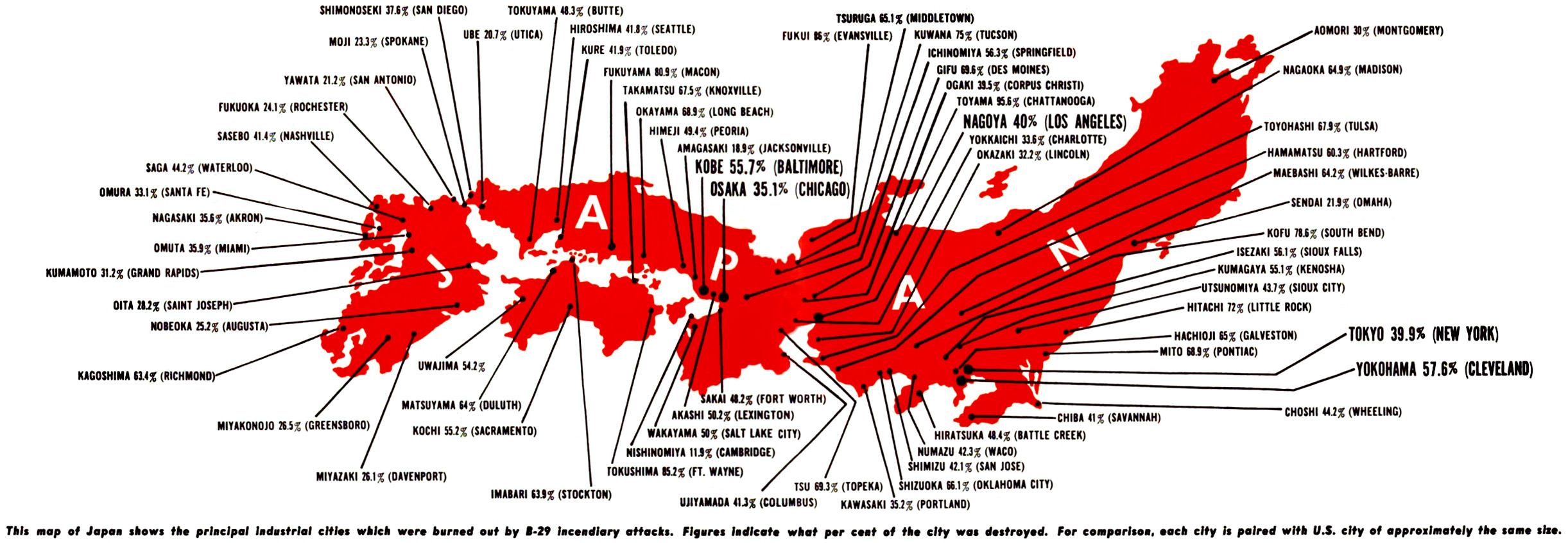
Beginning in November of 1944, four months after the fall of Saipan, a strategic island near Japan, the Allied forces began the systematic bombing of the Japanese mainland. The Japanese believed this to be an atrocious act. The Doolittle Raid, a moral raising bombing of Tokyo in 1942, did very little damage but was deeply concerning and upsetting to the Japanese. As I recall in my readings, they exacted harsh vengeance upon the pilots and assisting Chinese forces that they could get a hold of, because there was not enough fuel for the forces to return to a carrier at that distance (sorry I can't recall the source for this, might have been lecture or reading!). Similar to what /u/Venmar said, cities were laid waste to, arguably unnecessarily. The level of devastation in Japan was particularly harrowing because the majority of housing was made of flammable wood. The bombing of Tokyo yielded a firestorm that engulfed the city. The question for the allies was whether this sort of bombing was congruent with war aims. Was it necessary to kill 200,000 civilians in order to break morale? Was there enough light industry in the city being used for war materials that one could validate such a bombing? I don't have an answer, but this sort of destruction could probably, not unfairly, be considered an atrocity of some sort.
Source: Calvocoressi, et. al., Penguin History of WW2; Bess, Michael, Choices Under Fire: Moral Dimensions of World War II; lectures
Australian historian Peter Brune states that in New Guinea the Australian forces had an unofficial policy to not take Japanese prisoners. This was known to higher command who didn't do much to stop it. The reasoning by the troops at the front was that the Japanese weren't taking very many surrendering Australians prisoner (surrendered Australians were found tied to trees and bayonetted to death, for example) and so didn't see why they should burden themselves by taking prisoners. The Japanese could be shot out of hand as they tried to surrender or executed by those tasked to return them to the rear, who might report that the Japanese tried to escape.