Today:
You know the drill: this is the thread for all your history-related outpourings that are not necessarily questions. Minor questions that you feel don't need or merit their own threads are welcome too. Discovered a great new book, documentary, article or blog? Has your Ph.D. application been successful? Have you made an archaeological discovery in your back yard? Did you find an anecdote about the Doge of Venice telling a joke to Michel Foucault? Tell us all about it.
As usual, moderation in this thread will be relatively non-existent -- jokes, anecdotes and light-hearted banter are welcome.
Charles W. Macune, Professor Emeritus of History, RIP
Professor Macune was chair of the California State University Northridge history department when I was an undergraduate and MA student; he was widely known for his scholarship, his service to the department, and for his dramatic and engaging portrayals of historical figures such as Sir Isaac Newton and Subcommandante Marco. I never got the chance to take one of his classes, but I certainly recall him walking through the department offices in the garb of 16th-century Spanish nobility.
When I was at CSUN and struggling to support a family by waiting tables while I worked toward a career in history, I found myself short of the funds needed to apply for graduate programs. When he heard this, he wrote me a personal check for $60 on the spot so that I could carry on. A great historian and a great man, I owe him a considerable debt for helping me get to where I am today.
I heard today that he once apparently arranged with another professor to have himself "arrested" while dressed as a Zappatista. That kind of creativity, energy, and devotion to history is a rare thing.
Back from a hiatus, it's Better Know An Historian! And this week we visited with /u/Qweniden, our local wino, to talk about how "the history of Burgundy and its wine is in many ways the history of western Europe itself..."
Last night I compiled the index for my book. I'm still not totally clear why it needed to exist, because this is a ~100 page book consisting of three pages of historical introduction and 25 clothing patterns, but I did it. And in going through it I found a few cringey mistakes that I missed in proofing/my edits were disregarded for, which I'm half internally freaking out over and half pretty chill because hey, it's past fixing now so what's the point in worrying.
Now that it's done, I'm feeling itchy to do more patterning. I would love to do a book on lingerie dresses 1900-1925, that would be fantastic - although I'm not totally sure how many people would care, because that's a pretty niche topic.
As this is the 500 anniversary of the coronation of French King Francis I, the castle of Chambord will enjoy many new things in 2015. This summer they will introduce the Histopad, an application on their Ipads ( lend to the visitors ) that allows people to visualize the rooms as they used to be/look like.
Here is an image of the app. This project was successful in other places such as William the Conqueror's castle of Falaise. I can't wait to try that !
You guys have some mighty fine flair in here...Anyways, there was a thread earlier this week asking about German hold outs, similar to Japanese hold outs during World War Two after surrender. A comment thread appeared comparing Japanese hold outs, to which another commenter said "bushido" was certainly a contributing factor. I vehemently disagreed, but the comment thread was deleted for being off topic! So here I am, doing what historians do best, disagreeing and arguing. yay:
I would like to strongly disagree with the idea of Bushido playing into this idea of "hold outs." Perhaps you could argue that this mentality was a perversion of Bushido, but according to what I've learned, this is an inaccurate and simplistic statement.
If we consider those of influence in the Japanese military, by the time of the February 26 incident in 1936, the old guards, represented largely by the Toseiha (control faction) were some of the last exposed to what one might consider the true idea of Bushido. Samurai influence had waned long before in the Edo period and was practically extinguished in the early Meiji era. These men understood something about the Samurai bushido. However, those who took control of the army and the country afterwards, were of the Kodoha (imperial way faction - remember imperial way, it's important), and were represented by radical young officers and soldiers throughout the military. There were various cleavages throughout navy and army that I'm not privy to, but know that after the Feb. 26 incident, the Kodoha holds a large amount of influence and are young. Thus, they were not exposed to an older generation's understanding of bushido.
So, I said remember Imperial Way. The governing ideology of Japan during the "Dark Valley" was something called kokutai.
The state, to a Japanese, was itself a moral entity. The notion of kokutai, the national essence or polity, is complicated but embraces absolute righteousness, truth and beauty - in short, all national virtue. It was inseparable from the Emperor-system...Japanese ultra nationalism, although it did not admit of private interests, derived its authority from an appeal to the internal moral fortitude of each individual and his inseparable identification with the national virtue. Resting upon a consensus of devotion to the Emperor and to the kokutai...
-Calvocoressi, et.al., Penguin History of the Second World War.
If we consider this in conjunction with the question, and the truly unthinkable nature of surrender, it is certainly not a simple callback to bushido. The Emperor issued a separate surrender rescript to the armed forces for surrender, altogether more deliberate than the August 15 rescript to the public. Opposed to the "war not necessarily developing to Japan's advantage," Hirohito in the August 17 rescript to armed forces said "...with a view to maintaining and protecting our noble national policy we are about to make peace..." Kokutai was a dualistic devotion to internal morality and to the emperor and country as a singular entity. The bullets that each man shot from their rifles were, by extension, holy and pure in nature, because of the ideology. Additionally, the numerous instances of gyokusai which were basically mass suicides and banzai charges against enemy lines, discouraged surrender of any sort. See the island of Attu and Saipan, among others. For thoughts of intellectuals at home on that subject, see Donald Keene's So Lovely a Country Will Never Perish. So, this new idea of kokutai is much more an impetus for "hold outs" than the easy short hand of Bushido. For more on Japan's ultranationalism, see Maruyama Masao, "Theory and Psychology of Ultranationalism".
Not very well structured, but just wanted to barf it out somewhere.
My bugbear this week is books and specifically how the author positions that important first paragraph. Also known as: why academics shouldn't pretend to be Proper Writers by adopting little narrative flourishes.
What's brought to mind is Steven A Cook's The Struggle for Egypt, which charts, from a foreign relations perspective, the evolution of Egyptian high-politics since independence. It's not exactly a work of pop history. Yet its opening is largely out of character with the rest of the book:
Faluja Pocket. Al-Naqab Desert. December 1948. Trenches. There is no escaping them. They have become the dominant feature of a bleak landscape. They are home and prison for the officers and soldiers of the Fourth Division. The enemy pounds away with incessant attacks from both the air and the ground. This is what it has come to.
In fairness, Cook largely restrains his efforts at 'painting a picture' to that scene but that just makes it seem even more out of keeping with the rest of the book. Outside of pure pop history, I expect the writing in a work of history to be simple, clear and concise; little images like this don’t really add much.
In contrast, my favourite ever opening is probably Carr and Davies' Foundations of a Planned Economy (Vol 1). The opening paragraph (below) drops you straight into the detail and perfectly sets the tone for the rest of the book.
The experience of the harvest of 1925 demonstrated the twofold character of the grain problem. It was not enough to increase production: it was necessary also to increase the volume of grain actually put on the market. The 'marketability' (tovarnost) of the harvest became a familiar keyword in current discussions. The fourteenth party conference in April 1925 put 'the marketability of agricultural production side by side with the restoration of industrial production' as the major conditions of economic revival.
Of course, this is just my personal preference. But I'd be interested in knowing if anyone else is annoyed when authors confuse 'good writing' with 'paint a picture'.
Figured this would be a great place to introduce myself! I'm explicit_snark! I just finished my second year of undergrad studying Art History and History in a double major. I'm hoping to get my doctorate in Art History at some point in the future and become a professor after that.
I worked as an assistant for the sole art historian at my university this semester and loved every minute of it! She had me helping her administer exams, assist her in grading them, and set up tutor sessions to help the students in her Introduction to Art History (ART 101) class. Best of all I got paid about ~$200 a week to get a taste for what I want to do in the future, and can say that I am very excited for what lies ahead. :) Hopefully I can get the same position helping her next semester.
I've answered a few questions on here before, or rather the few I could come across that were related to art history! Hope to apply for flair soon but I figured I've been lurking for so long I might as well come out and introduce myself :)
I'm going to be living/working in Rome for 6 months starting very soon! Are there any historical/archaeological sites in Rome that are not very well known, but that are worth seeing? Beyond the pantheon, Vatican, catacombs, coliseum, etc , I'm hoping to find some interesting stuff off the beaten path.
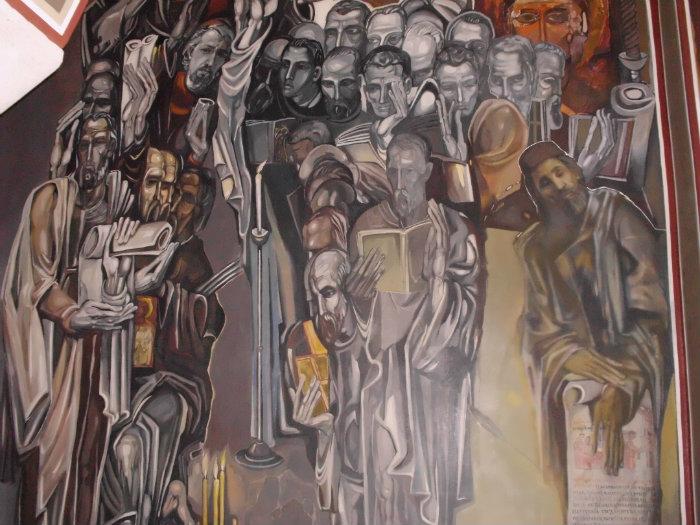
Bit of a specific question: A few years ago I traveled to the Bulgarian city of Veliko Tarnovo, one of the central sites of which is an orthodox cathedral. Inside the Cathedral the religious paintings were in a stunning and unique style. Does anybody know about this?
I am grading the final quizzes and final exams of the 90-person lecture session I was assigned to TA this semester, and it sucks so much. Most of the kids are actually pretty good, but I'm effectively pushing through 180 assignments that, with varying quality, have the same 2 answers.
Following on from my comment from last weeks' Friday-Free-for-All about the Lebensborn (fountain of life) program implemented by Nazi Germany, I just wondered if anyone knew of any memoirs (or accounts) of women that went through the program detailing what went on in the birth houses & their overall experiences? OR Does anyone know any accounts of Norwegians that shamed Norwegian-German aryan children & their mothers? Thank you :)
Here's a post about ebook prices. It's not history, but many historians like books so a little background on this topic may be interesting.
Ebook prices are higher than physical copies because some publishers have control over ebook prices, whereas they have virtually no control over the price of physical books. For physical books, the publisher gives the retailer a percentage (20% to 60%, usually around 40%) off the 'recommended' price, but the retailer is then free to sell the book at any price - perhaps well below the recommended price and even at a loss if they so desire. (With some limitations which might be incluced in an agreement; for instance to use the recommended price for the first few months after first publication.)
The system above is well-established and has been in place for decades if not more than a century. Ebooks don't fit in the above system. Logistics are simplified and once you have one copy you can in theory sell an infinite number. Thus retailers want to set a very low price on ebooks, to sell as many as possible. Publishers on the other hand want ebooks to be priced about the same as physical books, for a host of reasons, some better than others.
This led to a conflict between retailers and publishers which is still ongoing. Publishers demand to be able to set the price of their ebooks, retailers grudgingly agree. Amazon tried to force publishers to come over to the 'retailer' side by delaying or refusing to sell some books, publishers threatened to withdraw all their books, lots of arguments were had.
Take a case where the book is published by Scribner, an imprint ('daughter label') of Simon and Schuster. Amazon and Simon and Schuster recently came to an agreement where Simon and Schuster would keep control of the prices of their ebooks.
Thus you see the ebook priced at the 'recommended' price of the book, whereas Amazon is selling the physical copy at a huge discount (compared to the 'recommended' price). If you do the math, the difference between the ebook and the physical copy is about 40%. This is no coincidence. Amazon is big enough to get a good deal from publishers, probably acquiring their books at 50% or even 60% off of the recommended price. Amazon then proceeds to sell the book with a very low margin, such that smaller retailers cannot match the price without making a loss.
Anyone see previews or have been keeping track of History Channel's new miniseries Texas Rising? Does it seem accurate at all? Or are we going to get a bunch of bad history questions?
I'm sort of an amateur librarian, in that I like collecting media that has any merits at all. I've been trying to find audio that is historically interesting, curating and tagging it and all that jazz.
Does anyone have any ideas on what might be interesting to search for? A few months back someone posted a link to a collection of interviews of former slaves, and I've got that. I've found many of Edison's early recordings. Speeches by US presidents.
Mostly looking for audio that doesn't have corresponding video. Would there be any 1960s astronaut recordings, maybe?
If anyone's got any ideas, I'd love to hear them, and if you've got links that would be even better.
I have been thinking lately about Soviet thinking and what kind of thought crimes did/didn't exist in the USSR. What was permitted speech, what wasn't? More meta: what was the philosophical tenents (obviously Marxism/Leninism was the font) that yielded these laws?
I'm loosely familiar with Tsarist Russia and the Revolution so I have a certain notion of what preceded it and some of the forces involved at the start, but my knowledge trails off circa 1920 or so(and doesn't treat the philosophy at all).
Any book on nubian slaves in ancient egpyt.