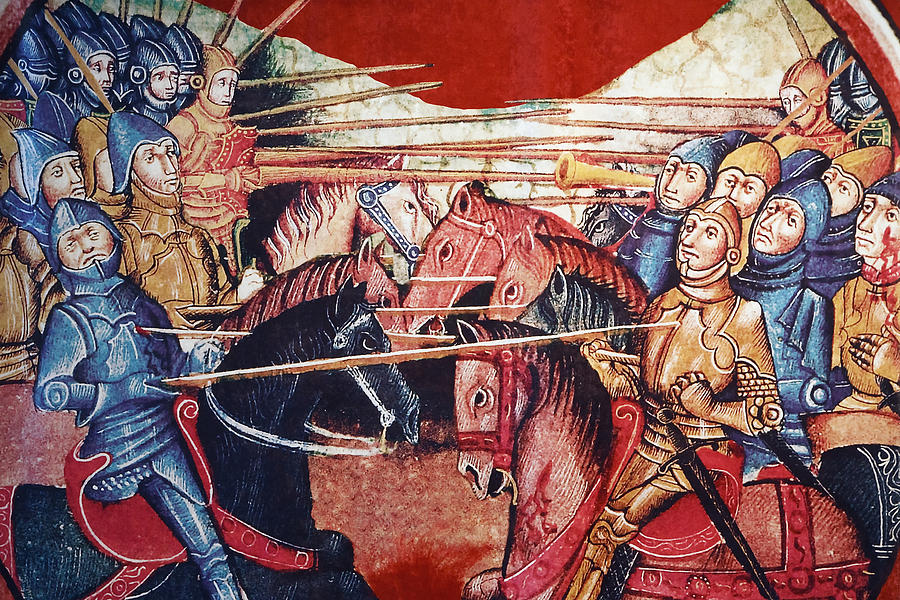
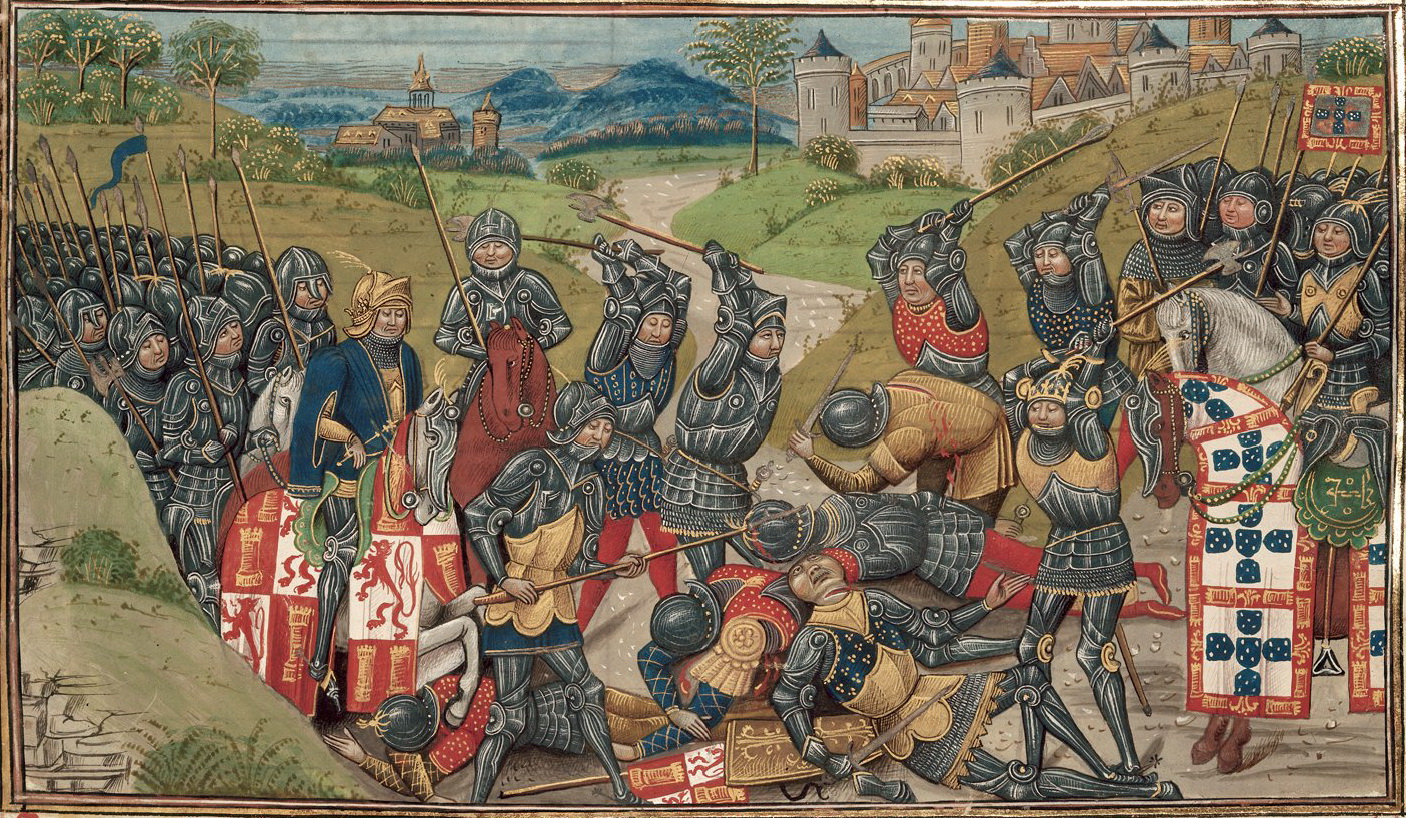
I've been amused by this trait in pre-1600's european paintings all my life; [people going through the most horrific injuries imaginable] (http://deremilitari.org/wp-content/uploads/2014/07/mounted-medieval-knights-in-battle-in-ken-welsh.jpg) look as if they were bored with life anyway and their killer did them a service. It would have been easier to draw open, panicked eyes and flailing arms than just laconic, [Eeyore-like pawns that die on command and without fuss.] (http://deremilitari.org/wp-content/uploads/2014/05/cf650ac3f1d2fc01e94ad438b68986c2.jpg)
I am very interested if there really are theories around this, and a lucid school of thought explaining the lack of dynamic or expression in these works of art.
Above examples: "Mounted Medieval Knights In Battle" from the museum of the Battle Of Navas De Tolosa (battle took place in 1212, I found no date for the painting), and "Battle of Aljubarrota" by Jean de Wavrin (1400's).
Individual emotional expression just wasn't an important element before that time in the European visual artistic idiom. During the Renaissance period the transition from a more iconic, conceptual representation tied to the platonic idealism which was the norm in Byzantine art ( http://en.wikipedia.org/wiki/Theodora_(6th_century)#/media/File:Theodora_mosaik_ravenna.jpg ) (and still is in present-day Orthodox Christian icons) to a style which took an interest into the material world and the people in it became visible. This was closely tied to the evolution of society which also evolved from one focused on the eternal ideal divine world to a more humanist one concerned with the material world and is a normal reflection of that. Consequentially we also see more and more works where personal emotion plays on important role, a tendency which would continue and be magnified in the Baroque art (eg. mystics stressing personal experience like Hadewych, or Bernini's Ectasy of Teresa of Avila). This increased concern with personal emotion and one's personal position in the world would continue to change society, most notably in the form of the Reformation (Reformed states like the Dutch Republic had blooming art scenes focusing on scenes from their daily life, still lifes, portraits, landscapes, etc.) and Contrareformation (which employed baroque religious iconography to secure its position again, eg. Rubens).
Just to latch on to save wasting time on a new post, why were medieval paintings so "bad"? As in, humans and horses famously don't look like humans or horses. Was it a certain style of the time or is it something as simple as artists hadn't mastered proper technique by then?
The soldiers' stoic expressions are a visual trope in medieval art that conveys the spiritual state of the soldiers at the moment of their death. For comparison, images of battles between Christian and non-Christian armies often depict the non-Christians with expressions of agony; the dying Saracen (i.e. non-Christian) soldiers in this fifteenth-century manuscript have agonized looks.
In the period we're discussing, and especially from roughly the the last quarter of the fourteenth century through the Reformation, Europeans were fixated on the idea of dying a good death. There were entire books dedicated to teaching people about the ars moriendi, the art of dying well. Your emotional state at the moment of your death was an essential indicator of whether you were saved or damned. No one could know for sure, of course, but external symbols were important clues about the state of your soul (that's why the hagiographies of saints often describe the body of a saint having a pleasant or sweet smell and not decomposing). Take a look at this image of St. Sebastian from a fifteenth-century manuscript at the Getty. The idea was that if you were a good Christian, your soul would be at peace at the moment of your death, which in turn would be reflected physically in your body. If you were damned, you would upset about dying and so might cry or shout when you died.
Lots of historians have written about the ars moriendi. Rudolph Bell's How to Do It is one of the best overviews. Nick Terpstra's The Art of Executing Well also talks about the art of dying well at executions.
Another question regarding medieval art; Why were images of animals given human features in medieval Europe? Example http://upload.wikimedia.org/wikipedia/commons/3/39/Anthropic_Farm_Units.png
#/media/File:Theodora_mosaik_ravenna.jpg)