My understanding is that before WW2 countries at war generally kept fighting to the trenches etc.
However, during WW2 and from then onwards it became common practice to target civilians (The Blitz etc.)
What lead to this? Which side started it?
Furthermore, if one side during WW2 stopped targetting civilians, do you believe the other side would have followed suit?
I think that the answer from /u/BritainOPPlsNerf is good for most aspects but misses one major component: the interwar bomber theorists. These men built on the ideas pioneered during WWI, which did include zeppelin bomber attacks on London. They also featured a number of conventional bomber raids on cities including London featuring the use of the Gotha bomber. Here is a picture so you can get an idea of the plane. Daylight raids were abandoned fairly quickly as the bombers proved to be quite vulnerable to fighters and antiaircraft fire. Later they would switch to night raids. These attacks were inaccurate and had relatively low casualties. However, they did spark ideas in a number of places.
The main theorist was Giulio Douhet from Italy. He penned a book that predicted that future wars would be won in the air due to the bomber. With advances in aviation after WWI, bombers became able to fly higher and faster as well as carrying more bombs and more defensive armament. As such, many agreed with Douhet's assertion that the "bomber would always get through." And these bombers would be able to destroy much more than their earlier counterparts. Douhet advocated for not just high explosive bombs, but also incendiary bombs and poison gas as well. The result would be the destruction of your opponent's factories and perhaps more importantly sowing death and terror amongst their civilian populace. With repeated raids taking out industrial centers and punishing your opponent's civilians, not only would their production capacity be reduced by being blown up or burned but a more important result would occur--the enemy's population was predicted to rise in revolt against their masters to demand an end to the war.
Douhet was joined by other theorists in other nations: Mitchell in the US, Trenchard in the UK, and Wever in Germany. Bombers were predicted to win the next war, and many nations invested heavily in them. Germany's advocate died in 1936, and the Germans chose to invest in the "fast bomber" concept over the heavy bomber idea. Results in Spain were interpreted as indicating that this approach would work. In the US and UK, heavy four engined bombers were designed and produced in large numbers. The thought was that the heavier payload and increased defensive capabilities would outweigh the increase in costs. Italian aircraft production never was able to match the scale of the Allies and lagged behind throughout the war.
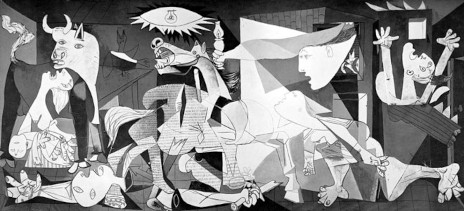
The comment from /u/BritainOpPlsNerf about Guernica being the beginning of terror bombing is correct in one important respect in that that bombing is identified as the beginning in popular memory. It got a lot of press coverage and Picasso's painting amplified it in the mind of many. However, in terms of casualties it is roughly in line with some of the WWI raids.
As for who started it, it was begun by the Germans as stated elsewhere. Along with Warsaw there was the bombing of Rotterdam before the Blitz, along with other cities. The initial German attack on London was a mistake, but it allowed the British retaliatory attack on Berlin to be seen as justified. Neither Germany nor the UK were able to sustain daylight bombing attacks because that idea of the bomber always getting though was proven disastrously incorrect. The technology behind antiaircraft fire improved and could reach the altitudes that bombers flew at, and interceptors were able to reach that altitude and move at a greater speed than the bombers. Combined with the lack of range for friendly fighters to escort the bombers, the crews that attempted daylight raids were savaged.
There were a number of contemporary opponents of strategic bombing. The most notable among them was Pope Pius XII, who reiterated earlier papal condemnations of targeting civilians via the air or otherwise. He also tried on numerous occasions to get Roosevelt to commit to not bombing in general, to not bomb Italian cities, or to not bomb Rome. On each occasion he was unsuccessful. The basis of these objections was the principle of distinction from the just war theory, meaning that one should distinguish between combatants and noncombatants and that to target noncombatants was immoral. There were other opponents as well, but many were opportunists. Some decried Guernica and Warsaw and Rotterdam and the Blitz, but were silent regarding Berlin and Hamburg, then they might object to Dresden and/or Tokyo, then might support or decry Hiroshima and Nagasaki. Normally these fickle condemnations were based on what political stance was convenient at the moment.
Still, it is remarkable that nearly every combatant in WWII engaged in the practice of deliberately targeting civilians with the new technology of heavy long-ranged bombers. Despite propaganda claims of pinpoint accuracy bombs were most often scattered about enemy towns either with indifference to civilian casualties or an explicit design to maximize civilian casualties. People chose to do this, and repeatedly did so. Only after the war with the advent of atomic bombs did many people begin to publicly question the wisdom of such attacks. My contention is that there was momentum behind the ideas of the interwar bomber theorists like Douhet, but people repeatedly chose to disregard their opponent's civilians for the promise of a war shortened by terrible attacks from the air. Once the investment was made into these extremely expensive machines, people chose to employ them to what they thought was their best effect--ignoring moral considerations or rationalizing them away.
I hope this answers the question for you. As always, followup questions from OP and others are encouraged. Feel free to also consult my user profile.
My understanding is that before WW2 countries at war generally kept fighting to the trenches etc.
This is a bit simplistic and worth a post in and of itself, so paging Dr. /u/elos_, please.
However, during WW2 and from then onwards it became common practice to target civilians (The Blitz etc.)
The idea of terror bombing was evident well before the German Blitz and was practiced in the Spanish civil war extensively by the German Luftwaffe volunteer contingent there; the Condor Legion. In fact, one can argue that the idea of terror bombing predates that from the example of German Zeppelin operations over the British Islands in WWI. The idea of terror bombing most often being recognized as leaping into the public mind at Guernica. The basic military principle behind terror bombing is that one can destroy the enemy's will to fight on the front and at home through the deliberate and random or targeted bombing of a city. Additionally, there would often be legitimate, if fringe, military targets, doubling the benefit.
Which side started it?
The Germans*. Well before the blitz on London we had, as mentioned, actions in Spain, as well as the terror bombings of Warsaw and Krakow. The bombing runs on Warsaw and Krakow also served to tie down the stretched-thin Polish air force, which was stuck in fighting attritonal dogfights against the Luftwaffe above the cities' airspaces.
*As a concept, Strategic bombing was explored by all nations inter-war, but Germany was certainly the first to put it into practice.
The general expansion of terror and strategic bombing is a result of a German blunder, then deliberate action during the Battle of Britain. Botched bombing runs hit civilian targets and a perceived effect was had on the population; more so up until that time than the Luftwaffe was achieving against military targets. The strategy then shifted from the flawed and losing strategy of attempting to destroy the RAF and the Home Island's defenses via attacks on military installations, to subjecting the British population to frequent and demoralizing attacks. This premise proved equally flawed, and prompted a violent and reciprocal reaction from RAF bomber command.
Furthermore, if one side during WW2 stopped targetting civilians, do you believe the other side would have followed suit?
This is conjecture outside the scope of this sub. However I will say this; doubtful. Considering initial terror bombing attacks on the UK began as a botch, an accident, then escalated to deliberate use of force, its a sign of frustration and desperation from the German Luftwaffe. Desperate forces do not de-escalate conflicts.