What kept the europeans from emigrating to Africa the way they did to America? From what I know about America before it was discovered, it looked a lot like what sub-sahara Africa looked like. A lot of tribes scattered around the land living rather uncivilized.
That's not quite right about the Americas. The Inca state, for one, was as much "a lot of tribes scattered around the land living uncivilized" as Rome or China or the Ottomans. It was a larger unified state than any in Europe at the time, with stable, expansionist, beaucratic policies. And if you compare modern Peru, Brazil, Mexico, and Canada, you'll see that there was hardly any singular path of development after European contact, just as their situations in 1500 were vastly different.
Diseases worked with Europeans with the Americas (they bought smallpox for instance, which decimated native populations) but worked against them in Africa. Europeans died from malaria amongst other things. This made it difficult to penetrate into the African hinterland until the late 1800s.
Secondly, Africa did have civilisation. The Ghana, Songhai and Malian Empires are testament to this. Those living in Swahili areas conducted trade with India. In time European arms, industry and shipping superseded these but the point is that they had existed.
A smaller third point would be that Africa wasn't really discovered, it has been known since antiquity. Indeed the earliest known map includes Europe, Asia and Africa.
From what I know about America before it was discovered, it looked a lot like what sub-sahara Africa looked like. A lot of tribes scattered around the land living rather uncivilized.
Actually, at the time of the "Age of Discovery", there were quite a few state societies and cities in Africa. When the Portuguese started traveling down the western coast of Africa they encountered the Kingdom of Benin, centered on Benin City and famous for its bronzeworking, and the Kingdom of Kongo. In the east were numerous sea-based Swahili city states, and the Sahel was home to Sahelian states famous for their cities and adobe architecture. At this time, before racialist ideologies had really taken hold, the Europeans didn't conceptualize Africans as particularly primitive; their main cultural feature in Europe's eyes was that they weren't Christian.
The Zimbabwe area was also home to states with traditions of building in stone (as seen in Great Zimbabwe and Khami), though these weren't true urban centers in the way we think of them.
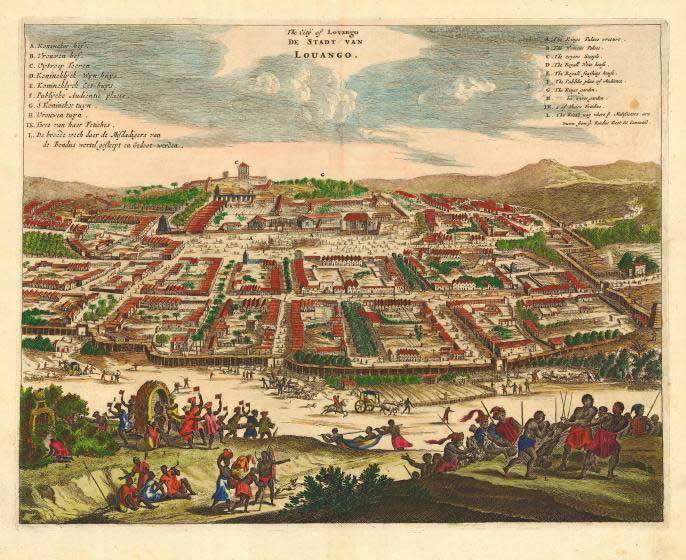
Before the Scramble for Africa really got going (it was actually pretty late in the scheme of things), along the west coast there was also Loango, the Asante State with its capital at Kumasi, the Dahomey state, and the Oyo state. In the Central African interior there were states such as Lunda and Luba. In the east there were the Great Lakes states in the Great Lakes region. In the south/southeast there was the highly centralized Zulu Kingdom, numerous Xhosa states, Lesotho (or "Basutoland") in the highlands of South Africa, and Tswana kingdoms in the highlands again but also along the fringe of the Kalahari and actively expanding into the desert. The south was generally less urbanized, but by the 19th century, Tswana towns often had populations in the tens of thousands.
It's telling that large-scale European colonization first took place in the southwest, where the temperate climate, low rainfall, and summer rain patterns prevented the growth of native African crops (though the Cape was also an important stopping point on the way to the Asia, which was also crucial, as well as the disease factor that others have mentioned).
So without bothering to unpack the baggage of terms like "tribe" and "uncivilized", quite a lot of Africa didn't really fit the bill.