What happened to Poland? I was confused about this because Germany was so worried about Russia on it's eastern front, and I was like "I thought Poland was a land buffer?". I know Poland existed before 1914, so why isn't it on the WWI maps I look at?
What is Prussia? In Hardcore History he keeps talking about Prussia, and I have a general understanding from high school, but throwing out all these names is a bit confusing. Was Prussia a country? Where was it located? It shared rulers with Germany?
They keep referring to the Serbians in the Austria-Hungarian Empire as Slavs and Serbs. Was Yugoslavia part of Serbia, or was Serbia something that came out of the break-up of Yugoslavia?
I hear a lot about Wilhelm II and Von Moltke the Younger, but I don't know hierarchy's in Europe. Who commanded who?
What happened to Poland? I was confused about this because Germany was so worried about Russia on it's eastern front, and I was like "I thought Poland was a land buffer?". I know Poland existed before 1914, so why isn't it on the WWI maps I look at?
Poland was a "buffer" but it was also part of the Russian state. Think of heteronational empires like, say, the Austro-Hungarians and you're almost there. Basically they were partitioned up between Prussia, Austria(-Hungary), and Russia near the end of the 18th century/early 19th century but Russia was keen on giving them a level of autonomy; this entity is known as "Congress Poland". After the 1863-65 revolts though their internal autonomy was quashed and they were de jure and de facto incorporated as Russian territory.
What is Prussia? In Hardcore History he keeps talking about Prussia, and I have a general understanding from high school, but throwing out all these names is a bit confusing. Was Prussia a country? Where was it located? It shared rulers with Germany?
Think of Germany as the United States for a moment and, again, you're almost there. Any serious historian of German Empire will seriously attest to this comparison if it was rigidly made, so keep in mind this is just a loose analogy to get you into the mindset here. Germany, like the U.S., is/was a federal state; that is it was composed of a bunch of States with a shared Federal government and its subdivisions, the 'states', were not unilaterally under Federal control.
That's where the buck stops though. The absolute crash course history of this (and please, if you want more explanation, don't be afraid to ask but I'll go over the basics) is that Germany for its entire existence was rather fractured between hundreds of independent states. These states were, by the 19th century, loosely held together by the Holy Roman Empire which had, at this point, Austria (the Hapsburgs) at the head; however the Empire by this point was more a ceremonial edifice than anything else but it did provide a level of internal security between these small states.
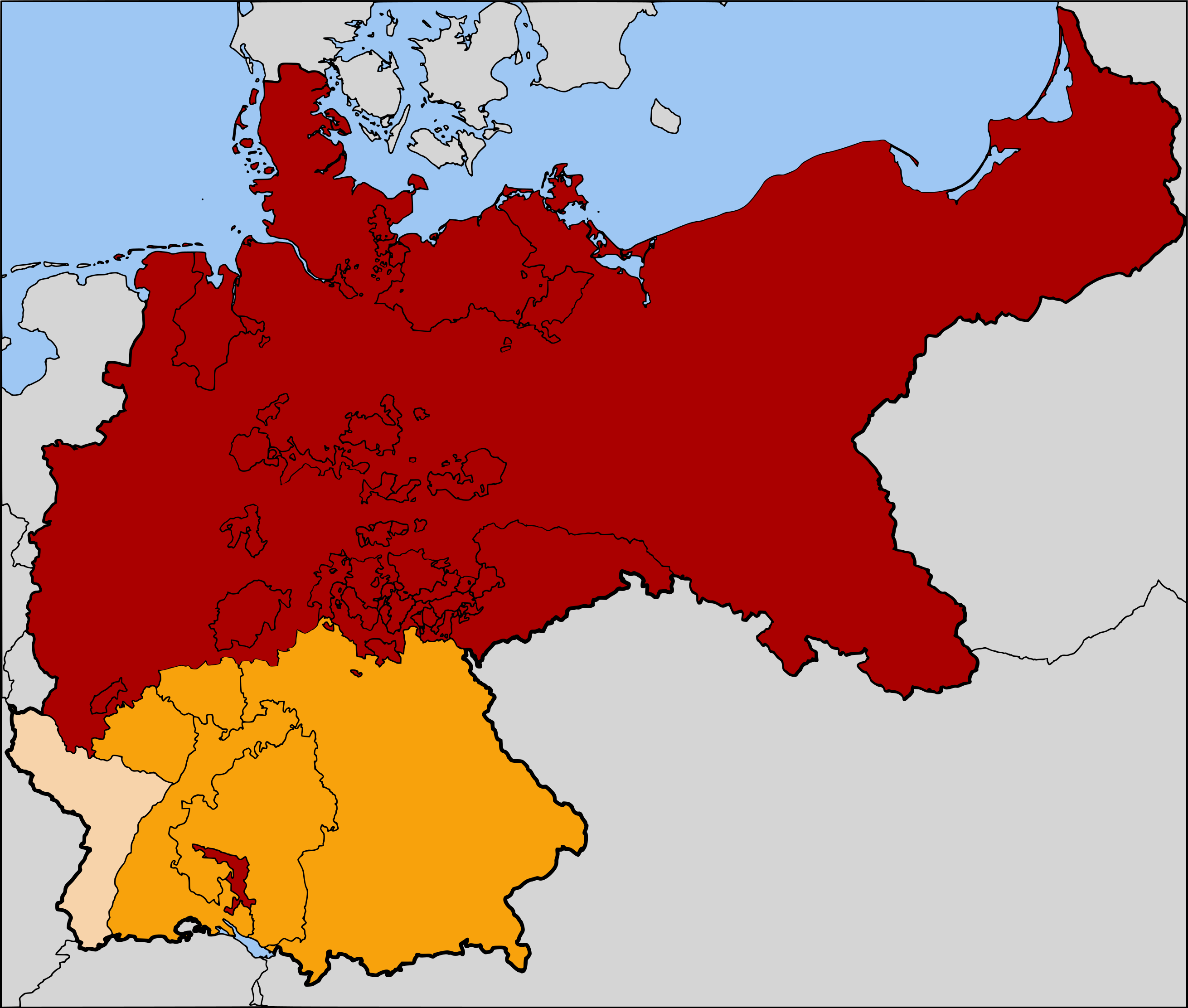
After Napoleon broke it down that internal security, this system which prevented all these states from waging war upon each other and giving mutual protection from outside invaders, there was a power void. After Napoleon's final deposing in 1814/15 the British in particular wanted to create a "Balance of Power", otherwise known as Concert Europe. The hope, with Germany, was that not one power would be permitted to dominate the German minor states and thus Prussia was given a large swathe of land in the Western parts of Germany to counteract Austrian influence. You can see it in green here.
Long story short that was wishful thinking. Even longer story short Prussia outclassed the Austrians in the end economically and militarily leading up to what is called the Seven Weeks' War in 1866. There was this little thing created as a sort of replacement for the Holy Roman Empire and, eventually, Prussia dropped out with all her homies and fought all of Austria's homies, notably Bavaria and friends in Southern Germany. Prussia whalloped them (hence the name) and would gain total dominance over Germany. They would form the North German Federation and would enforce rather draconian peace conditions on those Southern states of Bavaria & friends to force them under Prussian influence even further.
Imperial Germany would be formed after the Franco-Prussian War; the war being used to force Bavaria & friends in the South (who did not like Prussia) to commit to their military alliance. Further it was to crush the last hope of foreign intervention to come to the Bavarian's & friends aid; Russia was placated diplomatically, Britain was off doing its own thing, Austria was crushed 4 years prior, and now France was too. Germany would be formed with the Prussian King as its Emperor. Now you know how in the United States each state gets 2 senate seats? Think of their parliament as the same except they don't got equal representation; Prussia did not have a majority but they were unique in that they had enough to have veto power.
Bavaria notably took a lot of negotiating to get on board. They had a significant amount of seats and also sat on a council which decided, with equal representation, on foreign diplomacy decisions. She also retained control of her military (except in times of war where they could be ordered to go here or there) and some internal systems like railroads.
They keep referring to the Serbians in the Austria-Hungarian Empire as Slavs and Serbs. Was Yugoslavia part of Serbia, or was Serbia something that came out of the break-up of Yugoslavia?
Slavs was the ethnic/national identity of the Serbs, Slovenes, Croats, and Bosnians. Yugoslavia was the concept (and eventual application) of the unification of all Slavs in these states into one country. This was one of the leading crisis' that lead to the outbreak of the war; Austria-Hungary wanted to crush Serbia because all those other states were within her own borders as sub-states and as long as Serbia stood tall the concept of a unified, free state for the Slavs existed.
I hear a lot about Wilhelm II and Von Moltke the Younger, but I don't know hierarchy's in Europe. Who commanded who?
Willhelm II was the King of Prussia and Emperor of Germany. Helmuth von Moltke the Younger was the one in charge of Prussia's, and by extension all of Germany's, armies and was responsible for carrying out their battle plans.
Alright to start answering a few of these.
Prussia: The German Empire was not a solid homogenous mass. But made up of the various remaining German states dating back even to the HRE days. States like Bavaria, Baden, Saxony, and all the rest all remained constituent members, with many like Bavaria retaining their own kings and monarchies. Prussia though was very much teh "First amongst equals" her territory was the largest, anfd had led the German states against France in the Franco Prussian war when at the end the other German leader proclaimed Prussian ruler Wilhelm I Emperor, and the Prussian politician Bismark became Chancellor.
Prussian territory began on the Baltic coast in modern day Poland, with the capitol at Konigsburg(modern Kaliningrad), and extended South and West, eventually gobbling up many of the smaller states and becoming focused on Berlin.
In 1914 most of the Army and most of the higher officer corps was from the traditional Prussian aristocracy, the Junkers. Their ruling family had been elevated to rulers of the Empire with Wilhelm II the grandson of the first.
The Kaiser was not an effective ruler, given to mood swings, and rash actions, and rarely thought much through, along with folding when confronted with strong opposition especially from his military. However as Kaiser and Supreme Warlord he was in charge. So in July 1914 when the Sarajevo Crisis was coming to a head he was able to essentially write a blank check to Austria that Germany had their back, hoping that a strong show of force and his personal intervention with Tsar Nicolas would keep Russia from getting involved or a general war from starting.
But when it came obvious that war with France and Russia was on the horizon it came time to break out the mobilization plans, essentially rigid timetables to get the most troops to the front to win first. The Schlieffen plan Germany had adopted by then was focused on beating France first as in 1870 then turning towards he slow moving Russians. Moltke the Younger was the Chief of the War Staff, essentially the top General. His uncle had led the German armies against France in 870 to stunning victory.
However when Russia moved quicker then thought and was able to get two armies started out of Poland and Lithuania towards the Prussian homeland, the Kaiser attempted to stop the movements towards France, and change directions, or at least wanted to know if it could be done. Moltke told him in no uncertain terms that it was not, doing so would leave the German army unorganized and in a shamble for who knows how long and in now position to attack in either direction, and the Kaiser relented and the armies marched on toward France, while what troops could be spared went towards East Prussia with a recently retired officer named Von Hindenberg.
Poland had not existed as an independent state since the Napoleonic Duchy in 1807. After his defeat the territory was carved up at the Congress of Vienna between Prussia, Austria and Russia, with several rebellions and revolts in the 1800's tightening Russian control and eliminating any sort of autonomy they had.