This question is stimulated by [reports like this] (http://www.independent.co.uk/news/uk/home-news/boris-johnson-isis-militants-would-blow-up-the-pyramids-10257108.html)
What was the reaction of the original Muslim invaders of Egypt to monumental ancient cites such as Giza? What about other, more explicitly religious sites (temples, etc)
For all of the ferocity of the current Islamist iconoclasts, the original Muslim conquests weren't particularly destructive either to people or monuments, and what sources we have suggest that the conquerors were far more tolerant of local religion, even of those peoples who were not "people of the book" like the Zoroastrians than later writers would attribute.
The basic reason for this is that the initial conquerors viewed Islam as first and foremost an Arab religion. In order to convert to Islam you also had to associate with and join an Arab tribe. It wasn't until later writers and jurists started composing histories that the conquerors are supposed to have made "convert or die" type ultimatums to join the by-then universal religion. There's a separate theory that this kind of juristic iconoclasm was actually the direct result of Byzantine iconoclastic movements, particularly in the 9th century, so its presence in the 7th century would have been anachronistic. Personally I'm skeptical of that theory but that's another discussion.
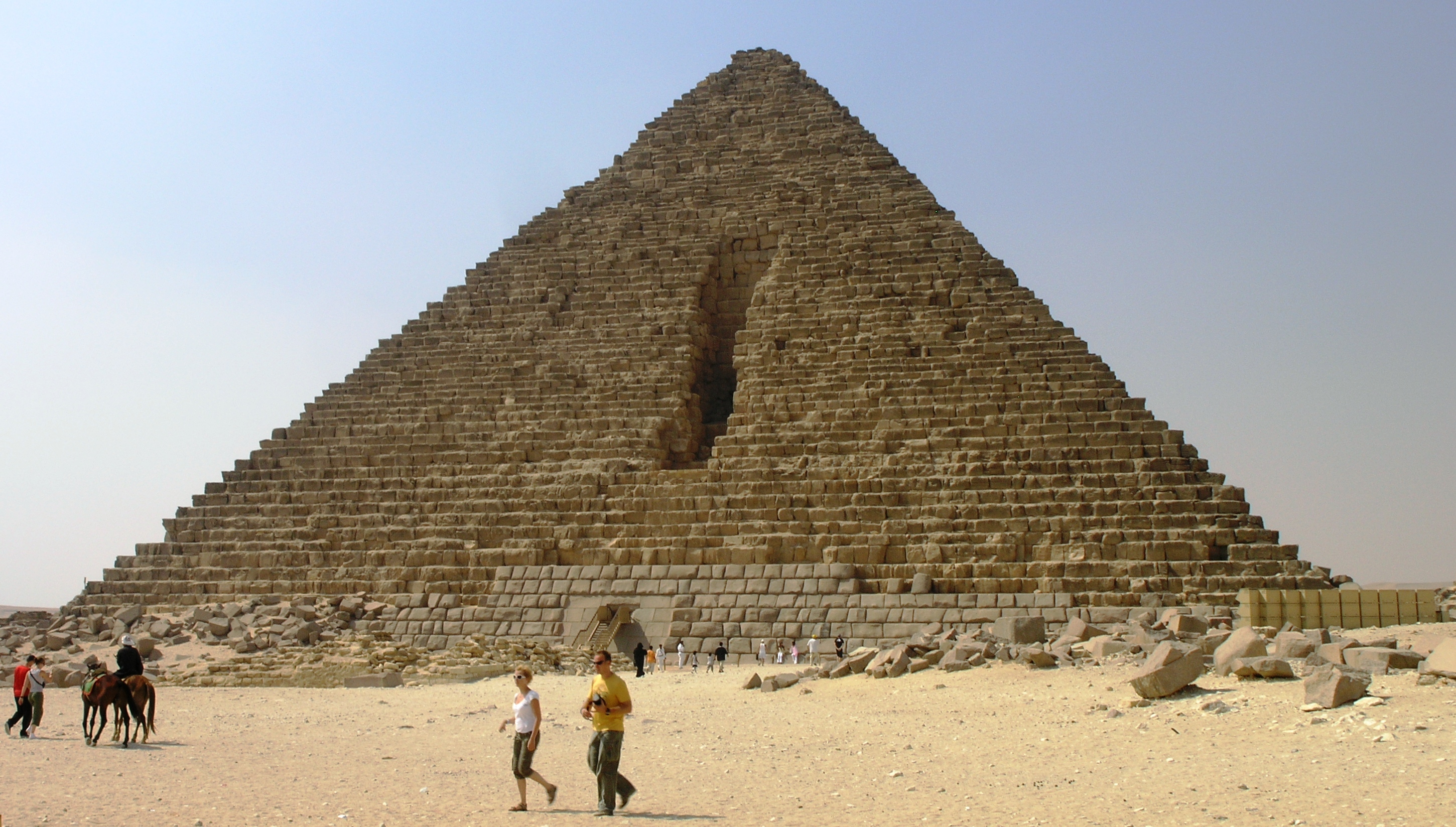
More interestingly for your question is what happened later, when the son of Saladin, Al Aziz Uthman actually did try to destroy the pyramids. He was apparently under the misapprehension that the pyramids were hollow, and so he erected catapults to destroy them, apparently on an anti-idols iconoclastic basis. Needless to say, he was wrong and the catapults failed to make so much as a dent. He then tried to disassemble the pyramids brick by brick. The writer on wikipedia has phrased this quite well as they found that the pyramdis were "almost as expensive to destroy as to build" and required a similar level of intense manual labour. He soon gave up but Menakure's pyramid still bears the scars of his efforts.
Earlier efforts to enter the Pyramids were motivated by trying to find treasure.
Supposedly some stones from the pyramids were used to build the Citadel (originally built by Saladin but renovated by Muhammad Ali) but that appears to be simply legend given that the stones aren't similar. Some smaller pyramids were apparently destroyed to build walls in earlier centuries.
The Sphinx is interesting as well. In Arabic is known as "Abu Al Hul," the literally "The Father of Terror" although I might render it just as "The Terrible One." Egyptians had basically no interest in it, although it was an object of superstition. It was basically a disembodied head in the sand until it was excavated by European archaeologists.
Sources:
For the practices of the early conquerors and some notes on misunderstandings about their supposed iconoclasm see Robert Hoyland's In God's Path. For more on the theory of how that iconoclastic legal theory developed under Byzantine influence that I mentioned see Benjamin Jokisch's Islamic Imperial Law. For the Sphinx and the Citadel see their respective entries in the Encyclopedia of Islam. Frustratingly I can't find a detailed source for Malik al Aziz's attempt to destroy the pyramid, but the effort is noted in the Encyclopedia of Islams entry on the Pyramids "Haram."
edit: typo
This strand of Islam is (relatively) new in its popularity. In the late 18th century, a Muslim theologian by the name of Mohammad Ibn Abdul Wahhab lived in the Arabian Peninsula. He intended to purify what he saw as corruption in Islam.
This was at a period when the Ottoman state ruled a huge chunk of the Islamic world. Ottoman Islam was overseen by a complex state bureaucracy. The Ottomans were adept at the realpolitik of the time and had many, many dealings with Christian powers. The Ottoman Islamic scholars would justify this in all sorts of creative ways. The personal Islam of most Ottomans was heavily Sufi, or mystic. There were many, many strains of this, but a lot of them venerated saints at shrines and particularly valued holy sites, and were not particularly perturbed by the ancient sites strewn across Ottoman lands. Many of them became religious sites as well.
Anyways, Wahhab rebelled against this and insisted, in a very binary black and white way, that monotheism meant no worshiping anything but God. So he advocated destroying anything that he thought might be worshiped instead of God. He also made a political alliance with the House of Saud. This religio-political alliance persists to the present day.
Wahhab and the Saudis rode against the Muslims bordering Arabia. They would kill Shiites, who they judged not real Muslims. For that matter, they justified killing Ottoman troops by saying they were part of a decadent, impure Islam and so were also not Muslims, and could thus be killed. Remember, these were the forces of the Ottoman Sultan, generally held to be the Sunni Caliph at the time.
Fast forward to the present day. Most post-Ottoman Muslim lands kept right on venerating shrines and what not. Wahhabis, otherwise known as Salafists, continued to dominate Saudi Arabia, which is now an independent country. They have lots of oil and lots of money. They have chosen to spend a good amount of this money funding religious schools worldwide that spread their particular version of Islam.
Al Qaeda, ISIS and the like have their intellectual roots with this movement. They are not very complicated thinkers and insist that anyone who thinks something built before Islam or anything that could be even tangentially something someone could consider a potential site of worship is probably being worshiped and should be destroyed.
And they destroy stuff. This idea was behind the destruction of old Sufi shrines and libraries in Timbuktu, and the giant Buddhas in Afghanistan. This stuff stood through centuries of Islamic rule. The houses of Mohammad and many of his companions stood in the Islamic Holy land until just recently, when the Saudis reasoned someone might be actually worshiping those and had them leveled. They actively destroy their history and that of those around them, when most schools of Islam, and until VERY recently the beliefs followed by most Muslims would have been very against this.