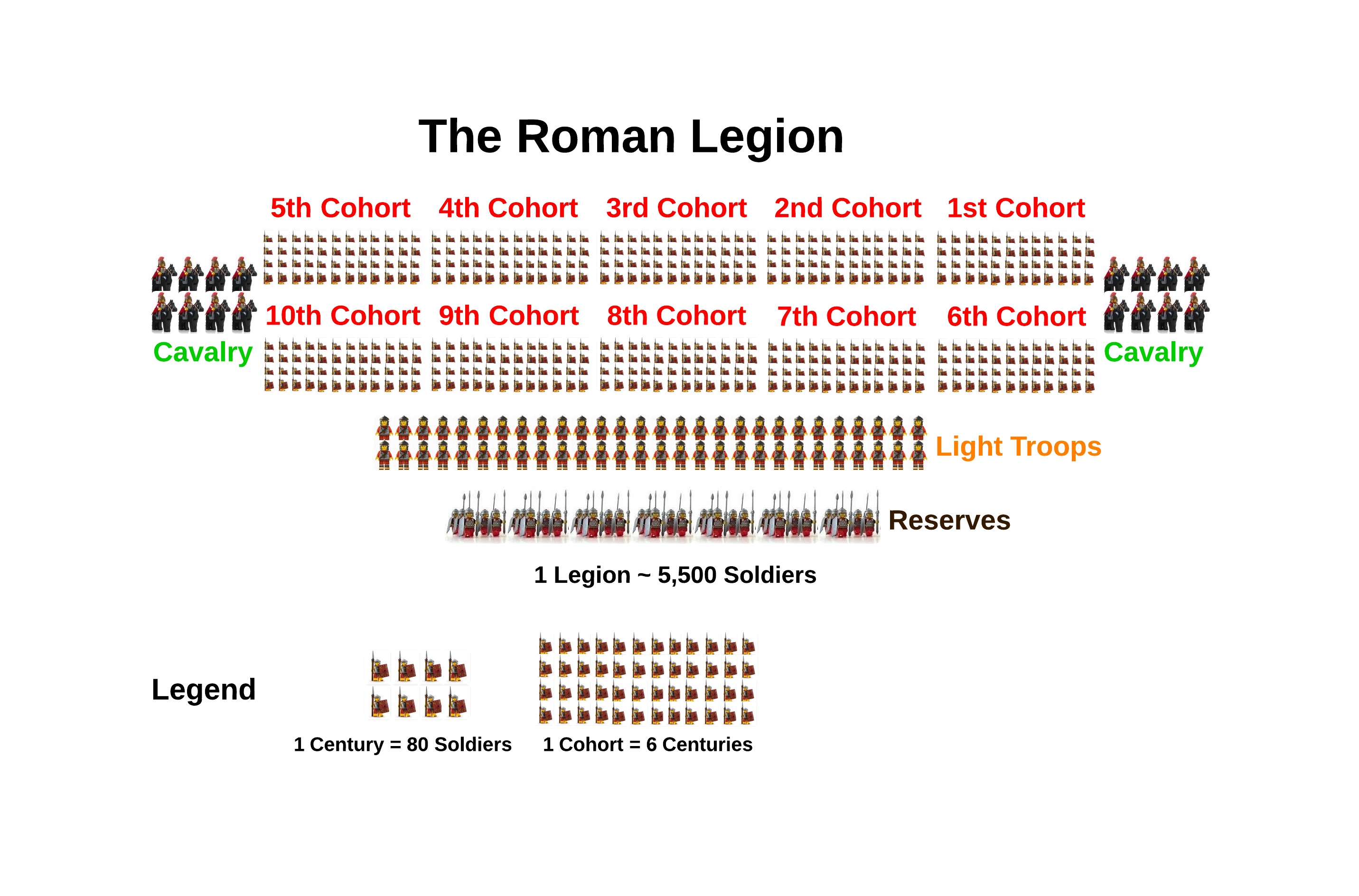
Before you ask, this is not homework. It's for my own enjoyment
Here is my Legion diagram [1356x4738px]: http://i.imgur.com/mXY73Zz.jpg
I want to be sure I'm as accurate as humanly possible. I've based my own work off this image: http://roadchimp.files.wordpress.com/2013/01/legion.jpeg
My legion consists of:
80 men in a century

6 centuries in a cohort

10 cohorts of legionnaires.

the "First Cohort" double the men as I read they had

Each cohort has an officer and standard.

120 cavalry on each wing

300 light infantry in the rear.
Also, I was trying to go with the Marian legion reforms, not sure if I am correct. Would any of you historians be able to confirm or critique what I've come up with?
Firstly, let me say that I really enjoy what you are trying to do! I do have a few points I would like to mention.
the "First Cohort" double the men as I read they had
While it is likely that some legions did have double-strength centuries in the first cohort (thus making this cohort double the size of a normal), it is unclear precisely when this change occurred, or how it held true during the period from the Late Republic to the mid third century A.D. Fragmentary lists showing the numbers of men discharged from the legio VII Claudia in 195 A.D. suggest that 47 legionaries were discharged from the first cohort, and 39 from the seventh cohort. Given that the magnitudes of discharge are relatively similar, and that legionaries could be discharged for several reasons aside from end of service (such as illness or wounds), it is unlikely the first cohort of the legio VII Claudia was double the size of the seventh. While this does not attest to the size of the first cohort in all legions, it does suggest that during the late second century A.D., the size of the first cohort is unclear. That it was always double strength cannot be conclusively deduced. That said, service in the centuries of the first cohort, especially for centurions, was always considered more prestigious.
Each cohort has an officer and standard
There were no legionary cohort commanders, and legionary cohorts did not posses a standard. The cohort is not analogous to a modern battalion, and is best viewed not as an organizational unit, but rather as a tactical unit, a group of cooperative centuries which, through training, could act in unison on the battlefield. Older scholars have tried to link command of the cohort to it's senior centurion (the pilus prior), but this idea was firmly rejected by Benjamin Isaac^1. The equestrian and senatorial tribunes of the legion also did not hold fixed tactical commands. Only when a cohort was detached from it's parent legion (becoming a vexillatio) did it receive a commander of suitable equestrian rank and a standard (vexillum, from which vexillatio derives).
300 light infantry in the rear.
By the time of Caesar's campaigns in Gaul (and likely earlier), specialized light troops like the velites of the Middle Republic were gone. I have not read anything which attests to legions having a permanent light corps. All legionaries were equipped with shield, thrusting sword, and javelins, taking their place in the line.
If you already haven't, I would check out Goldsworthy's The Complete Roman Army (it should be available in most university and many public libraries). Goldsworthy provides excellent, readable scholarship on the army through various periods of Roman history, and it's really the best introduction out there.