A professor of mine used to participate in digs in Palmyra, I'm sure he's a very sad man today.
Palmyra was a critical oasis town between the Roman and Parthian/Sassanian political zones. The Middle East and North Africa were far less desert in the early centuries CE than they would become later and there were far more viable places to live in areas that today are sparsely populated wasteland, and Palmyra, as a major trading hub between the Roman and Persian world, prospered and grew to considerable power and influence.
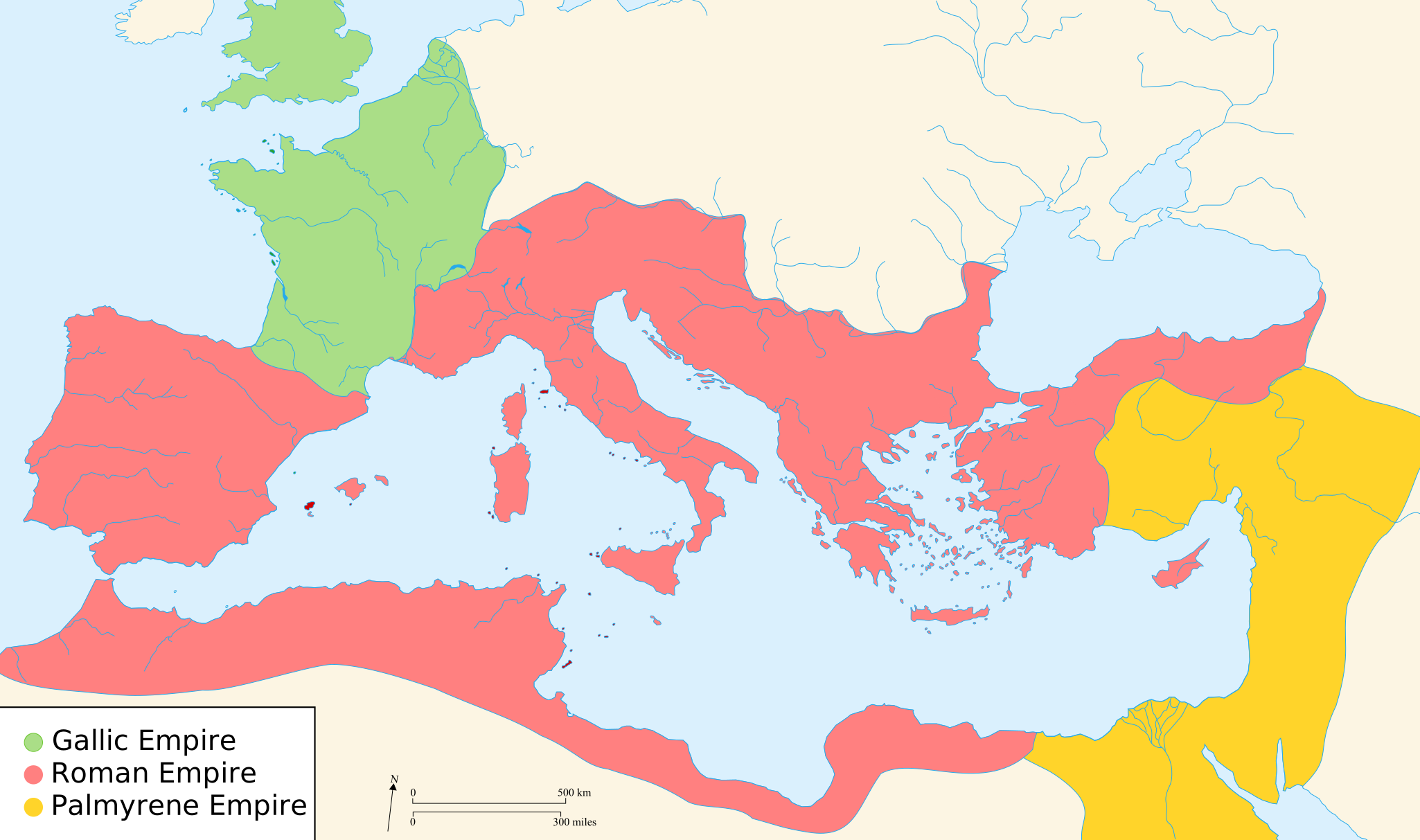
In the 260s CE during the Crisis of the Third Century, Imperial authority fragmented after the Sassanid capture of the Emperor Valerian. Valerian's son Gallienus, attacked on four different frontiers (Gaul, Italy, the Danube, and the East), basically gave up on the first and last of those and left them to their own devices while he struggled to shore up the middle two. As a result, both Gaul and the East formed their own political entities independent of Rome. http://upload.wikimedia.org/wikipedia/commons/7/7c/Map_of_Ancient_Rome_271_AD.svg This map is rather late in the period.
The local ruler of Palmyra, a Roman citizen of Syriac origin named Odaenathus, proclaimed himself king of kings of all of the Eastern provinces but did make nods to Gallienus' overall overlordship. Rather than try to seize the whole empire, Odaenathus strove during his years as Palmyrene Emperor to war with the Sassanids to prevent them from making any gains on Imperial territory while Gallienus was fighting in the Danube and Italy. Though it looks on the map like Gallienus let two thirds of the empire secede while he wasn't looking, both the Gallic and Palmyrene empires devoted their resources to fending off external invasions (defending against the invasions is what precipitated their existence, after all) rather than pursuing civil war.
After Odaenathus' untimely death, the throne of the Palmyrene empire theoretically fell to his young son, but his wife Xenobia took over the regency and was tired of ruling in Rome's name and decided to pursue carving out the Palmyrene Empire as a more permanent and real entity. Notably, she conquered Egypt, the vital grain supply to Rome.
By this point, the new emperor, Aurelian, had brought the Gallic Empire back into the fold and had no patience for Xenobia, and in a short campaign he defeated the Palmyrenes, reannexed the territory, and, after Palmyra rebelled yet again, ordered the city depopulated, forced its citizens into exile, and looted the prosperous trading settlement.
Culturally, Palmyra was an unusual blend of Roman, Persian and native influences. It had an unusually strong sense of place and local identity, which can be seen n the well known Palmyrene diaspora. And added to this it has some of the most spectacular above ground ruins from the ancient world.