There were several cultures, both archaeological and historic, based around the Great Lakes. Here are just a few examples.
The Old Copper Complex: Beginning around 6000 years ago, the Old Copper Complex developed around Lake Superior. These are a collection of cultures defined by their extensive and diverse use of copper objects. Helping to fuel the production of copper weapons, tools, ornaments, and ceremonial items were the copper mines on Isle Royale in Lake Superior. Around 3000 years ago, they stopped producing copper weapons and tools, refocused their industry on ornaments and ceremonial items, and traded with other peoples to the south and east for stone that made more durable implements. This, by definition, was the end of the Old Copper Complexes, but the cultures that formed the complex kept on going with a new set of tools at their disposal and the copper trade would continue until Europeans arrived on the continent and began disrupting the trade networks in various ways.
Western Basin and Sandusky Traditions: These are two archaeological cultures found in the western and southern portions of Lake Erie between 1500 and 400 years ago. Initially the Western Basin Tradition occupied the southern tip of the Ontario Peninsula, while the Sandusky Tradition was based around Sandusky, Ohio. Between 500 and 1000 CE, the Western Basin Tradition pushed south, settling in the areas around modern Detroit and Toledo, as well as establishing themselves on the Bass Islands and neighboring islands in the middle of Lake Erie. This sparked a long series of conflicts with the Sandusky Tradition, who pushed back against the Western Basin and by 1350 CE had dispersed them into other parts of Michigan, Indiana, and Ontario, effectively ending the Western Basin Tradition as an archaeologically recognizable culture. In the process, they also came to settle the islands of Lake Erie. The Sandusky Tradition seems to match up with the historic Mascouten; the Western Basin Tradition may have been another group of Central Algonquians.
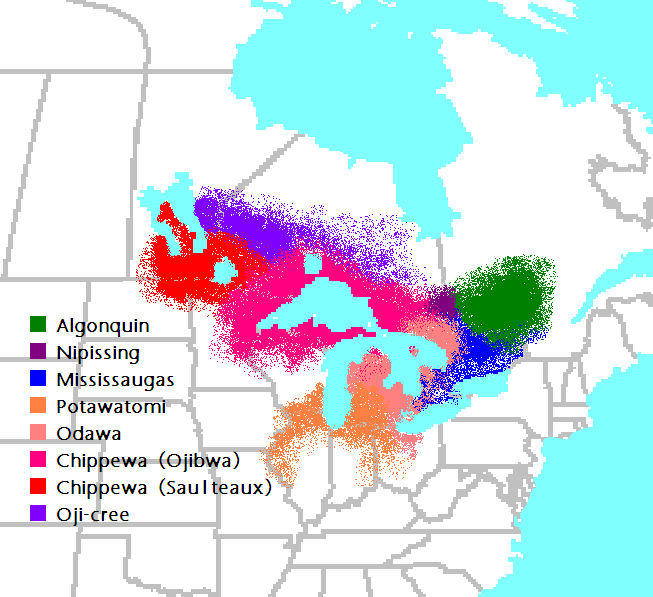
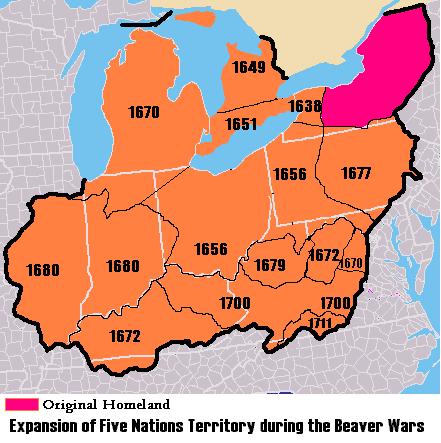
Anishinaabe: As far as laying claim to the entirety of the Great Lakes, the Anishinaabe came closest. Around 900 CE, they left the east coast an started migrating up the St. Lawrence River, stopping periodically along the way: near Montreal, Niagara Falls, near Detroit, on Manitoulin Island, at Sault Ste. Marie, near Duluth and finally Madeline Island. Along the way various groups split off from the main body of the migration. Near Detroit, the Council of Three Fires was established. This was a confederacy formed by the Potawatomi (the Firekeepers), the Odawa (the Traders), and the Ojibwe (the Writers), and various social duties important to the integrity of the Three Fires was given to each. The Potawatomi remained in southern Michigan while the Odawa and Ojibwe continued north. The Odawa settled initially on and around Manitoulin Island, with the Ojibwe heading west to Sault Ste. Marie before encircling Lake Superior. During the Beaver Wars of the 1600s, a lot Anishinaabe territory was shaken up as the Haudenosaunee (Iroquois) expanded rapidly through the Ohio Valley and eastern Great Lakes. In the counter-offensive against the Haudenosaunee, the Anishinaabe were able to take advantage of the situation and more firmly establish themselves throughout Michigan, southern Ontario, and expanding into northern Ohio (since the aforementioned Mascouten had been previously driven out by the Haudenosaunee).
Jiimaan: I suppose I should say something about the types of boats used. To the best of my knowledge we haven't found any preserved in the archaeological record. This may indicate that the jiimaan (or wiigwaasi-jiimaan to distinguish them from biiwaabiko-jiimaan - modern aluminum canoes) may have been used since ancient times (EDIT: Forgot to mention why. Outside of a few exceptional circumstances, a jiimaan isn't going to last for more than a few decades, unlike a dugout canoe that could last centuries when buried). Jiimaan is the Ojibwe word for a birchbark canoe. They come in a variety of shapes and sizes, the largest being upwards of 40 feet long. A 30-foot long jiimaan could be managed by three men and carry a ton of cargo even in shallow water. Jiimaan are particularly good in shallow water, allowing them travel along rivers and streams, and are light enough (when empty at least) to be carried overland (also light enough that when some of the smaller ones were brought ashore, they had to be staked down to avoid being carried off by the wind). Out in the deep water of the Lakes, however, they had to be used cautiously. Waves churned up by strong winds could easily upset them. Historically at least, small sails were occasionally used to help cross open water, but again, only when the winds weren't too strong.