For example, would a high-status individual in a tribe in present-day New York State in, say, 1550 be generally aware that people from other parts of the world were conquering lands far to the south?
While it's difficult to say exactly who knew what when, there are several definitive pathways along which this sort of information reached important leaders in what's now the United States.
For one, Taino fleeing the Spanish conquest of the Caribbean headed north and founded the village of Abaibo in Florida, under the protection of the certepe of the Calusa, a powerful nation that dominated southern Florida and, by and large, successfully resisted European conquest until the early 1700s.
In the oral history of the Natchez, recorded by French historians in the 1720s, there's an incident that seems to suggest knowledge of the Spanish defeat of the Aztecs. It describes a war that occurred among the people who lived to the southwest of the Natchez and who lived in huge stone houses (note: this might also be a reference to or an amalgamation with Pueblo communities to the west). A leader among these people proclaimed himself emperor over all, though many resisted. Into this conflict arrived the Warriors of Fire, who are explicitly said to be the Spanish. Those resisting the would-be emperor get the Warriors of Fire on their side and send word to the Natchez, asking them to join in the fight. The Natchez decline, warning the others that the Warriors of Fire are only going to turn on you once you've defeated the emperor. The episode ends with a statement that the Natchez have heard their warning had come to pass, indicating that they received this information secondhand.
In 1521, Francisco de Chicora was abducted by the Spanish from coastal South Carolina. Over the next couple years, he spent time in the Bahamas, Hispanola, and Spain before returning to his homeland during a failed Spanish attempt to colonize the area. Francisco's people were on the doorstep if not actually part of one of the most prominent Mississippian nation in the east - Cofitachequi - and artifacts from the failed Spanish colony were observed in Cofitachequi a little more than the decade later. It seems quite likely the the information Francisco would have about Spain and its colonies would have reached the ears of the Lady of Cofitachequi soon after he returned to North America.
Similarly, in 1534 that sons of Donnacona, leader of Stadacona (present day Quebec City), were taken to France by Jacques Cartier. They returned a year later. From his sons and Cartier, Donnacona would have learned much about France and Europe in general (unfortunately Cartier's journals are more concerned with what he learned about North America than the questions Donnacona asked about Europe, though it was a topic of conversation). During Cartier's stay along the St. Lawrence, Donnacona made several unspecified diplomatic journeys to his allies, frequently returning with representatives. While Donnacona died while stranded in France, his people were dispersed from St. Lawrence Valley and variously joined up with the Wendat in southern Ontario and the Haudenosaunee in New York, potentially carrying information gathered by Donnacona and his sons with them.
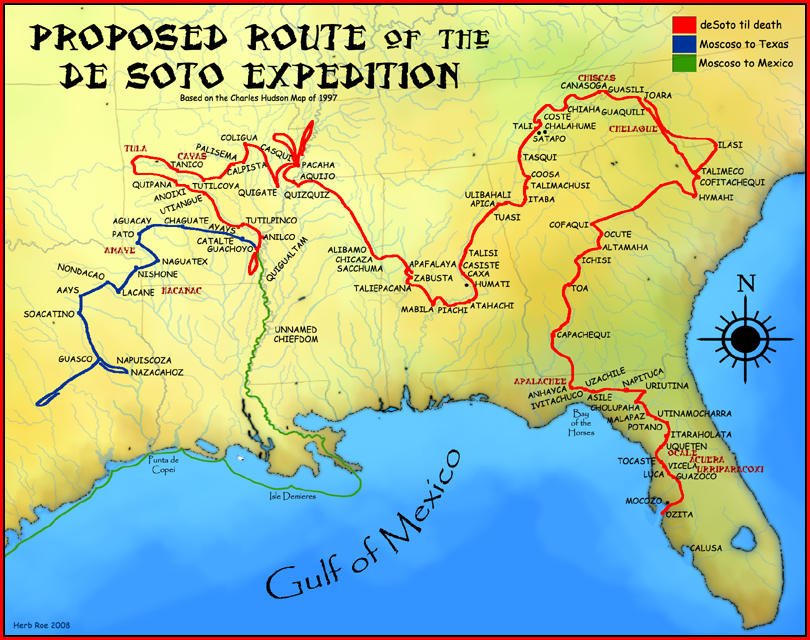
In 1539, de Soto's entrada lands and spends the next four years marching through the Southeast. De Soto's path takes him through many of the major nations of the region and intersects with many of the trade routes linking the Southeast with the Northeast. News would have definitely spread. While I don't have a good example of how far or how fast news of de Soto's entrada would have spread, it might be useful to consider than toward the end of their own expedition, de Soto's men heard of the contemporary Coronado entrada, which was operating further west. Along the way, various members of de Soto's entrada deserted or were captured, providing another way for information about the Spanish empire to circulate in the area.
In 1561, Don Luis was abducted by the Spanish from Virginia. He'd spend the next ten years in Cuba, Mexico, and Spain, before returning with a Spanish attempt to colonize the area. Don Luis abandoned the colony almost immediately and when the Spanish tried to drag him back, it sparked a conflict that wiped the colony out. While its far from conclusive (and personally, I'm quite skeptical), it's been hypothesized that Don Luis is the same person as Opechancanough, brother and successor of Wahunsenacawh (Chief Powhatan). On a similar note, Tisquantum (Squanto) had been back and forth across the Atlantic three times before the English colonists arrived at Plymouth and spent time in England and Spain.