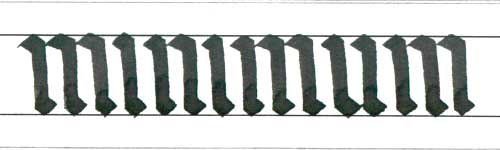
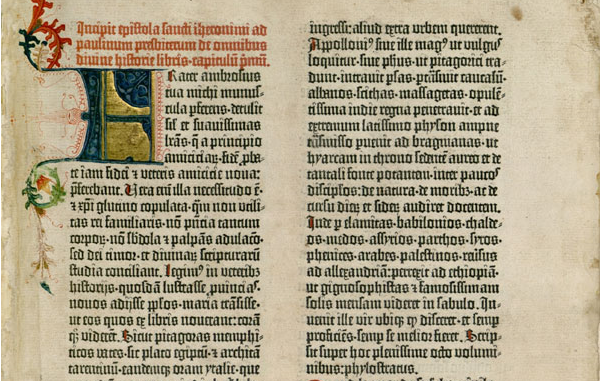
I was wondering why the script changed. The carloingian minuscle was easier to read then blackletter isn't it? example: carolingian and blackletter as an extreme example, but this version of blackletter might be a better one.
It probably is just because I'm not used to reading blackletter and the minuscule looks more like our modern font. But still I have the feeling that in minuscule the letters are more distinct then blackletter.
I can't really say why it evolved that way authoritatively. I've heard it was to minimize the amount of parchment needed by squishing everything in close. If you took a measuring tape to a bunch of manuscripts, you'd see the writing is generally tiny, and the pages are small too. Books of Hours with those detailed illuminations? They're like 4x6 inches.
and the minuscule looks more like our modern font
I can speak to this though. In the Carolingian Empire, they made new copies of tons of old documents. They made new copies, in the Carolingian minuscule, of Roman documents. Understandably, when the Renaissance rolled around, the Carolingian documents were much more likely to have survived than the by then 1500 year old Roman ones. So you have all these Roman documents written in Carolingian, and you don't really have much in the way of originals. So then during the Italian Renaissance there was this sort of nostalgia for Ancient Rome. The Italic hand was directly based on these "Roman" documents that were actually Carolingian copies. Italic is the foundation for a family of modern fonts. The blackletter style didn't really catch on in Italy like it did in France.
Source-wise... I think Sheila Waters and David Harris. Maybe Drogin. Those are the calligraphy books on my shelf that include significant history in them (and also I studied under Sheila Waters in person).