Usually, people consider the Achaemenid Empire the First Persian Empire and the Sassanid Empire the Second Persian Empire, conveniently skipping both the Median and Parthian empires even though they inhabited the same regions? Is there a specific reason for that?
This is an interesting question, but first we have to understand and break down the term "Persian." What does it mean? Can we say that it refers to any state (or really anything) from the region of Persis? In that sense, we could characterize the Achaemenid and Sassanian empires as "Persian" empires because they came from Persis. But this is a rather simplistic definition and ignores important cultural elements inherent to both powers. For example, the Achaemenid empire would adopt numerous court and royal practices from the Medians to the point that Greek states would disparagingly call them "Medes." And even for the Sassanians, there is a debate on the origins of the dynasty, with some even arguing that they may have well been a Parthian clan thus turning their rebellion less as a nativist Persian uprising and instead as a way to replace one dynasty with another. Okay, but now what? Another definition we could use is to mention cultural and royal practices that are decidedly from the Achaemenid empire. As a model, this definition is helpful because it means that we could explain the usage of specific royal titles and practices from the Seleukids to the Arsakids to the Sassanians. In order to get a "list" of these practices, we can use Herodotos, Xenophon, and even Arrian as sources. Overall, the point is that defining "Persian" is very challenging and depending on what definition we use, you can get a different response to your question.
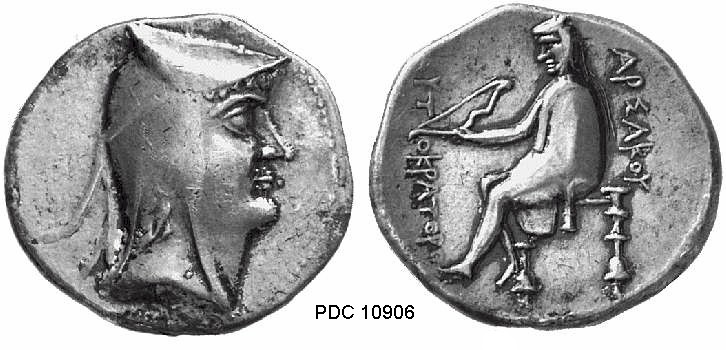
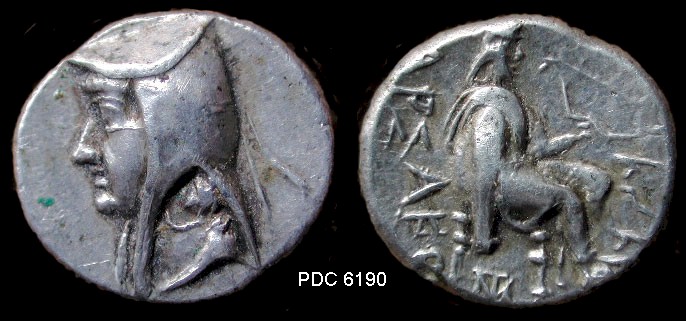
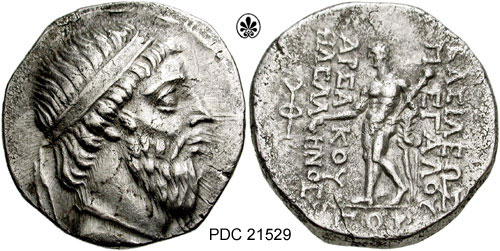
But now we go to your question directly: why are the Arsakids ignored when talking about the "Persians" (I know too little about the Medians, so I cannot answer that question)? Once again, the difficulty is that we have to define "Persian." If we used our basic definition as in from the region of Persis, then the Arsakids are most certainly not Persian because they came from the area east of the Caspian sea. But if we look at the second definition, then perhaps you could make the argument that the Arsakids did indeed adopt elements of Persian rule. In my opinion, no the Arsakids are not a Persian dynasty. Let's start with the beginnings of the dynasty under Arsakes I in the 240s BC; he ruled over the area of "Parthia", an area to the east of the Caspian. If you look at the coins like this or this, you notice a few things. First, these coins are all in the Attic standard which is kind of weird being that this ruler is so far from Greece. And then you can see that the titles that he uses are in Greek! They translate to "ARSAKES AUTOKRATOR" or Arsakes self-ruler. Kind of weird that this Iranian ruler would use these titles. And then if you look at the obverse (heads) side, you notice apart for his kind of weird hat, he has a little bit of what appears to be string or tassles coming out from the back of his head. This a diadem, and in this period, the mark of a king. But wait a minute, the title doesn't mention Arsakes I as a king! In the end, all of these elements mean that Arsakes I is not playing a Persian king at all, but instead a Hellenistic king. But let me add a caveat, not a true king, but the semi-independent ruler of this shitty northern region that is nominally obedient to Seleukid rule. Ahh yes, more-so than the Persians, the Arsakids were more interested in emulating the Seleukids! This is a big point, because often in Iranology, the Seleukids are ignored and many mistakenly make the Araskids out to be resurrecting a Persian empire after a brutal Hellenic interlude in the Iranian plateau. Never mind the quasi-nationalist undercurrents that this theory entails!
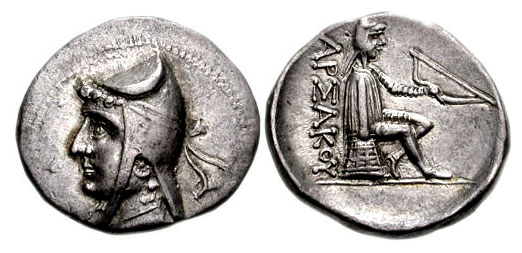
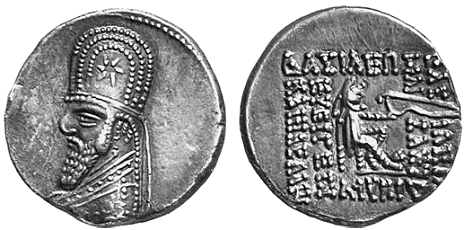
Okay, in order to make the long story short, around the 170s BC, the Arsakid king Mithridates I would go balls deep against the Seleukids to the point that he could take over the area ranging from Mesopotamia to the borders of India (he also fought the Baktrians and defeated them). In his coins, we begin to see a transition: his early coins are the regular coins that we saw from Arsakes I; but his later coins become more interesting: like this or this. As you can see, there is a huge shift occurring, and while some historians may attribute this to the Arsakids merely re-purposing the old Seleukid mints and thus the minters doing that they had always done but with a different king, this argument is unacceptable as it assumes royal passivity. Coins are a very important ideological tool that allows virtually anyone to know who their king is and the kind of paradigm that he is pushing. The first of the new model coins I referred to has this title: "BASILEUS MEGALOU ARSAKOU," which translates to "Great King Arsakes;" The second coin has this title "BASILEUS MEGALOU ARSAKOU PHILHELLENOS" or "Great King Arsakes Friend-of-the-Greeks." Once again, these are specific titles that are more catered to a Hellenic audience (if we accept that only a Greek person would have been able to read Greek). Now, the real fun begins when we compare these coins to Seleukid coins, like this one. On the reverse (tails) side, you notice that the motif is different, but the orientation of the letters in a somewhat square like fashion surrounding the motif is similar to the Arsakid coins. Once again, the important point to remember is that the Arakids purposely emulated this motif in order to characterize themselves as successors to the Seleukids NOT the Achaemenids. Add on the fact that Persis at this time was governed by a separate dynasty that was nominally subservient to the Arsakid king, and you can see that it might have been weird to be a Persian dynasty if they did not even directly rule over Persis itself (also the region of Persis did not really like the Arsakids, and in fact supported the Seleukids in their failed attempt to retake the Iranian plateau in the 130s BC).
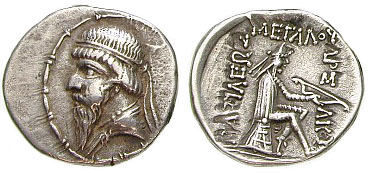
All of these points counter the notion as the Arsakids purposefully emulated the Achaemenids and instead showcase that they wished to be seen as successors to the Seleukids instead. Some have argued (mainly Dr. Vesta Curtis of the BM) that the reign of Mithridates II showcases a change in ideology. Here is a specific example; as you can see, he has adopted a fancy new hat or tiara, he has a kickass beard, and he has added a few titles: "BASILEUS TON BASILEON MEGALOU ARSAKOU EPIPHANES" or "Great King of Kings Arsakes God-Manifest." Right of the bat, the title "King of Kings" may references the the titles of the Achaemenid titles (although it must be mentioned that "King of Kings" is a Near-Eastern title in origin) and the tiara is kind of wierd. Dr. Vesta Curtis has argued that these elements may suggest a re-appropriation of Achaemenid motifs. I...don't really see it. I mean, the title is in Greek, not Aramaic and there is nothing to suggest the tiara is Achaemenid in origin. I do think that the Arsakids may have adopted some Achaemenid practices, like king Vologases II (ruled in the AD 50s) staring to employ Aramaic letters on his coins, but even then, it was quite selective. For that reason, I think that it may justified that the Arsakids are not put as part of the Achaemenid empire.
But then, nor should the Sassanians be because they were closer to the Arsakids than they were to the Achaemenids! I hope this answers your question and please don't hesitate to ask more!