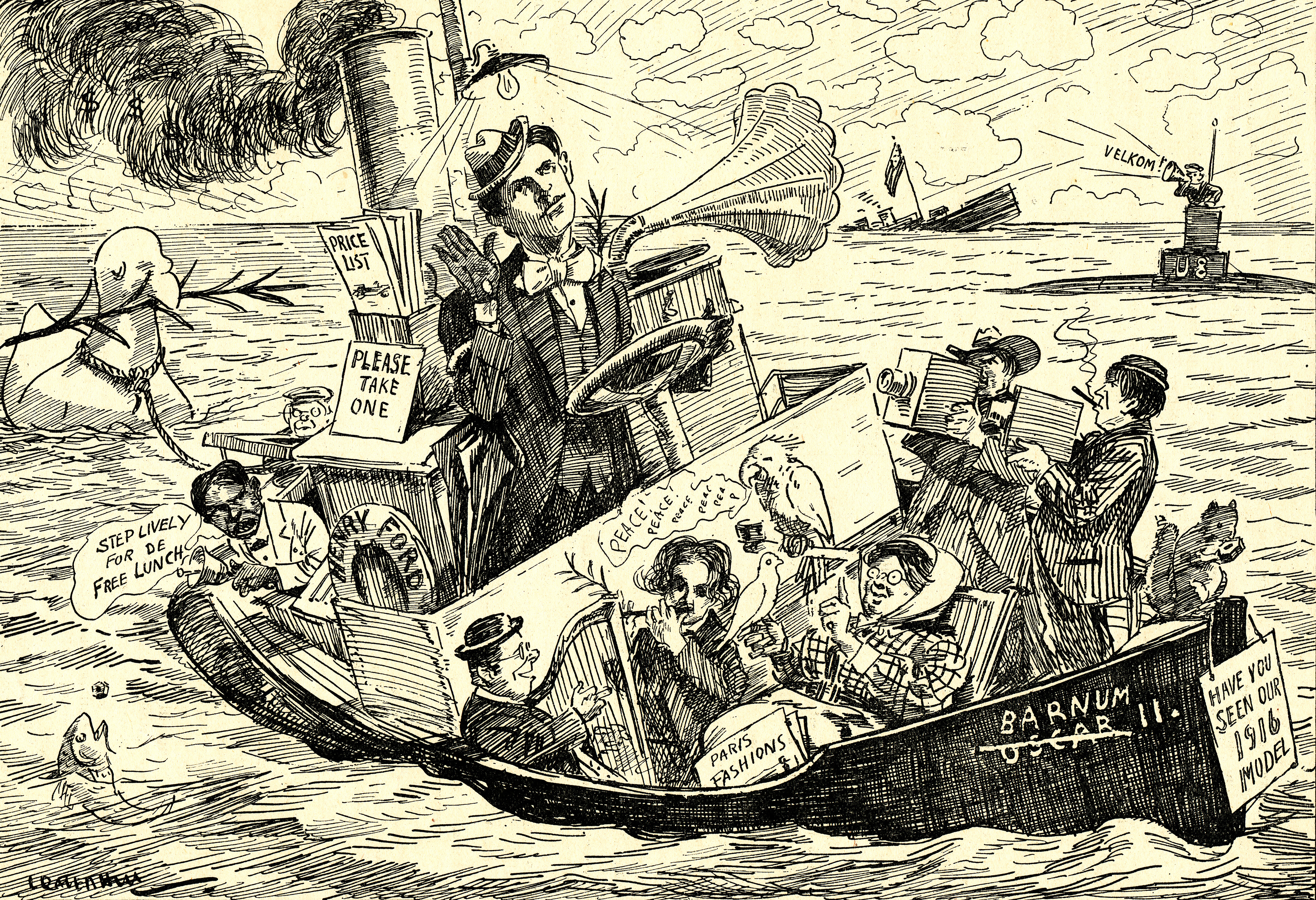
Henry Ford was a virulent, unrepentant conspiratorial antisemite, but there's not very much convincing evidence that he was ever a Nazi sympathizer.
On December 4, 1915, nearly a year and a half into the Great War, the ocean liner Oskar II left New York City for Europe. On board was Henry Ford, a man with a singular vision: to end the war in Europe and "get the boys out of the trenches by Christmas." By 1915, the 52-year-old Ford was one of the most famous men in the world, and was renowned for his commitment to pacifism and opposition to the war. On board his "Peace Ship" was a delegation of peace activists, including Hungarian-Jewish journalist Rosika Schwimmer, who claimed to have secret diplomatic cables that indicated the European powers were willing to negotiate. Ford's mission was roundly ridiculed in the global press, and their incredulity was borne out; after arriving in Oslo to a cool reception, Ford decided to abandon the quixotic enterprise and returned home.
Most biographers trace Ford's antisemitism to the failure of the Peace Ship, for which he certainly held Schwimmer responsible. However, Collier and Horowitz note that even before the ship departed, Ford had remarked "I know who started the war - the German Jewish bankers. I have the evidence here. Facts. The German Jewish Bankers caused the war. I can't give out the facts now, because I haven't got them all yet. But I'll have them soon." The rest is history: Starting from 1919, Ford made frequent references to "the Jews" in private conversation; in 1920, he made his feelings public for the first time in an interview with the New York Times, saying "the international financiers are behind all war. They are what is called the International Jew-- German Jews, French Jews, English Jews, American Jews. I believe that in all these countries except our own the Jewish financier is supreme... Here the Jew is a threat." That year, The Dearborn Independent published the first issue of "The International Jew: The World's Problem," a series based mostly on the hoax "Protocols of the Elders of Zion." Through the 20s, Ford faced defamation lawsuits, but continued publishing the Independent until 1927, when he publicly apologized and retracted his antisemitic accusations in the face of increasing bad press.
It is worthwhile to note that the brand of antisemitism espoused by Ford and most other contemporary antisemites lacked the racial element that would be introduced by the Nazis. For Ford, the international Jewish conspiracy involved only a small cabal of Jewish financiers, and he never assigned Jews to a "subhuman" race; in fact, throughout the libel trials he frequently pointed to the fact that Ford Motor Company never employed fewer than 4,000 Jews at any given time (though never in any office positions, of course). "I don't hate the Jews," Ford remarked to a friend in 1927, "I want to be their friends ... the Jews have gone along during the ages making themselves disliked, right? They ignored their own splendid teachers and statesmen. Even they could not get their people to mend their obnoxious habits. I thought by taking a club to them I might be able to do it." Ford was, in the words of a contemporary newspaper, "a man with a vision distorted and limited by his lack of information."
That the Nazis held Ford in extremely high esteem is incontrovertible, but the extent to which Ford reciprocated that admiration is murky. Ford received the highest civil order of the Nazi state, the Grand Cross of the German Eagle, in 1938, and had the dubious honor of being the only American mentioned by name in Mein Kampf. Ford was not the only American to receive the Grand Cross - a medal intended to attract American economic partners - and whereas IBM President Thomas Watson expressed his "pride and gratitude" upon recieving the award, Ford remained silent. Link concludes that "Ford's horizon hardly extended to the political and economic realities of Nazi Germany" - and allegations that he funded the Nazis runs entirely contrary to his personality.
It's also worth noting that the only country to rival Nazi Germany in its admiration for Ford was the Soviet Union - there, "My Life and Work" went through no fewer than eight editions, and FMC technicians helped plan the GAZ auto plant; the GAZ-AA, mainstay of Red Army Logistics, was a license-built model AA truck.
For further reading about the link between Fordism and Nazism, I can't recommend Stefan Link's article enough: Rethinking the Ford-Nazi Connection.
The main other source is "The Fords" by Peter Collier and David Horowitz, and "My Life and Work" by Henry Ford.
The reality is more convoluted than simple labels. Yes, he did publish anti-Semitic materials, he also would recant them too. He thought that Jewish financiers had started the first world war, and hated jews because he was such an ardent pacifist. He published the Protocols of the Elders of Zion in the dearborn independent and later in the International Jew. He would later apologize for these writing after they were proven to be forgeries. It was alleged that he financed the Nazi party in the '20s, but it has never been conclusively proven and cannot be considered anything more than gossip of the day. It should be noted very few if anyone saw the holocaust coming, so assigning a moral judgement on those who could not conceive of it is ahistorical. He did take a medal from the Nazis in 1938, but so did the head of GM, it was for achievements in industry . The German subsidiary of Ford would collaborate with the Nazi's, but it was not under control of the Ford Motor Company after 1941. He wrote to the president of the ADL in 1942 to denounce anti-semitism and racism. So at times he did , however he also recanted and spoke against Anti-Semitism. His company would also be a major supplier for the Allies, and incurred massive losses in doing so. Many large international companies of the day had dealing with the Nazis, Germany was a major economy. So simple labels don't overly work well in this instance