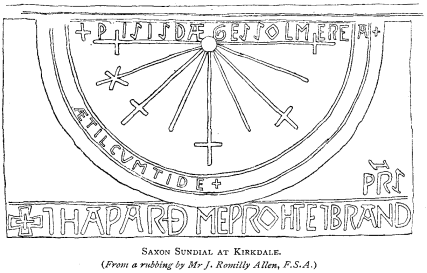
I don't believe that most medieval systems of timekeeping have been addressed in the threads in the FAQ. The Anglo-Saxons, who controlled England from c. 500 AD to 1066, utilized an octaval system of time measurement, diving the day into eight equal three-hour periods, each of which was known as a tid, from which we get the modern English tide. This system of measurement can be glimpsed through Anglo-Saxon sundials, such as the Kirkdale sundial, and various computistical writings, such as Bede's De temporum ratione (On the Reckoning of Time) and Aelfric's De temporibus anni. Note however that the Kirkdale dial subdivides the four tides of the day hours. After the Norman Conquest, there was a gradual shift to a duodecimal rather than an octaval system, a change that is reflected in the sundials of English churches.
Sources and further reading: Aelfric, Martin Blake, ed., De temporibus anni. The thoughts of a tenth- and eleventh-century monk on the seasons and measurement of time are very interesting and Blake provides a good introduction to the work.
Arthur Green, Sundials, incised dials or mass-clocks: a study of the time-markers of medieval churches. A dated but very interesting study of the sundials in English parish churches.
The Hindu units of time lists multiple systems. The top one shows Nakṣatra Ahorātram = 24 Hours down to Truti = 0.031 µs.
In a lot of fantasy books set in a medieval time they keep referring to a glass? What is that and where did they get the idea of it?
Swahili refers to time by how it relates to the closest six o'clock (most likely a formalization of sunup and sundown), if memory serves. Four in the afternoon will literally translate to two hours before six (pm).
They used to have a system of time keeping where the hours get longer or shorter depending on the time of year. I think it was in China or Japan, but in the summer, the day hours were longer and the night hours were shorter. In the winter, it was the reverse. I'll try to find some sources. I also think it was split into 4ths. 4 "hours" per day and 4 per night.