An employee of the CSA once told me this. It sounds like something that would be true, but I haven't managed to find any evidence one way or another.
Yes and no.
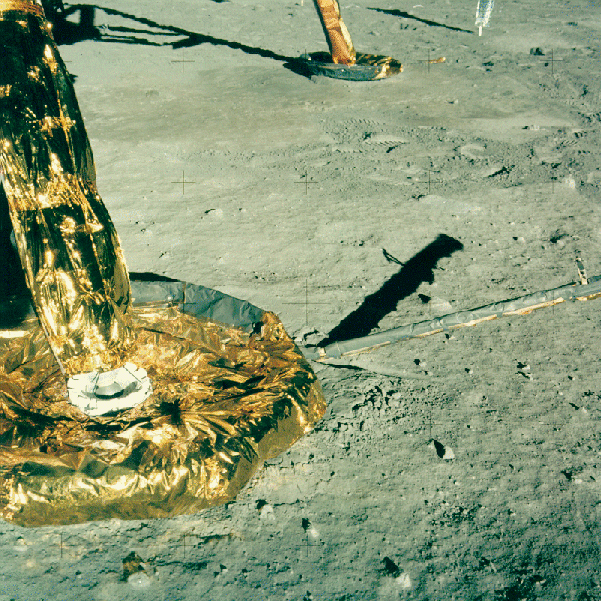
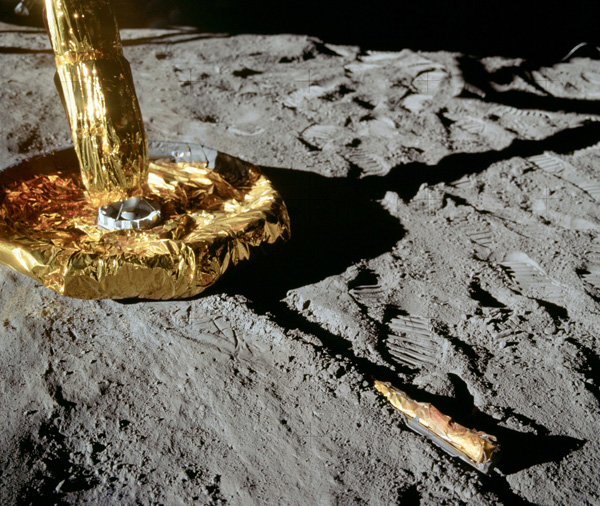
The four landing gear system "legs" (or "struts") on the Apollo Lunar Module descent stages were indeed built by a Canadian company called Heroux-Devtek, based in Quebec. These landing legs were constructed of a light-weight aluminum and compressible honeycomb design to aid in shock absorption. These legs and their landing footpads were indeed covered in a very thin layer of insulating Kapton and Inconel foil wrap, which was manufactured by DuPont in the good ol' US of A. The fact that the landing pads were covered in this foil simply to ensure that a US-manufactured product was the first thing to contact the lunar surface is a bit of hyperbole though. They were wrapped in this foil because of Kapton's excellent insulative properties in a vacuum environment, and Inconel protected the equipment from the blast coming from the Lunar Module's descent engine.
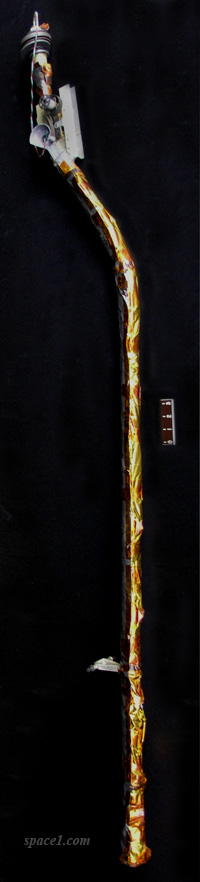
Now, if we really want to be pedantic, the first part of the lunar module to actually contact the Moon's surface was the "lunar surface sensing probes"* - which were a set of thin aluminum tubes that were attached to the footpads of three of the four extended landing legs (and these contact probes were also wrapped in the same Kapton/Inconel foil). These contact probes hung below the lander footpegs so that they would be the first things to contact the lunar surface. Once contact with the surface happened, the collapsing weight on these probes would trigger a switch and illuminate a blue "contact light" in the cockpit of the LM, letting the Commander and LMP know they were within a few feet of a proper landing and could safely shut off the DPS (Descent Propulsion System) engine.