I'd never really heard much about Henry Knox before and was curious how he gained his military training, so of course I went to the definitive source, Wikipedia! It sounds like his training came from a combination of reading about military history and tactics and participation in some local artillery companies. Here are the relevant pieces:
However, Knox was also involved in Boston's street gangs, becoming one of the toughest fighters in his neighborhood. Impressed by a militiary demonstration, he joined a local artillery company called The Train at 18.
And later:
In 1772 he cofounded the Boston Grenadier Corps as an offshoot of The Train, and served as its second in command.
I've always sort of assumed that colonial militias just trained with the stereotypical musket line formation, but it seems that wasn't the case, so this brought up a couple questions. First off, how common were artillery companies in the British colonies? Secondly, to what extent did different colonial militias specialize in different types of combat or different combat roles?
I'm sorry that I've taken so long to get to this - been busy preparing for a class. One of the reasons people weren't exactly tripping over themselves to answer it is because there frankly hasn't been much scholarly writing on colonial artillery units. My answer will draw from the primary documents I've come across when working in museums and various tour guides and staff training manuals working at military history sites. The biggest primary source I've worked with from an artillerist, beyond Knox's own papers, is the diary of William S. Pennington of the 2nd Continental Artillery.
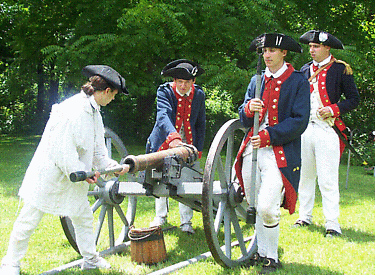
Artillery officers, as a group had to receive more training and a higher degree of education than officers in other army branches. As such, there was a degree of prestige that accompanied service in the artillery that other branches of service sometimes lacked. There was also not much of a line between artillery and military engineering. In the Continental Army, the Sappers and Miners (engineers, basically) wore the same uniforms as artillerists: blue coats with red facings, with gold laces and buttons.. Artillerists from every European country wore some variation of this uniform, and red is still considered the color of the artillery.
With all the extra prestige and plumage of the artillery, it's only natural that well-heeled militiamen would want to claim a stake in the history of professional artillerymen. One of the first militia units in Massachusetts was the oddly named "Ancient and Honorable Company of Artillery. According to their website, they were formed more as a training school than as a unit expected to conduct heavy siege work. During the French and Indian War, there was some provincial regular artillery units, but I don't really know much about them.
During the Revolution, artillery companies attracted a few big names. Henry Knox's interest in artillery predated the American Revolution, as you've noted above. It should be noted that grenadiers were generally considered elite during the period, so having a unit that claimed to be artillery grenadiers is just kind of heaping honors upon honors (like the "Ancient and Honorable" Artillery Company). In New York, Alexander Hamilton helped organize a militia artillery company, before attracting the attention of George Washington and going on to make a career as his aide-de-camp, confidant, and political fixer/hatchetman. The Second Continental Artillery was commanded by John Lamb, one of the big names in the New York Sons of Liberty. Notice a theme here? Artillery officers tended to be big names with big ambitions, and a natural ability to either lead or find their way to the top of the heap.
I have not seen much evidence to indicate that colonial militia units did a lot of training with cannon. In fact, they barely seem to train with muskets. Fred Anderson's A People's Army, a study of Massachusetts' provincial regulars during the Seven Years War, found that many could barely handle a musket or perform the most basic military maneuvers. As such, I think that these artillery units were more about social positioning than they were about serious military training. Militia, with the exception of Massachusetts in the year or so before Lexington and Concord, were rarely able to achieve military proficiency in the technical, regimented style of warfare in which artillery was best employed.
I welcome other relevant specialists, such as /u/prufrock451, /u/sleepyrivertroll, or /u/smileyman to amend or add on to anything I've said here. /u/donaldfdraper is also generally excellent, though distressingly European.