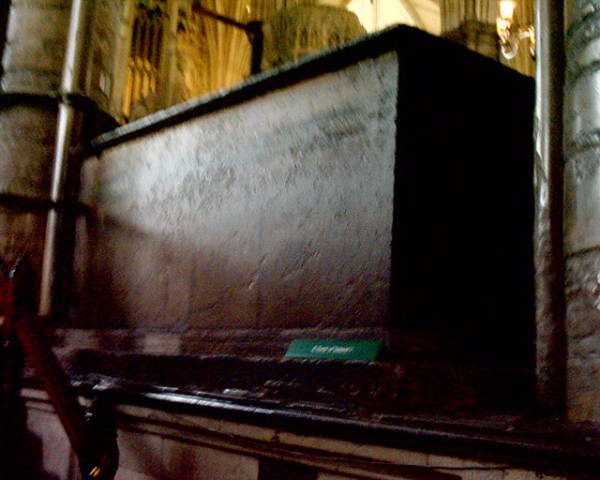
I just read this post and /u/cazador5 said he'd like to describe him in greater detail. So please do.
edit: Holy cheesecake, these reponses are awesome!
Rubs hands together enthusiastically
Thanks for giving me the opportunity! I appreciate the assist. Now Valkine has already drafted a great response below, and really I'll just try and fill in the blanks. I'll give you a larger historical context and then give you some idea as to why he may have been relatively unique in relation to other monarchs of the time.
First off it is crucial to describe Edward's early years. Edward's father was Henry III, who himself is an absolutely fascinating English monarch. Henry came to the throne very young, and was early on manipulated by the various competing powers in England. The tensions and power struggles of his rule never truly subsided, with younger competitors taking the place of older power mongers. Henry III was not what you would commonly consider a strong King, and this weakened his position. Henry bore the weight of history - his father, John, had been perhaps one of the more hated English kings in history, and the signing of Magna Carta had invariably changed the relationship between the King and his barons.
In any case, the second Baron's rebellion (led by Simon de Montfort) temporarily put Henry in a bad place - first he was made second-in-power to a council of nobles (headed by Montfort), and then after the battle of Lewes (which Edward participated in) he was imprisoned. This is more or less when the Edward we know presents hismself. He was given command of the right wing of Henry's army, and succeeded in smashing the opposite flank of Montfort's army. But his pursuit was too wild, and by the time he returned to the battlefield Montfort had broken Henry's remaining forces. Edward decided to go into captivity with his father, and it is clear there was a close relationship between the two of them.
Perhaps one of my favorite stories about Edward comes from this time. While Montfort had both the King and the Prince in captivity, his rule was weakening. Montfort was a controversial figure, and many disliked a foreign noble consolidating so much power at the expense of the native aristocracy. With rebellion brewing in the Welsh marches and other areas, Edward looked for a chance to escape. He was given an opportunity when he was allowed to go hunting, and after being given a horse he simply rode away from his guards and escaped to the rebel stronghold of Montgomery. It is purported that he cheekily waved goodbye to his captors, which I think is awesome. In any case we know that he raised a large force, largely from the Marcher lords who had escaped destruction at the battle of Lewes. He then completely outwitted Montfort, in perhaps one of the few examples we have of medieval strategy. Caught between two converging Montfort armies, Edward turned and surprised the first, destroying much of it. He then repositioned his army to block Simon's march, then descended on Evesham, crushing Montfort's forces. All this while still the Prince of England!
Soon after Edward went on crusade, and there are a lot of tales about his venture. While it was relatively unsuccessful (the crusader states had been heavily reduced to a fragment of their former territory) he was still able to broker a deal with Baibars, the Mameluke leader. He also was apparently attacked by an assassin, and while we don't have a definitive story of what occurred, my favorite tale is that he awoke in the middle of the night to the assassin preparing to stab him. The tale says that despite being cut by a poisoned blade, Edward nonetheless wrestled the man and killed him with his bare hands. That should give you some idea of the man we're dealing with.
Henry III died while Edward was on crusade, and he returned to England and was coronated in 1272. Other than his military accomplishments, there are several political events that I think are noteworthy. Edward was the first English monarch to willingly call Parliament, and should probably be credited with increasing it's legitimacy as a political body. Instead of being a force that solely attempted to limit the powers of the King, it was during Edward's rule that it became a mechanism to raise taxes without reaching a crisis. Parliament was also composed of 'knights of the shire,' which we essentially elected representatives (who did not need to be knights after a certain point) from among the landholding members of a shire. As such Edward's reign was a crucial turning point in the increasing power of Parliament, but also its relationship with the monarchy and as a body with the authority to approve taxes.
In addition, Edward's first decade or so of kingship were incredibly productive in terms of legal reform. The Hundred Rolls were a series of audits essentially, in which a large majority of estates were investigated, and rights/duties reevaluated. It was not without resistance, but all in all it represents a large scale attempt to reassess the state of Feudal England, as well as discern which rights and powers the Crown had retained or lost in the course of the various rebellions.
Now the rest of Edward's reign has already been covered in pretty good detail by Valkine, so I'll quickly run through it. Edward was the English monarch who holds the credit for finally conquering Wales, as /u/Valkine already suggested. The strategy and tactics that he utilized, as well as his ability to keep his army in the field for much longer than his predecessors (he was perhaps one of the first English kings to fully understand logistics) gave him a crucial advantage over the Welsh. He was also instrumental in constructing an impressive line of castles through Northern Wales (Gwynedd), the area that had been the center of Welsh resistance. Castles like Conway, Rhuddlan and Caernarvon are still there, and are some of the best examples of medieval castles that exist. They were massive projects, and their construction nearly bankrupted the Kingdom, but they are impressive nonetheless.
When it came to Scotland, Edward walked a fine line between benevolent overlord and brutal tyrant. He was instrumental in setting up a grand court to decide between the Bruce and Balliol claims to the throne. When Balliol was chosen he was strongly in favor of his kingship. But Balliol resisted Edward's call for troops to fight in France, and so Edward marched north and defeated the Scottish king at Dunbar. Afterwards he stripped Balliol of his lordship (ceremoniously tearing his royal tabard from his body, thus Balliol's nickname 'Toom Tabard' or 'Torn Tabard') and assumed control of Scotland directly. This is what set the stage for the events surrounding Wallace's uprising, as mentioned before.
When Wallace and Moray won at Stirling Bridge, Edward was quick to return from the continent and gather an army to subdue Scotland. As mentioned in the other thread, Edward handily beat Wallace at Falkirk, utilizing the famed Welsh longbowmen for one of the first times in English history. This would have a massive impact on military history going into the 14th century.
The war didn't end there, however. While Scotland was stable for a time, Robert the Bruce (grandson of the Bruce who had been in contention for the Throne back in the day) ended up rebelling, and there were several more campaigns into Scotland. In the end it took a massive effort (staying the winter in Fife with his army, something almost unheard of at the time) and massive amounts of resources to force Bruce into hiding and regain the lost ground. His legal reforms in Scotland mirror his reforms in England in Wales, and perhaps could have formed the basis for a stable government. But Edward's death in 1307 meant that the English position in Scotland became untenable, and strife would continue into the early modern era.
Apologies in advance to /u/cazador5 for hijacking this thread before he even gets here but I can't pass up an opportunity to talk about one of my favorite English kings. I'll try and leave stuff for him to talk about when he gets here and focus instead on one of my favorite things to discuss about Edward I.
There are a lot of factors that make Edward I so interesting to me. He ascended to the throne later in life than was usual (he was 33) and he grew up and matured through a series of rather violent baronial revolts. He's responsible for what is arguably the most permanent addition of land to England (The Conquest of Wales) in addition to really kicking off the major Scottish-English conflict that lasted for the rest of the Middle Ages and pretty much right up to James I's accession to the English throne.
The thing that I find most fascinating to talk about Edward I, though, is how he relates to one of my favorite historical debates: how do we define a 'Good King'? By we I mean Historians. Looking back, what qualities make a king 'Good'? The reason I love Edward I for this discussion is that he complicates it to the point of frustration. Let's look into a few general areas to explain my point further:
1 A good King is Strong
Edward I definitely fits into this definition. If I had to summarize Edward I in two words I would use "Hard Bastard." He remains one of the most battle tested English Kings and depending on your perspective he either ruled with an Iron Fist or competently employed royal authority to prevent baronial civil strife. He certainly learned from the baronial revolts of his father and oversaw what is arguably the most significant expansion of English royal authority in the High Middle Ages.
The thing is, though, is this a good thing? Sure he prevented a repeat of anything like Simon de Montfort's baronial revolt, and certainly preventing civil war is important, but it could be argued that he oppressed the power of parliament and the rights of the people to have a say in their rule. As modern historians should we be praising authoritarian royal power over the fledgling growth of future democracy? Ideally we should be objective, but let's be honest that's impossible. It has also been argued that Edward I's severe authoritarian tendencies may have sowed the seeds of revolt that so drastically ruined Edward II's reign. The nobility may not have been keen to see a second Edward I and took advantage of Edward II's weakness early in his reign to assert their own authority. Alternativley, though, Edward II could just have been a terrible king.
2 Was the Conquest of Wales 'Good'?
This topic, as well as the significantly more controversial subject of the Scottish Wars, is particularly interesting given the current trend in Britain towards devolution of power (and possible break up). On the one hand Llewelyn the Last could be argued to have deserved his usurpation. He violated the terms of his treaty with Edward I and seemed to actively try and annoy Edward (who showed remarkable patience). On the other hand, is the Conquest of neighboring territories the mark of a 'Good King'? It's not entirely dissimilar to Imperialism and generally in a modern context that is viewed in a negative light. Should we admire Edward I's conquests or should we condemn him as a warmonger?
3 The Wars with Scotland
Easily Edward I's most controversial achievement and one of the reasons he's so interesting from a historiography stand point. To somewhat oversimplify things: The Scots hate him, the English think he's pretty great. Who is right? Is the warmongering heartless monster who wanted to subjugate freedom-loving Scotland or was he simply a strong king pursuing a logical course of action?
I'm obviously pointing out several extreme arguments as if they represent a pure dichotomy. The answer to most of my questions is inevitably somewhere between the two poles. However, where you fall between those two is an interesting matter to discuss and requires a certain level of admitting the existence of your own bias. I also find he's a great way to challenge people's preconceptions on how history is written.
I am definitely on the side that is Pro-Edward I. I think he's a fascinating figure exercising his royal authority with admirable skill. I don't think you can judge him by modern standards or with regard to modern nationalist ideals. However, certainly not everything he did was admirable and I will refer you to my earlier summary, he was a "hard bastard."
Edit: I realized I should include references...my brain is going slowly today.
Marc Morris A Great and Terrible King is a great, approachable biography of Edward I.
Michael Prestwich wrote an amazing, and longer, biography of Edward I as well as The Three Edwards which is a great discussion of warfare and politics across the reign of all three of the really famous Edwards.
G.W.S. Barrow's Robert Bruce and the Community of the Realm of Scotland is obviously not a biography of Edward I but includes a lot of discussion of him from a very nationalist Scottish perspective.
It looks like /u/cazador5 and I have filled this thread with Edward I stuff...but not actually answered the second half of your question. In brief:
Edward I is called Longshanks because he was really goddamn tall. His tomb was opened in the 18th century and he was measured and I believe he was somewhere in the range of 6'1" or 6'2" tall. While in modern times that's the average height of a Danish person, in the Middle Ages it's pretty outlandishly tall. For contrast, the average height of the soldiers found in the mass grave associated with the Battle of Towton (1461) was about 5'7".
The phrase Hammer of the Scots was painted on the side of Edward's tomb (specifically it said Edwardus Primus Scottorum Malleus hic est, 1308. Pactum Serva or "Here is Edward I, Hammer of the Scots, 1308. Keep the Vow"). The line is probably not original to the tomb, though, and was most likely painted on in the 16th century.
Edward's tomb is actually kind of interesting in and of itself (interesting stuff about Edward I is basically endless). It's a large blank rectangle of marble in the middle of Westminster abbey. That's not particularly interesting, but it is interesting that there's no effigy of him on it. Edward I paid to have the effigy of his father Henry III redone to be particularly fancy and Henry III's tomb is really elaborate. In contrast Edward's is extremely plain. It's possible this reflects how Edward nearly bankrupted the kingdom (thus not being able to splurge on his own tomb) but on the other hand, a huge rectangle of marble wouldn't have been that cheap and one would expect the money could be found for an effigy if Edward had wanted one. Why he wanted his tomb the way it is we don't know, but it is intriguing.
Just to clear up what tiny tidbits my far more learned colleagues left aside, he was called Longshanks because he was very tall. 6'2", in fact, which while slightly above average today, was exceptionally tall in the Medieval era.
'Shank' is an old word for 'leg' or 'shin', and I believe it's still used in the jargons of butchery and cookery.