I've read a few texts suggesting that the Teutonic Knights relied on the assistance of local civilians to act as militias and cooperative parties during the Northern Crusades. How would these crusaders communicate with the Balts? Did the Balts have to learn German, or vice versa?
It’s important to remember that the Northern Crusades didn’t come out of nowhere, they were a dramatic escalation of nearly two decades of Germanic Christian interest in the Baltic.
By the time the Teutonic Knights rolled into the dark forests of Livonia in 1198, their language and religion had already made something of a penetration and they had allies on the ground.
Writing in Languages in Contact and Contrast, Juris Baldunciks claims that “direct contacts between Latvians and German sea traders began in the second half of the 12th Century. So the influence of German (Middle Low German) on Latvia is supposed to have started in the last decade of the 12th Century.”
As trade along the Daugava river, which flows from the Baltic, through what is now Belarus and Latvia, and into Russia, between German merchants and the Rus increased, a Christian presence followed with it in the form of Augustine canon Meinhard in the 1180s “with a band of merchants simply for the sake of Christ and only to preach.”
Meinhard, was installed as Bishop of Livonia in 1186 under the wider Archbishopric of Bremen. He built a church at Üxküll (now Ikšķile, Latvia) and castles were built at Üxküll and nearby Kircholm (now Salaspils, Latvia). The church holdings at Üxküll included animals, residential buildings and farmland, which would have implied a certain amount of trade and negotiation with the Livs who considered the Germans potential allies against their neighbours.
In 1189, the Livonian leader Caupo of Turaida converted to Christianity. Later baptised, he became a staunch ally of the church (Latvian legends remember him as "Kaupo the accursed, the scourge of the Livs,... Kaupo who has sold his soul to the foreign bishops.") and in 1203/4 he even met Pope Innocent III.
Meinhard was replaced on his death in 1196 by Berthold of Hanover, previously an Abbot in Lokum, he had already spent a decade with Meinhard doing missionary work among the Baltic heathens and the fruits of their labours was a significant rump state. The Catholic Encyclopaedia (1913) tells us:
Berthold’s predecessor, assisted by merchants from Bremen and Lubeck and a few converted natives, had built fortifications along the River Duna, where Christians held their religious services and could protect themselves against the fury of the pagans.
Sometime around 1196, the church begins to roll out its levies into Livonia and it’s this taxation, as much as Berthold’s aggressive proselytising, that begins to provoke a violent response from the Baltic pagans. The seeds of Crusade finally begin to flower.
All of which means that the Teutonic Knights would have been able to make use of a working knowledge of Low German from some of the population, those with regular contact with the traders and missionaries, and a small but sympathetic Livonian Christian population who may have possessed a working knowledge of Low German and/or Latin.
Also, these ‘local civilians’ may well have included German missionaries from Berthold’s flock, who would have needed some knowledge of Livish, Lettish etc.
Though active a few years later (he arrived in Livonia in 1205), Henry of Latvia, who chronicled the Northern Crusade, and was able to speak Lettish, Livish and Estonian.
Though thoroughly Germanic - he had a German forename and described the Germans as “we” – arguments sprang up in the 19th and early 20th Century against the backdrop of competing Baltic German and Latvian nationalism that Henry may have been a native Livonian.
If so he’s an example of one of the interpreters the Teutonic Knights would have been able to make use of, but even if we discount this as patriotic revisionism some of the theories surrounding his knowledge of languages might prove useful too.
A 1953 article by Paul Johansen suggested that Henry may have studied Segeberg Abbey, where Meinhard had once been canon and where Livonian converts (such as John of Vironia) had been sent for training. At Segeberg, with its growing history of Baltic missionary work, he may have learnt a rough scattering of useful words and phrases.
As a final point, in the 12th Century the German states were by no means ethnically homogenous. The German push east was still relatively recent and large Slavic populations remained north of Magdeburg in the Altmark, Havelland and Flaming.
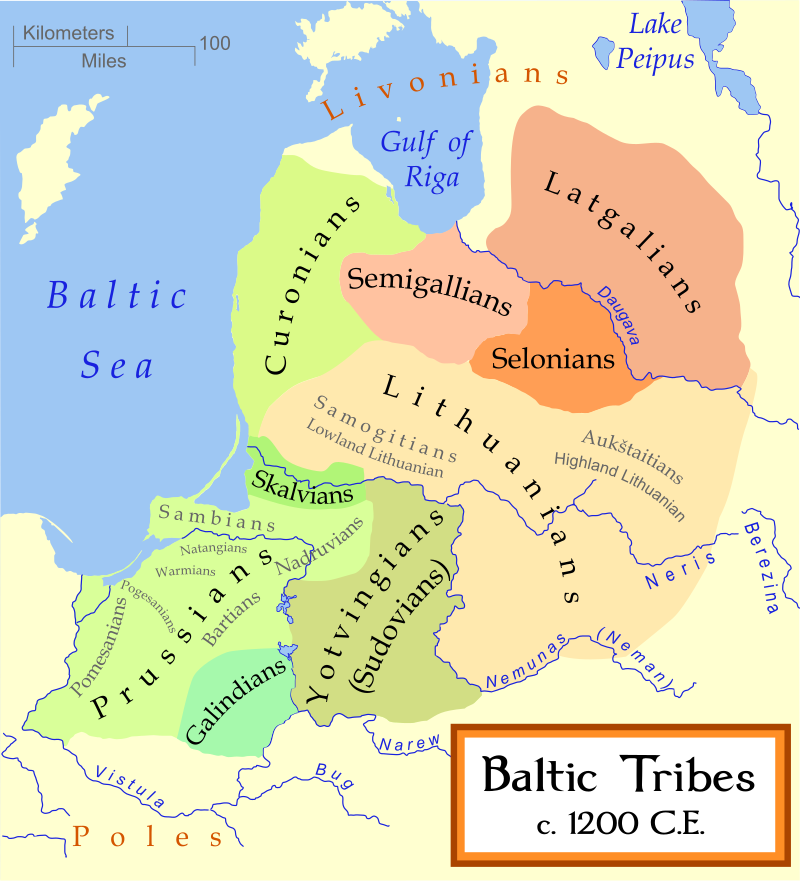
These Slavic languages are distant cousins the Baltic language family (which includes Lettish, Samogitian, Semigallian, Old Curonian and Selonian, but not Livish or Estonian which were Finno-Ugric), and there’s a possibility that not only would ‘German’ scholars and priests such as Henry have been conversational speakers of both Low German and a Saxon Slav dialect, but they may also have been of Slavic descent.
Mutual intelligibility may have been negligible for the Baltic languages, but it would have certainly given them a head start when it came to picking up an unfamiliar tongue.
This map of tribes might be useful if anyone's getting dizzy.
Sources: The Military Orders Vol. III: History and Heritage by various, Crusading and Chronicle Writing on the Medieval Baltic Frontier by various, Livonia, The Popes and the Baltic Crusades: 1147-1254 by Iben Fonnesberg-Schmidt and Rus’ and the Baltic Crusades in the Thirteenth Century by Anti Selart