Today:
You know the drill: this is the thread for all your history-related outpourings that are not necessarily questions. Minor questions that you feel don't need or merit their own threads are welcome too. Discovered a great new book, documentary, article or blog? Has your Ph.D. application been successful? Have you made an archaeological discovery in your back yard? Did you find an anecdote about the Doge of Venice telling a joke to Michel Foucault? Tell us all about it.
As usual, moderation in this thread will be relatively non-existent -- jokes, anecdotes and light-hearted banter are welcome.
So for those who haven't discovered /r/subredditsimulator, it is pretty hilarious. The sub uses bots to make comments, constructed with markov chains that draw their source material from various subreddits. /r/AskHistorians is one of the subs represented, and /u/AskHistorians_SS is awesome.
So, I am a big fan of the Asterix-comics. I don't know if they're a big deal across the pond, but they're really popular here in Europe. Also, they're chock-full of subtle and not so subtle references to ancient (and modern) history and pop culture. You should definitely check them out if you like Roman history.
When I was doing some boring research stuff yesterday, in a collection of inscribed votive silver sheets from Hagenbach in SW Germany, I came across one that was inscribed so:
D(omino) M(arti) / And/ossus / Obbe/lexxi(!) / f(ilius) / v(otum) s(olvit) [l(ibens) m(erito)]
= AE 1999, 1136; 2000, 1264.
An offering to Mars, to fulfill an oath because divine favours were granted, by an Andossus - son of Obbelexx. Imagine my suprise! Latinized as Obbelexxus, but probably close to the name Belex, which was also on some of the sheets. Obbelexx seems to be a singular form, with no similar names from anywhere.
In fact, the names of the characters from the comics are all just plays on words (Asterix from Asterisk/Aster, the star; Obelix from Obelisk; the chief Vitalstatistix, all with the Celtic suffix -ix added on), so that one of them matches an actual name is pretty neat (the tablets were found in the 60s and 70s, and published much later, so there's nil chance that Goscinny/Uderzo had any idea).
Those votive offerings probably came from somewhere close to the Pyrenees, and were deposited in Germany after being taken as spoils, because most of the names on these tables (like Belex and Andossus) are only attested from southern Aquitania near Auch.
So we can conclude the following:
At least one of the two didn't stay a bachelor all his life - maybe Obelix decided to go seek true love after getting over the whole Falbala-affair?
His son had a name that must have come from southern Aquitaine - however, Obelix was born in Aremorica. Possibly Obelix was the son of immigrants, or he married an Aquitanian woman, and his son or possibly already he himself emigrated to there. Possibly the wild hogs of Aremorica were close to extinction and he went off to search for unexploited areas. If Obelix was the son of Aquitanian immigrants, that would explain why he gave his son an Aquitanian name, otherwise, it will have been taken from the mother's side. Obelix' father was named Obélodalix, so we can probably rule out the former version.
Third, and worst - Obelix son had become Roman! He sacrificed to Mars, not to Teutates, he latinized his fathers name, and he had the inscription made in Latin. That must have led to serious trouble in the family, though an Obelix having become milder with age is also a possibility.
This also helps us in dating this otherwise undatable inscription, to around 30 BC - 20 AD. Obelix was not yet a father in 50 BC, so anything before 30 BC is too early for his son to already having grown up to an age where he would need to think about success in war, and he would certainly not have lived long past the year 20.
Received a great email. I passed the selection and will start my education towards becoming a history teacher in september in Amsterdam. 13th rank out of 100.
Afterwards I hope to start studying history itself at an academic level at the university of Amsterdam, which could be either a year or four years from now.
MA thesis was effectively approved the other day (some minor revisions of the research methods need to be dealt with, but that mainly involves talking to my supervisor when he returns to the country). Preliminarily titled "The Soviet Legacy in Abkhazia and South Ossetia," I'm going to try and determine how much, if any, impact the Soviet era had on the separatist movements in those regions, chronicling from around 1917 to 1991, or thereabouts (while the Bolsheviks didn't actually control the region until 1921, I'm including the independent Democratic Republic of Georgia as it plays a role in all this). Far as I can tell, there hasn't been much regarding this specific topic, though it has been partially covered in other works as a side-feature or something.
Time for another round of Guess the Artifact, which I was happy to see /u/Taiko continued last week. I'll start off with a relative easy one. Which culture made this:
Cool little object lesson from /r/ArtefactPorn is this fifteenth century map of Rome which shows what Rome looked like to a religious person in fifteenth century Europe: basically a bunch of churches with a few ancient monuments interspersed in. You can see Augustus' tomb in the bottom, the Praetorian barracks on the left and the Colosseum in the middle, but it is really a Christian city that is marked primarily by steeples and crosses. I find the omissions pretty interesting, particularly the Baths of Caracalla, which at this time would have just about been bigger than any church in the city but are ignored because this is before we began to fetishize the "ruin" look.
I have also decided there are two different ways to air grievances about typos in an academic review: you can be fairly blase about it, pointing out that typos are an issue and the manuscript probably should have been given another round at the editors. Or you can be unbelievably petty about it. I submit as an example of the second the end of one review I read recently:
An incredible number of misspellings of non-English words and names (e.g., van Crefeld for van Creveld, 341, 392) suggest that OUP should be added to the so-called "prestige presses" that no longer care about accurate proofing and editing.
Words hurt, guys! Words hurt...
How do we define "a scholarly, authoritative work"?
For example, I've read a very interesting - and thick book by Robert Fisk, The Great War for Civilization: the Conquest for the Middle East. Now, the parts with the appropriate bibliographies and references are fine, but he also wrote down and documented his observations when he was in the area (mostly Lebanon, although at one point he said he met Osama in Sudan).
Now, my question is, is this considered authoritative? If, for example, he said "in Lebanon, on X date, I see groups of Y doing horrible things", would this considered a "fact", or a "reasonable assertion"? I'm sure Mr. Fisk - and all of us - have biases, so how do we know who is more believable than the others?
How many people here are on Twitter? I follow a few AH panelists, but I'm curious if there are more.
I'm @journeymanhisto, by the way.
I mod /r/HistoricalWorldPowers, which is a Reddit-based alternate history RPG. Lately, we've been lacking one of the two mods who usually alternate approval of technologies that people research.^1 We would be thrilled if an AH flaired user who has a good knowledge of the technological history of the world in general (i.e. not me) and has lots of free time to spend on Reddit could apply for the position!
^1 The tech system isn't a tech tree. Rather, every week each player can research five things you want (only one military technology per week) and they will be approved or denied by a mod based on cultural and technological prerequisites.
Hey, college and university students: do you still use Rate My Professor, or there some new site that does the same thing?
I've been trying to read Robert Bartlett's The Making of Europe for the past couple of weeks but can't read more than a couple of pages at a time before losing interest. This sucks because the thesis of his book is really cool, but I find reading it is such a slog which is disappointing because I've read some of his other works and they were pretty decent. I guess I like the idea of the book but can't stand how it's written.
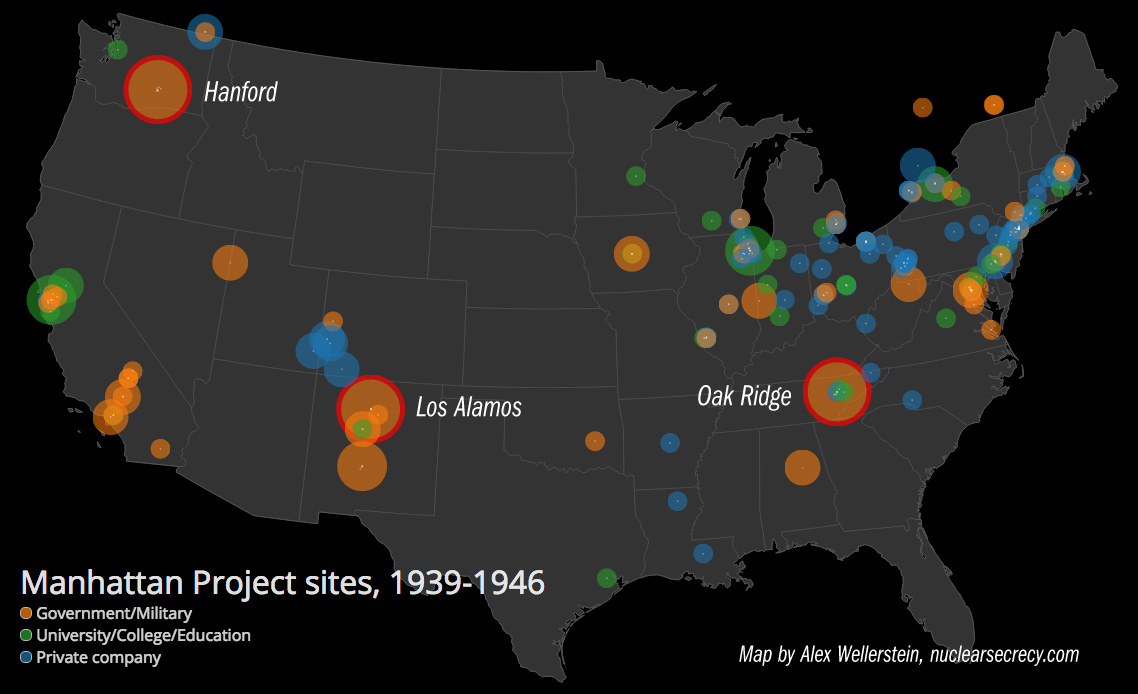
I've been working on a giant database of all sites where some part of the work in making the first atomic bombs took place. So far I've got well over 200 separate sites. I posted a static preview of the map I'm making with it on my blog today. I'm still working to improve the dataset (trying to get exact addresses wherever possible, and to show the interlinkages between the sites with arrows or something), and then am making an interactive visualization (using D3.js) that will let people zoom in, hover over sites, change the sorts of metadata that are indicated by colors, and so on. Anyway, it's a much larger and more complicated map than the standard sort of map one usually sees of this sort of thing.
I'm rereading Marc Reisner's Cadillac Desert, about water management in the American West. Man, what a book. I'd read it as an undergrad, but I didn't fully appreciate it. Reisner can be over the top at times, but he provides a compelling account of the transformation of the West through bureaucratic (even James Scott-ish, a bit) management of rivers through dams and irrigation projects.
Is there any other historiography than american historiography were the term ''antebellum'' or a closely related term is used to refer to a time period ?
Something I thought of a while ago: 'Real historians frown at the idea that you can chop up history into clearly distinct "periods" with hard cut-off dates. But if I'm a bad person and do it anyway, what would it look like?'
The results, for European history specifically, are the following 25 periods, grouped into four "ages". I'm very curious to know what the real historians (or at least people more knowledgeable than me, which is to say, almost everyone here) think of it. Any periods that are too long or too short? Important changes I've missed or irrelevant footnotes I've blown up to era-defining moments? Or is the project as a whole just terribly misguided?
GREEK ANTIQUITY
ROMAN ANTIQUITY
THE MIDDLE AGES
THE MODERN AGE
What's the best free alternative to Wikipedia (as wiki has plenty of accuracy and nationalism issues) for general history reading?
I registered this week for my first quarter of classes at my new school, UW. I've just transferred in as a History major and am taking upper level Comparative Colonialism and Italian Renaissance courses this summer.
My excavation's done this year. I was very happy to see great improvement in the students I was teaching, but I felt a bit like an army drill sergeant near the end. I was constantly encouraging them to dig faster so we could meet our deadline and excavate one of the more promising structures on site, a pit-house that gave plenty of metal signals. Turns out it was partly filled with industrial rubbish from metalworking, including a nice casting cone. However, in all, none of the artefacts we found on-site (apart from that one silver coin) pointed in a high-status direction, so we have little evidence to think that the craft huts were associated with the hall-buildings. In all, based on the small part of the settlement we excavated so far, it seems the two phases of use were distinct and separate.
My personal suggestion is that we have here a chief who went along with the Housing Bubble of the 950s instead of investing in overseas liquid assets, lost it all, and got his property forfeited and repurposed into an industrial scrapyard.