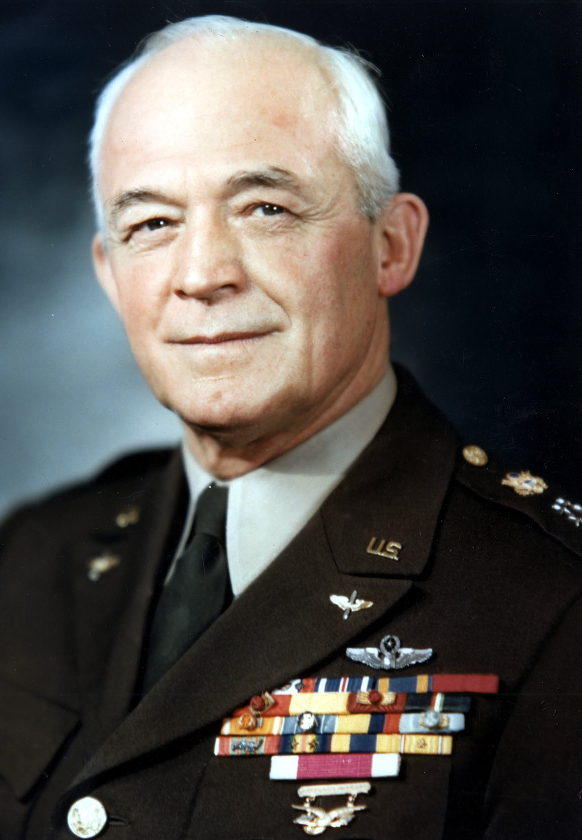
Officer here, so I can answer some of these questions.
I'm assuming you're looking at a picture of a modern American general, like this one of David Petraeus compared to an older photo of generals/admirals in their service dress uniforms, like this one of Admiral Halsey, this one of General Hap Arnold, or this one of General Bradley?
First of all, note that most of those ribbons/awards for valor or personal achievement have remained the same: Admiral Halsey's Navy Cross, Navy Distinguished Service Medal, etc. are identical today for those who have been awarded them. General Bradley's Bronze Star (third row on the left) is also present on General Petraeus's uniform - third row on the right with a 'V' on there for having been awarded the Bronze Star for Valor.
Note too that different branches have different regulations regarding how many medals must be worn. For instance, some branches allow you to wear all or only a portion of your ribbons - in the case of some of these WW2 generals, if they wore their full set of ribbons/medals/awards - including their giant collection of foreign awards, they would have a giant set as well.
The ribbons/medals all placed in a specific order, by order of precedence, with awards for personal valor/actions being at the top. If you'll notice from that link, campaign/war participation ribbons are generally placed at the bottom, and that's where the biggest differentiation begins between old generals and those of today.
In the case of General Bradley, for instance, he received campaign ribbons for:
Note that he's also wearing in his portrait some foreign ribbons, including the Luxembourg War Cross it appears.
Now, with regard to a modern general, like General Petraeus, those medals for valor/personal achievement still exist and have largely remained unchanged. What has changed, however, is that a whole new set/series of ribbons for services/campaigns/actions have come about. While GEN Petraeus is too young to earn a WWI or WWII medal, of course, he has had a lot of medals created for newer campaigns/conflicts/actions that didn't exist during Eisenhower/Bradley's day, to go along with the National Defense Service Medal.
For example, his Humanitarian Service Medal was first created in 1977, and has been awarded to those who have participated in certain humanitarian efforts as deemed appropriate to the Joint Chiefs.
Likewise, his Armed Forces Expeditionary Medal was created by President Kennedy in 1961 to award service medals for campaigns for which other individual campaign medals have not been awarded. The Pentagon link there covers a lot of this, including what recent actions qualify:
Grenada (Operation Urgent Fury) 23 Oct 1983 - 21 Nov 1983, Libya (Operation El Dorado Canyon) 12 Apr 1986 - 17 Apr 1986, Panama (Operation Just Cause) 20 Dec 1989 - 31 Jan 1990, Haiti (Operation Uphold Democracy) 16 Sep 1994 - 31 Mar 1995, Somalia (Operations Restore Hope & United Shield) 5 Dec 1992 - 31 Mar 1995, Former Republic of Yugoslavia (Operations Joint Endeavor & Joint Guard) 1 Jun 1992 - 20 Jun 1998, only for participants deployed in Bosnia-Herzegovina and Croatia, Former Republic of Yugoslavia (Operation Joint Forge) 21 Jun 1998 to a date to be determined
Add on General Petraeus' participation in campaigns such as the Iraq War, Afghanistan War, War on Terror (each of which has their own ribbon) and you can see how quickly General Petraeus has had many more ribbons he has been eligible for than those who served in WW2.
So in summary: there have been a lot of new ribbons/medals created in the decades since the end of World War II that didn't exist back then.
As far as those patches/tabs and badges, I can speak about the naval side of things. Note that with Admiral Halsey, he has his gold Naval Aviator wings, which have been around for close to a century now and are only awarded to qualified pilots in the Navy, Marines, and Coast Guard who have completed flight training. In fact, it was the specialized jobs of pilots during WWI which led to the creation of wings to designate their qualifications for aviation jobs.
The Submarine Warfare Officer badge (which FADM Nimitz wore) was created by then-Captain Ernest King, in 1923, to designate submarine officers who were also a new breed of officer in the Navy (to go along with pilots, which were all a different group of officers from the traditional surface warship officers).
Over the years, more badges have been created, with Surface Warfare Officers finally receiving their own design in 1978 per OPNAV 1412.4. In recent years, things like the Information Dominance Corps have received their own badges for warfare-qualified Intel / IW officers.
The Army was the same way: the Combat Infantryman Badge was created in World War II/approved in 1943, and was created to award/designate infantry who have traditionally had the toughest/most grueling/deadly jobs in the military. This badge is only awarded after they have seen action in combat.
Since then, of course, the Army as well as all the other branches have created more of these types of badges/awards to differentiate the expanded number of jobs/specializations within each branch. Case in point: the Naval Astronaut badge was created in the 60s and is given to those Navy/Marine/Coast Guard pilots who become astronauts, such as Alan Shepard and John Glenn.
I hope this helps.
Note that most of the sources are linked direct to .mil websites that give you more background/history behind each ribbon/badge/medal, including dates they were brought into being, etc.
Edit: So I figured I'd just give you the direct .mil links to each branches' awards pages which give background/historical info on eligibility behind each award given out:
Greetings everyone. So far this thread is filling up with casual observations which aren't meeting subreddit standards. Just a reminder which sub we are in: it's /r/AskHistorians so do review the rules for answering before posting.
A few highlights that may be most relevant here:
Answers: Answers in this subreddit are expected to be of a level that historians would provide: comprehensive and informative. As such, all answers will be assessed against the standards of Historiography and Historical Method. You should cite or quote sources where possible. ...
Sources: Sources are highly encouraged in all answers given in r/AskHistorians. A good answer will be supported by relevant and reliable sources. Primary sources are good. Secondary sources are also acceptable. ...
Write an in-depth answer: ... Ask yourself these questions:
Do I have the expertise needed to answer this question?
Have I done research on this question?
Can I cite my sources?
Can I answer follow-up questions?
If you answer "Yes" to all of these questions, then proceed. If you answer "No" to one or more of these questions, seriously reconsider what you're posting.
No personal anecdotes: Personal anecdotes are not acceptable answers in this subreddit...
No speculation: Suppositions and personal opinions are not a suitable basis for an answer in r/AskHistorians...
Thanks!
You should ask r/military considering this isn't really history but more modern day.
Is there such a thing as "award/medal inflation"?