After reading the MLK speech I was thinking about the history of that word and how it has changed. Did the change occur earlier in some countries than others or within different groups of people?
Google N-gram (which tracks language usage in Google books) can help. See this chart. Notice that "Negro" starts hitting a rapid decline in the late 60's, just when "Black people" and "blacks" starts to get noticeably more common. By the late 70's, "Negro" and "Black" seem to have about reached their current level popularity. Because of the way that the researchers coded the n-grams, "African-American" is harder to capture (hyphens count as separate words; also, I don't know why it says "only one result" when that's clearly not true), but it seems like this was a product of the very late 80's and 90's, though the term continues to rise past 2000, though at a slower rate than in the 90's (to see true year-by-year estimates, turn smoothing to zero).
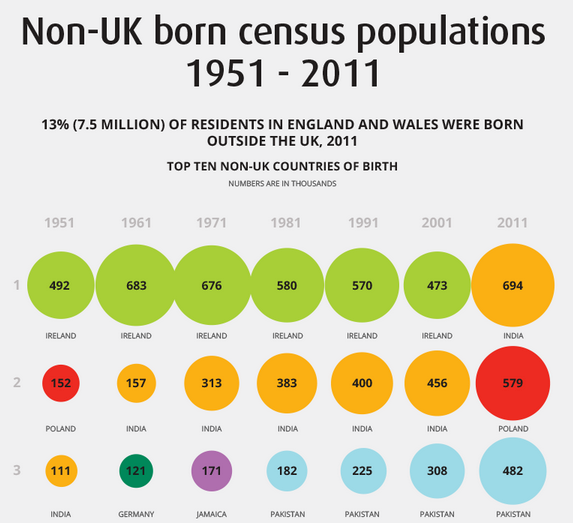
For the original study, the researchers created separate British and American corpuses. Looking at the British usage versus the American one, it seems like negro declined slightly later in Britain and that "Black" was the less immediately taken up as a category. I would speculate this is because in Britain Afro-Carribean/Caribbean/West Indian is its own category (and, I believe, the dominant source of Britain's Black people in the 70's), and not necessarily combined immediately with the sub-Saharan African immigrants mainly from former British colonies in Africa. In the 1971 UK census, Jamaicans were the third largest group born outside of the UK (after only Irish and Indians), but by at least the 1980's, Africans were also a significant group, and by the 1990's, there were more incoming Africans than people from the Caribbean. In statistics on British minorities, Black Africans and Afro-Carribeans are still often treated differently, rather than as one united "Black" group. I see from the "Black British" Wikipedia that, at least occasionally in the 70's, "Black" was an inclusive category that included South Asians, at least in some far left circles. I'm not sure what the state of the art research is in on second and third generation group identity in Britain, but the 2011 census for instance had three possible Black tick boxes:
"Black African"
"Black Caribbean"
"Any other Black/African/Caribbean background"
All groups are much smaller in Britain, accounting for only 3% of the current UK population, and were a much smaller percentage in 1970, when the vocabulary was changing (they were only 2% of the UK population in 2001). In the US, on the other hand, Black people have always been a much large proportion of the general population--11.1% in 1970, 12.6% in 2010.