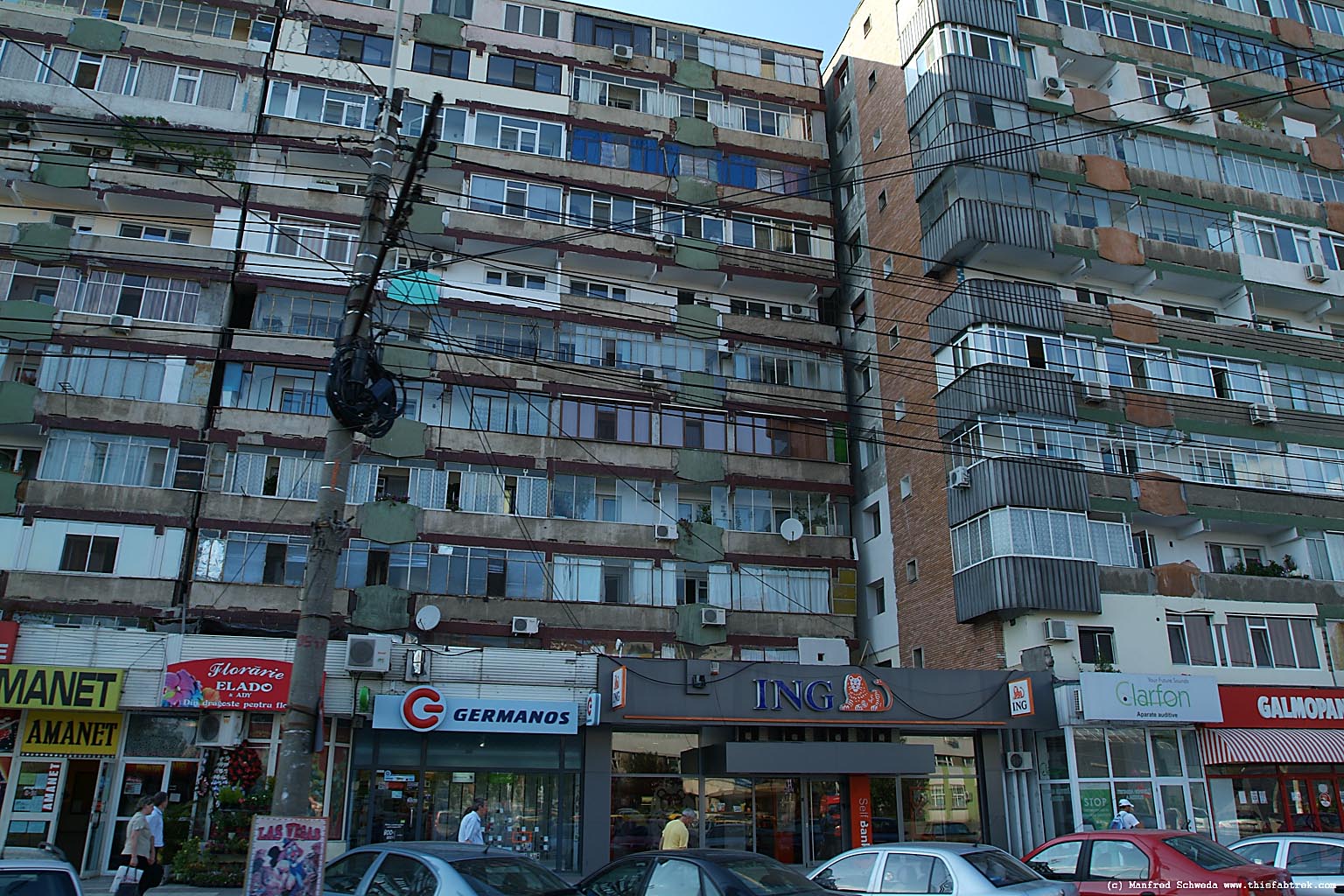
If you type in any country that was part of the USSR or the Eastern Bloc and check out inner city areas or tower blocks or whatever a large part of the architecture looks rather desolate and grim (I know that there are also beautiful places in all these countries, I am not meaning to be ignorant). Was this an intentional thing? I know Brutalism was a popular choice in the West in the 60s and early 70s but by the 80s there was a shift into different designs and Brutalism was largely derided. I'm just wondering if maybe the style was built intentionally for a particular reason, such as maybe a form of optical oppression or something like that. If not, I am generally curious as to why this style of ugly architecture has stood and continued to last over time.
Although the drab ugliness of Eastern bloc architecture might seem like a tool of social oppression, the reality behind the adaptation of prefabricated concrete was more prosaic. This architectural style was an expedient solution to a postwar housing crisis that at the time seemed to be modern.
The popular image of the Eastern bloc city is one of rebar and brutalist prefabricated architecture, but this was far from the only architectural style employed by the various Communist states. Soviet architecture in the era of NEP and early Stalinist periods was actually quite modern and progressive. The Zuyev Worker's Club is an example of this type of building embraced by the Constructivists of the early Soviet period. Late Stalinist architecture gravitated towards a monumentalist and excessive ornamentation, as exemplified by the Stalinist "Wedding Cake" style of the "Seven Sisters" Complex built in Moscow postwar.
The problem with both of these architectural approaches is that did not resolve the acute housing crisis of the postwar period. Not only did the war destroy much of the preexisting housing, but the drive towards implementing a centralized economy centered on industrialization created exacerbated the housing shortage. Urban planners and architects were under intense pressure from the state's authorities to resolve this housing crisis, hence there was an very little resistance to both prefabrication and concrete. Aesthetic concerns took second priority to resolving the housing shortage. This resulting use of extensive prefabrication built upon and expanded prewar concepts in urban design pioneered in the West during the Depression. The resulting Brutalist architectural style of the 1950s and 60s was both cheap, efficient, and alleviated the housing shortage. Many contemporaneous urban designers on both sides of the Iron Curtain saw Brutalism as a progressive and modern approach, which eased the adaptation of this style.
The problem with Brutalism and other ferro-concrete structures was that whatever their aesthetic charms, such as they exist, wore off with time. Rebar leached through the concrete, the large, flat concrete slabs handled inclement weather poorly, and their relative permanence made their destruction more labor-intensive than other dilapidated buildings. But the problem with replacing this style with a new form of housing in the Eastern bloc was that the once the planned economy was geared for the production of prefabricated concrete slab panels, it became difficult to produce different building types. Prefabrication was cheap, efficient, and available, which became highly attractive in the period of Brezhnev economic stagnation when the West moved away from Brutalist architecture.
Sources
Schlögel, Karl. Moscow. London: Reaktion, 2005.
Zarecor, Kimberly Elman. Manufacturing a Socialist Modernity Housing in Czechoslovakia, 1945-1960. Pittsburgh, Pa: University of Pittsburgh Press, 2011.
The ugliness wasn't intentional, no, although I do think it would be fair to say that there was something intentional about the buildings' size and uniformity that reflects a Communist preference for the urban, modern, and austere, and plenty of people find this ugly. But what makes some of these buildings remarkably awful is that they were made from cheap materials, badly maintained for decades, and now they're falling apart, and falling-apart modern buildings just look grim and decrepit rather than charming and picturesque like buildings in older styles often do.
The reason so many of these buildings were built is, like another commenter said, because of housing shortages and the movement of people from villages to industrial centers. Eastern bloc governments had something of a thing for huge projects that required forcible relocation (dams, mines, etc) or massive movements of workers. The styles of houses also shifted and improved somewhat over the decades.