I have to give a demonstration lesson to 7th graders about a pre-Columbian civilization as part of my second interview for a teaching job. The kids are in a class that focuses on 500 CE to 1500 CE and they have been doing independent studies on the Incan, Mayan, and Aztec civilizations.
I was asked to do a "close reading" exercise (basically marking text for content, vocabulary, etc. at length) for 12 year olds about a different civilization during that 1000 year period in the Americas.
Can anyone help guide me with a good place to look for a readily searchable (I have to give the demo in two days) civilization or, even better, a short passage about one that might be good?
Any help is useful. My knowledge of this topic is pretty lacking and I want to be as prepared as I can be in such a short period of time. Thanks!
For readily accessible civs, I would recommend Moche, Tiwanaku, or Teotihuacan.
The Moche were a bureaucratic kingdom from the north coast of Peru. Theire ceramics and monuments are quite nifty. You can usually find some good news articles on them as well. This is a great overview published by a Peruvian university I've worked with, but it's a bit more pithy. I would reccomend the section on "The Structure of Mochica Society."
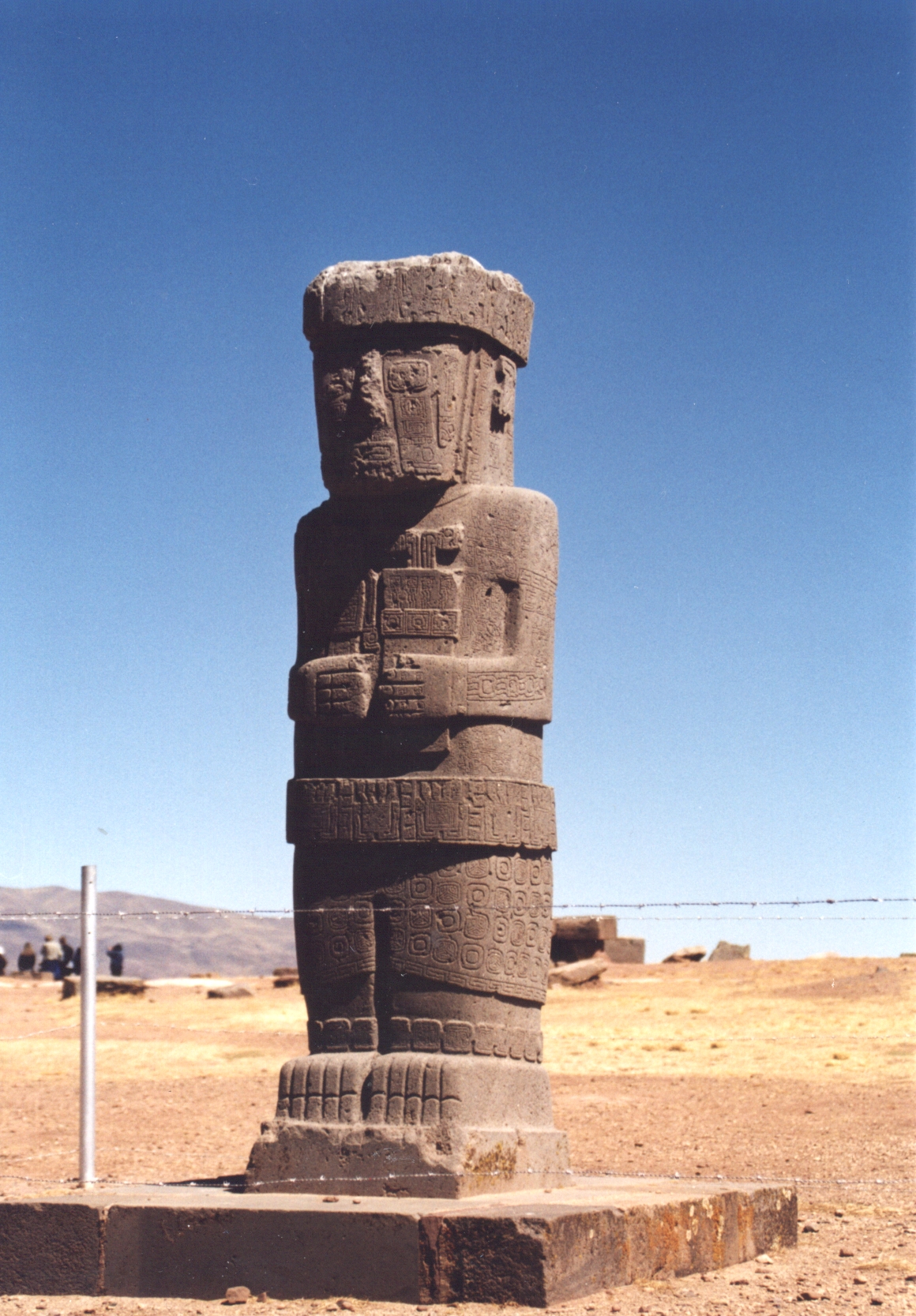
Tiwanaku was an empire, of sorts, who capital sat to the south of Lake Titicaca in Bolivia and influenced southern Peru, Bolivia, and Chile. A lot of your stereotypical "ancient temple" motifs are ripped straight from Tiwanaku's buildings. LiveScience actually has a pretty good article on it, and the people referenced are the top scholars (a.k.a. I work with them). If you can get your hands on the book Cities of the Ancient Andes, it has a better overview of the culture as well. (If you can't, I can get you a scan.)
Teotihuacan was likely the largest pre-Columbian city in the Americas, located in central Mexico. The Aztec revered it as a great ancient place, and the city's political shenanigans lifted Tikal to be the first Maya superpower city state. It's in the same Mesoamerican tradition in the Maya and Aztec, so if the kids are burnt out on that, it might not be the best. On the other hand, it can integrate well into existing knowledge to help conceptualize a complex political scenario. The best overview is in Michael D. Coe's Mexico, which I could also get for you.
As for sources, National Geographic and Archaeology have more-or-less accurate, but certainly readable, articles. They do tend to be about specific elements of those cultures (e.g. work being done on a certain monument), but do provide some background. Archaeology has a lot online, and NGM can be found at any library. If you want to get into some real academic stuff, I know a few more accessible articles. For other resources, museums with good online collections include the LACMA, the Met, and Mueso Larco (requires very minimal Spanish knowledge, or good guessing, to use),
To expand on /u/CommodoreCoCo's suggestions I would recommend
The Tarascan Empire. They were situated in what is now present-day Michoacan. They were contemporaries of the Aztecs and were sort of a "cold war" rival. They had resisted several Aztec attacks which embolden them to take Toluca only to lose it a few years later to the Aztec. Since that exchange the two powers set about creating a string of forts defending their borders. I highly recommend Helen Pollard's book Tariacuri's Legacy which covers the history of the Tarascans quite well. Although for something shorter and more digestable I recommend this article and this article by Pollard.
The Mixtec are located in what is now present-day Oaxaca. They were a later people who intruded on and competed with the earlier Zapotecs. The Mixtec were actually able to capture the former Zapotec capital of Monte Alban and added several of their own constructions to the already impressive ceremonial center. They have several colorful codices that have survived to the present-day in which you can draw some wonderful images from. For a history of the Mixtecs (and Zapotecs and Chatinos) I would recommend Mixtecs, Zapotecs, and Chatinos: Ancient Peoples of Southern Mexico by Arthur Joyce.
I always like to recommend these three readings by Christopher Beekman and Alexander Christensen on the Epiclassic migrations in Mesoamerica. They do tie into the origins of the Toltec peoples and later Aztec peoples. 1, 2, 3