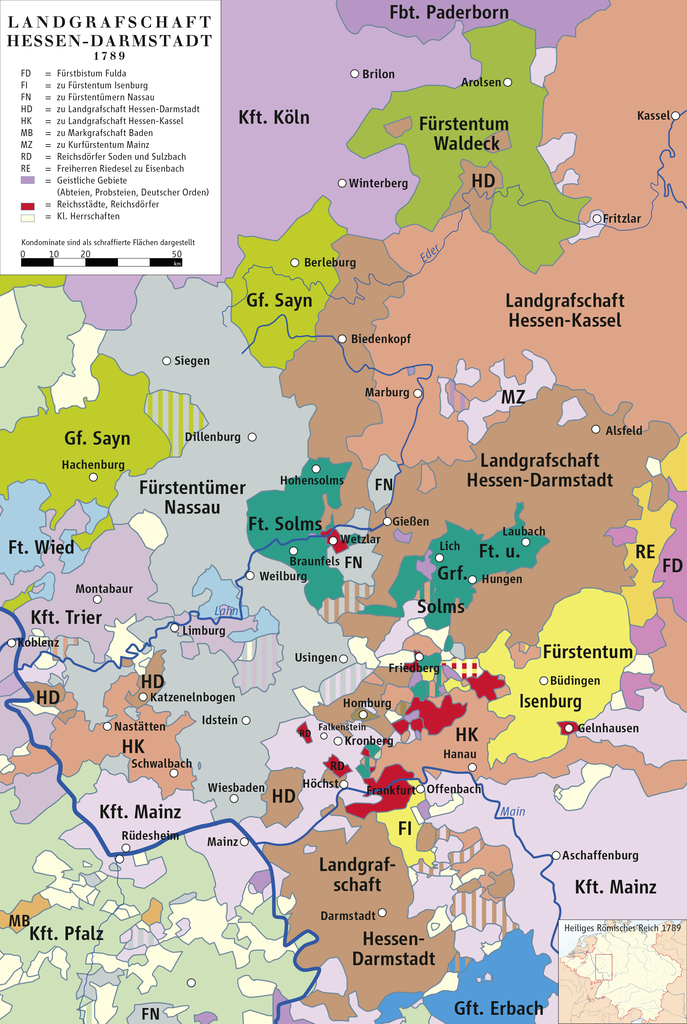
This question came to me from looking at the map of the Landgraviate of Hesse-Darmstadt of 1789.
Were there controls at every border crossing? That would sound like an incredible nuisance for any traveller to me. And even worse, wouldn't that also mean that any trade over larger distances would become less and less lucrative? If someone had goods to transport from Biedenkopf in the North to Darmstadt in the South the goods would be produced and sold in the same state, but in between they had to cross maybe a dozen borders; how would that work?
Or did they maybe do the controls on the market squares in the cities themselves? But wouldn't that make smuggling and selling of illegal goods easier?
I'm looking forward to any insight you might have.
Most of the info I've found about this concerns the period between the 1648 Peace of Westphalia, which ended the Thirty Years' War, and the turn of the 19th century that you brought up.
The various territorial lords of the Holy Roman Empire (collectively known as "princes") exercised the right to collect taxes and tariffs within their lands. As far as trade tariffs go, they remained an important source of income for lords and applied not just between territories, but within them as well (at the beginning of the 19th century, Prussia had 67 internal tariffs protecting small markets [1]). As a matter of fact, the borders between different territories in the HRE were never clearly demarcated, and kept shifting, so these tariffs were collected in different ways over time. The Elector of Brandenburg and ruler of Brandenburg-Prussia, Frederick William (ruled 1640-1688) imposed municipal duties on certain foods, beverages, and luxury goods which were collected at city gates. In the Electorate of Bavaria at this time, duties were collected at "surcharge offices" [2].
As for goods transported through territories, many customs posts had been set up by lords during the Thirty Years' War illegally, without permission from the Emperor. They were abolished by the Peace of Westphalia, but 10 years later the princes managed to include a clause in Emperor Leopold I's electoral capitulation (the agreement a Holy Roman Emperor made with princes upon election) which allowed them to set up their own customs posts after consultation with all neighbouring territories. In 1711, this was amended in Charles VII's capitulation to require the agreement of the relevant Imperial Circle. As a result, there were indeed many controls within the Empire, which were a hassle for travellers: in the mid-18th century, there were at least 30 customs posts between Hamburg and Dresden, 17 more between Dresden and Prague, at least 36 posts between Ulm and Vienna and a post every 10 kilometres between Basel and Rotterdam. Customs dues accounted for about 50% of transportation costs. As for smuggling, this was more of an issue when people were circumventing general bans on trade beyond the Empire, such as when wool exports and French imports were banned after 1672. The customs duties themselves remained relatively low between the smaller states of the Empire, as no one state wanted to suffer a trade war with others [3].
A quick note on Prussia again: a different measure that Frederick II (ruled 1740-1786) enacted after the Seven Years' War was an excise tax system called the Régie, based on the French model of central administration rather than local authorities, and carried out by mostly French tax collectors. They also collected at town gates [4].
Concerning Hesse (this is post-HRE, but you might still want to know about it), they were one of the first states to seek out a customs union after Prussia abolished their internal tariffs in their Tariff Law of 1818. The then-Grand Duchy of Hesse had nine-tenths of its population engaged in agriculture, and its main industry producing textiles was hurt by lack of free access to other markets. They entered into a customs agreement with Prussia in 1828 [5]. The Prussian customs union would eventually expand into a general German Customs Union (Zollverein) in 1834.
[1] The Global Financial System, 1750-2000 by Larry Allen, p. 193
[2] State and Finance in the Holy Roman Empire from c. 1650 to c. 1800. A Survey by Markus Denzel and Danny Weber, pp. 4-5
[3] Germany and the Holy Roman Empire, Volume II: The Peace of Westphalia to the Dissolution of the Reich, 1648-1806 by Joachim Whaley, pp. 273-276
[4] Studies in the Economic Policy of Frederick the Great by W. O. Henderson, pp. 67-71
[5] The Zollverein by W.O. Henderson, (2) The Expansion of the Prussian Customs System, 1818-1828
Well, border control is relatively new concept. It emerged to wide spread around WWI, before that it simply was really rare. Earliest I've heard about something similar was during the black death in 1348 when Kazimierz the Great of Poland, decided to quarantine Poland from it's neighbours. Which by popular belife was one of the reasons black death didn't take many lives in Poland during this period. Although I am uncrtain as to truth of that.