Here's the text I'm referring to: http://avalon.law.yale.edu/19th_century/sp1819.asp
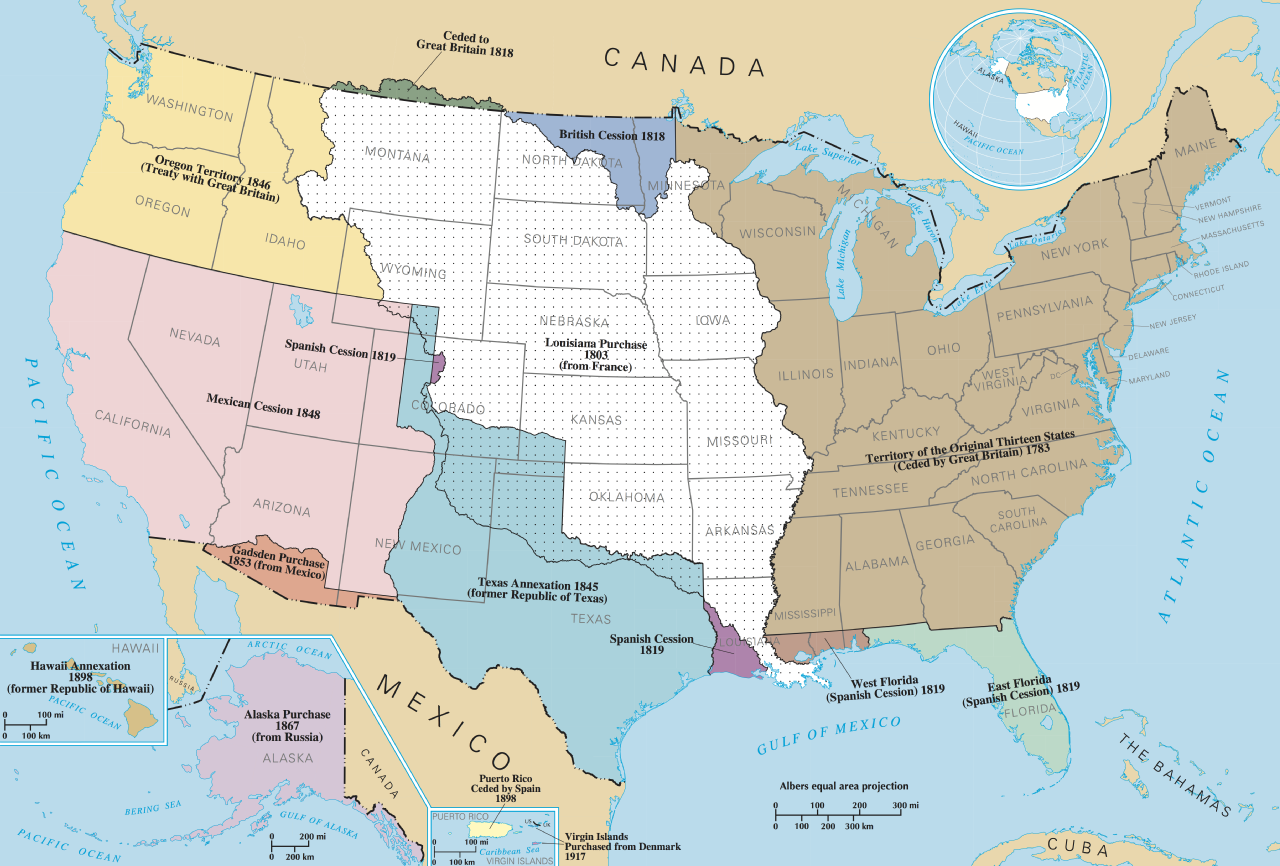
And the map: https://upload.wikimedia.org/wikipedia/commons/thumb/2/29/UnitedStatesExpansion.png/1280px-UnitedStatesExpansion.png
The answer seems to lie in Rivers. The Louisiana Purchase got the United States a lot of land from France. Land the France had acquired, from Spain via Napoleon. The reinstated monarchy of Spain, following Napoleons defeat, was contentious on the borders of the dealings. And the treaty made here, Adams-Onis set out to define the disagreements, as well as well as purchase Florida.
What would better help you determine how the United States 'acquired' those territories, you'd want to use a Geographic Map of the region. The Treaty says the border will follow the southern coast of the Arkansas River TO IT'S SOURCE, unto the Latitude of 42 North. The issue in Colorado existed because the United States believed their border of the Louisiana Territory to run up to the PEAK of the Rocky Mountains, and there was some confusion there, it would seem.
So, should the river's source lie North or South of the 42nd Parallel, the border, from the Source, would run directly to that parallel (which is the long horizontal border that stretches west under Oregon and Idaho. The river source appears to the base of that purple bit. And so everything East of the source, north to the 42nd, became US territory.
It's really complicated legal talk, which makes it a bit confusing to read about. But I'm unsure if there was any goal or value in that land that the US wanted. It merely seemed to follow the course of the Arkansas, which was river that defined the border of the Louisiana Territory from Kansas to Colorado initially. And as you can see from the map, Spain was actually ceded some territory from the United States, as it fell under the 42nd Parallel (the Blue and Pink areas in Wyoming that have the dots representing the Louisiana Purchase [you can see a large portion of Oklahoma and Texas territory made it's way back into Spanish sovereignty as well]).