I'm a military historian and I'm currently reading through the Court Martials of British cavalrymen from 1815. Some of the equestrian terminology is baffling and Google doesn't come up with anything. I wondered if anyone here could suggest what the following offence means "giving his horse a low back and riding home without a lease" - it must have been something quite serious as the offending soldier was sentenced to 100 lashes of the whip, but I just can't guess what it means.
Many thanks in advance! (I've already tried r/horses - they suggested I try here!)
Ok. I have some suspicions about what this means. I can't find any proof, so this is more speculation than what I'm comfortable with.
However, I did make some progress with this. Admittedly, it was challenging.
First, I looked up alternate meanings of the word "low." One of them is "lacking in vitality or health." I'm willing to bet that the officer meant "low" in this sense. A "low" back would be a back that is sore or in pain.
Any number of things can cause a sore back, but because the trooper was punished severely, I think he probably rode the horse incorrectly or too harshly.
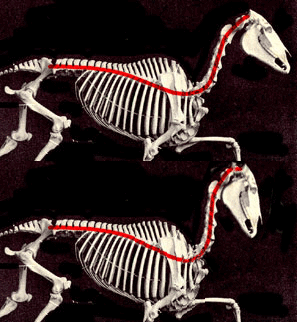
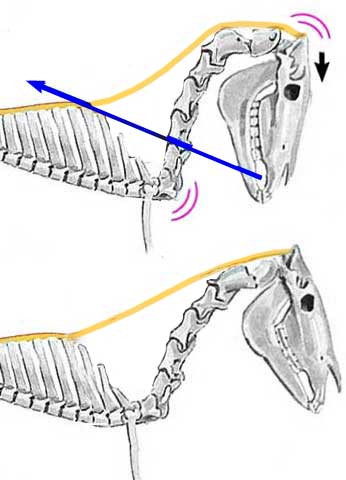
My suspicion is that the trooper was riding the horse for an extended period with the horse's head forced up and back, which would cause the back to drop and become sensitive from pain. The trooper probably had "heavy hands" and pulled back on the bit a lot.
So, you can see the effect of holding a horse's head and neck up here and here.
Cavalry horses typically were outfitted with martingales, which would prevent the head from going that far up and back.
Alternatively, he might have galloped his horse for an extended period of time on a hard surface, which would make the back tender.
I couldn't find that exact term in any of the cavalry manuals that I have. I'll keep looking, but as it stands, this is really all I can give you. A cavalryman could abuse his mount in any number of ways. Francis Dwyer talked abut this a fair bit in his c.1880 book, "Bits and Bitting, Seats and Saddles." There are also references to rider abuse of the horse in this c.1860 manual, "The Cavalry Manual." (See: http://babel.hathitrust.org/cgi/pt?id=hvd.32044080700651;view=1up;seq=58)
There are other manuals that I consulted, of course, but none specifically used that phrase.
But at any rate, damaging the horse's back was a very serious offense, because it made the horse effectively unusable. For more information on the horse's back, Dwyer's book is an excellent scientific source:
https://archive.org/stream/onseatssaddlesbi00dwye#page/30/mode/1up (Page 35).
As for leaving without a lease, I don't have a clue what that means.
Paging /u/BritainOPplsnerf, sounds right up his alley. Also /u/DonaldFDraper.
"Without a lease" is reminiscent of "without a leave". Any chance it is a typographical error?