Melee combat is largely asymmetrical: You hold the shield on your left side and presumably rely on your own weapon to protect the right hand side (vice versa for left handers). However basically all shields have been symmetric - circles, ovals, squares, rectangles and the classic flat top pointy bottom European medieval shield. The only one I can see that isn't is a jousting shield - but that's essentially symmetric with a cutout to help hold the lance.
"Melee" combat is a gaming term that fails to capture the diversity of close-quarters weapons combat. Between disciplined heavy infantry, light irregulars, gladiators, brawlers, and duellists, there were many ways to fight hand-to-hand, and shields served different roles in all of them.
Shields served a number of purposes on the battlefield, and single combat may have been the least important. Firstly, they were shelter from arrows, javelins, and other launched weapons. Symmetry here is good, since you are literally hiding behind it, and you yourself are symmetrical, barring some strange disfigurement. Secondly, they were used as part of a tight or interlocking shield wall in a line of infantry. Symmetry is also useful here, since uniformity of shape and orientation are needed to build a good wall without unpredictable gaps.
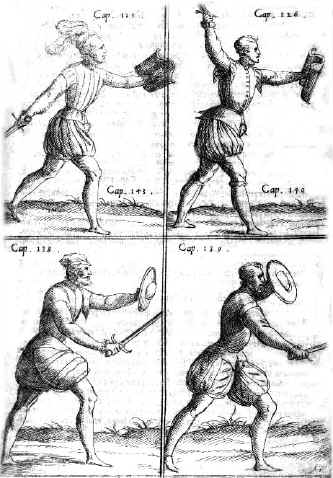
For single combat, shields were less popular. To be more precise, the large infantry shield (such as the Hoplite shield, Roman scutum, or medieval kite and heater shields) that is super-useful while arrows are raining on your formation, or a mass of enemy soldiers is trying to break your line, was a bit on the heavy side for the free-wheeling world of single combat. In these circumstances, fighters often switched to small targets or bucklers in place of the heavy infantry shield. Bucklers were used less as a shield, and more as a parrier, actively used to catch and deflect blows, rather than simply hide the target. Buckler-type blockers have been observed everywhere from Roman gladiatorial equipment (example) to late medieval and Renaissance fencing manuals (example example). Symmetry is less of an issue with bucklers, but they were small enough that asymmetry would not provide much benefit for the defender. If you were going to go in the direction of asymmetry, you might get more benefit from other left-hand defences such as cloaks or main-gauche daggers (example), or even discard your left-hand defence entirely, especially if using a weapon that could be used with both hands (example).
TL;DR: shield symmetry has useful applications in massed warfare; shield asymmetry is not as useful with the smaller bucklers that were more common in single combat.