As we all know, the New World was discovered and colonised largely by Europeans travelling West. Notwithstanding the difference in distance requiring travel (the Atlantic being narrower than the Pacific, making it more traversable; having said that - the Bering Sea?), why didn't any of the large Asian civilisations, such as the Chinese, 'discover' the New World or Australia?
Furthermore, even when such lands were discovered by the more modern world, why did they not colonise these new places, whilst, for example, the European settlers were slowly making their way over-land across the Americas towards the Pacific? Why not plonk new cities along the American-Pacific coast themselves?
Basically, why do we have San Francisco and not San Fransokyo?
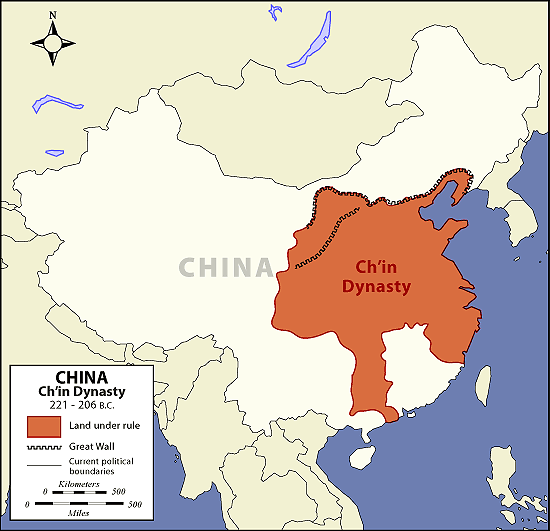
The geography of the Chinese Empire throughout most of premodern history has had the region surrounded by various other neighbouring states/kingdoms as well as 'barbaric' hordes. The Chinese either expanded outwards through the defeat and following assimilation of these other ethnic groups and their territories, or entered into tribute-gift relationships with other kingdoms. These territories were found to the north, west, and south - essentially every direction on land other than east (since that was open water) - and so they found it much easier to slowly move over land gaining new territory rather than moving across the ocean. Remember as well that there's ~4500 km between China and Australia, and even further across the Pacific, which is a point I'll touch on soon.
As we know pre-Opium Wars, China as an empire had an expansive, rich source of luxurious goods - most notably silk, tea, and china, or porcelain. Similarly, coming back to the point on surrounding tributary states/surrounding kingdoms that China traded with (e.g. India) which provided China with external trade goods such as spices, meant that the entire empire had a sustainable internal and external trade network.
Coming back to the point on sheer distance and no incentive to actively expand for colonisation, there was no valid justification to fund a voyage that far south, navigating through various islands to find something else. Although we know notable figures such as Zheng He made ventures outwards, those journeys were not made with the discovery of new lands to colonise in mind, but more as a demonstration of the power of the Chinese empire.
Compare these two maps - the Qin dynasty and the Ming - the area of China has expanded inwards, to the north, west, and south. A conquest into these areas throughout history would obviously be a lot easier than going south across water, and coupled with the fact that these outer regions were still very much worthwhile to take in under the empire meant that the Chinese just didn't need to discover either the New World or Australia.