You may find my answer to a similar question interesting, I've copied it in full below:
Is there any evidence of homosexual activity amongst medieval European monks?
Yes, a lot of evidence. Exhibit number one is the Liber Gomorrhianus of Peter Damian published in the mid 11^th century (the Book of Gomorrah). Peter Damian was a very influential member of inner papal circles during the period known now as the 11^th century Gregorian Reforms, a period which saw a lot of Papal and clerical energy directed at reforming what was viewed as the lax morals and heresies of clergy including simony, lay investiture and clerical marriage. This was part of the same movement which led to schisms and conflict between papacy and monarchs, particularly with the investiture conflict with the emperors of the Holy Roman Empire, starting with Henry IV.
Damian's tract takes a theological stance against sins of homosexuality, but in particular sets out to explain the sinful nature of sexuality and homosexuality in the context of monastic life. He proceeds to be very detailed about the nature of the sins of monks (as well as other clergy, including females), and the order of their sinfulness. For example, Damian ranks the sins:
Four types of this form of criminal wickedness can be distinguished in an effort to show you the totality of the whole matter in an orderly way:
some sin with themselves alone [masturbation];
some by the hands of others [mutual masturbation];
others between the thighs [interfemoral intercourse];
and finally, others commit the complete act against nature [anal intercourse].
The ascending gradation among these is such that the last mentioned are judged to be more serious that the preceding. Indeed a greater penance is imposed on those who fall with others than those who defile only themselves; and those who complete the act are to be judged more severely than those who are defiled through femoral fornication. The devil's artful fraud devises these degrees of failing into ruin such that the higher the level the unfortunate soul reaches in them, the deeper it sinks in the depths of hell's pit.
Liber Gomorrhianus is not alone in identifying sex among clergy, it was preceded in the 10^th century by Regino of Prüm's De synodalibus causis et disciplinis ecclesiasticis and earlier in the 11^th century by Burchard of Worms' massive Decretum. However, where Regio and Burchard identify sex among clergy as sinful and prescribe penance for it, Damian is viewed as an outright obsessive attack. Damian was an advocate of deeply ascetic clerical practice.
Damian in his Liber Gomorrhianus identifies other issues of sex among clergy, including sex with minors. It was Damian's belief, and many of his fellow reformer's belief, that sex and marriage among clergy was a pollution of the sanctity of holy orders, a sanctity which they believed was corrupted in the centuries since Peter and the Church Fathers (like Augustine) set down the model of Christ's apostolic life.
Although Damian was one of the most important reformists with Hildebrandt and Humbert, and published important canonical works like Liber Gratissimus, his tract on homosexuality should be taken as evidence of the existence of sex in the monastery, but given the 'cool reception' given to the book by the papacy it can't been seen as canonical Church policy - we are told that Pope Adrian II took it from Damian and attempted remove it from circulation. Sex within the monastery was complained about through the balance of the middle ages, although not nearly so forcefully nor obsessively.
The full English translation can be read here:
For background see:
Not directly related to your question, but Guibert of Nogent, whose Monodies is the only surviving first person memoir from a monk in the middle ages has some pretty screwed up sexual stuff in it.
There is a masturbation scene, which is normal enough I suppose, but when he gets to talking about his mother it get's weird. I don't remember all of the details, but I'm pretty sure he says his mother was raped by a demon. And then you ask yourself, how would Guibert have known all of this? Because he and his mom talked about her sex life, that's how.
Chiming in (though a bit late) for east Asia - first answered here:
Homosexuality in Japan and China between monks and samurai
Homosexual relationships in Japan were (from most sources) not common, however they did exist. In most homosexuality-related articles of pre-modern Japan it is not presented as something that happened often, rather it was kept quiet - you didn't parade around announcing who you were sleeping with, you just did it. More notable accounts of homosexual relationships exist between samurai and their 'squires' - pederast relationships between a mentor and a student. These were more open and acknowledged by the public, as the fathers of these boys would essentially sign away their children for a period of time to serve under the samurai. However, these relationships would still count for the minority. These relationships stemmed from pederasty between buddhist monks and their proteges or acolytes, which was even more common within monasteries.
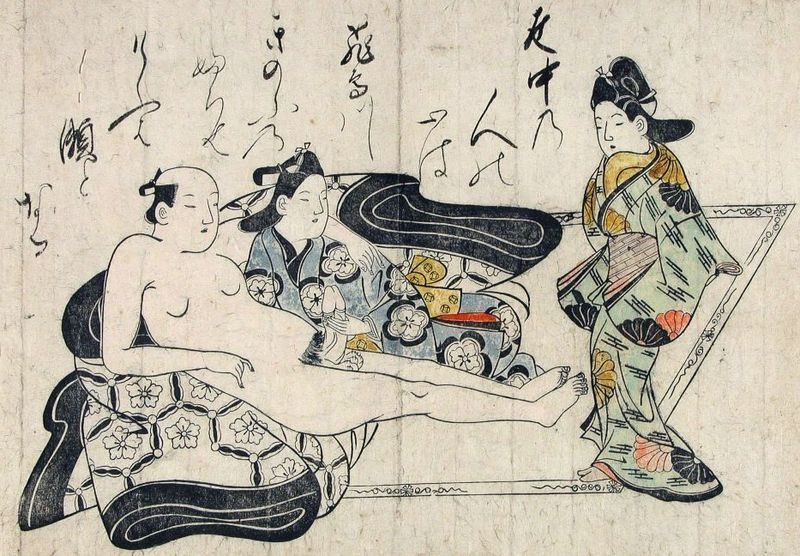
Similar to China, homosexuality for the most part has always been legal in Japan, with no recorded punishments (to my knowledge) for homosexual relationships, so this would not have been an issue raised in feudal Japan. Homosexuality would have (at the very least) not been seen as a distasteful act either, as many paintings and woodblock prints exist (this one is a good example of shudo) depicting homosexual relationships. Also, similar to China, the social stigma of negativity surrounding homosexuals never truly developed into a concern in society until the Westernisation of said countries from the 19th century onwards.
In China, homosexuality was seen similarly to how it was seen in Japan, with Buddhist temples not differentiating between homosexual or heterosexual relationships. Some sources even claim that emperors themselves engaged in multiple homsexual relationships:
Confucianism did much the same, focusing more on social philosophy. The laws regarding homosexuality were directed more towards prostitution than to mature relationships. In fact, recorded opposition to homosexuality appeared later on when Christian and Islam writers that reflected their own attitudes reached China.
Other sources:
How the Japanese became foreign to themselves - Hein, P.
Here too:
Attitudes of the Mongols towards homosexuality
Similar to quite a few east Asian religions' attitudes towards homosexuals - Buddhism, for example, in both China and Japan (the branches of the original religion that came from India), tended to be a lot more open and welcoming towards homosexuals - not the relationship itself/sexual orientation but the act.
For example, pederast relationships existed between monks/samurai and their apprentices, whereby the 'homosexual' relationship was one that was meant for the older man to teach the younger, as a symbol of the transition from boyhood to manhood. Note that these weren't exactly homosexual relationships, but rather a consensual one where the act was performed, if that makes any sense.
The Mongols themselves as an empire were quite tolerable to other religions, and perhaps a reason for this was that (and I'm not an expert on religion so I'm probably overstepping my bounds a bit here) many religions, e.g. Buddhism (Indian), Christianity, and Islam all condemned the act of sodomy, rather than the sexual orientation of LGBT. Buddhism viewed the act of sodomy to be the same embodiment of the visceral needs of humans in their lust, Christianity saw sodomites as sinners, and the Quran ^(?) similarly disapproves of those who practiced sodomy.
Another reason could be that Genghis wanted the empire's population to expand, which could be done only through heterosexual intercourse (which is similar to his original expansionist attitude), though again this is all borderline speculation.
TL:DR - Homosexuality wasn't a thing so much as the act of sodomy - these 'relationships' existed between monks and their proteges, and while we have evidence of these 'relationships', it's harder to tell the exact spread of it since so much of your private life was kept secret.
Some Byzantine monasteries are actually incredibly perturbed by this question. We have some surviving typika (foundational documents) that spend a great deal of time making sure people who might tempt the monks away from chastity can't enter the community - women are of course the most basic target of these restrictions but they often specifically mention young boys and eunuchs. Some of these even come from the same monastery or group of monasteries over a period of time (usually on Mt. Athos), so we can observe newer versions of each typikon specifically restating earlier bans - so we know the first ones weren't obeyed - or instituting new bans based on intermittent "scandals."
Scholarship on Byzantine homosexuality in general is basically nonexistent (if anyone has any, pleeeease send it my way) but Derek Kruger has an article on early monastic homosexuality that might help give some idea of the situation.