What was the relationship between ancient romans/greeks and their gods (was it perceived as one of trust and love, pragmatism, fear...?) Also how did ancient romans/greeks see their faith explaining metaphysics? Modern religions often portray all of the observable and even the internal emotional world as not only caused by God but an expression of God, part of its very being. Did the romans/greeks also see things this way or were the gods seen as being powerful players in a world explained and constituted by philosophical and scientific truths?
What was the relationship between ancient romans/greeks and their gods (was it perceived as one of trust and love, pragmatism, fear...?)
I can answer this part of your question pertaining to the ancient Greeks and the answer isn't clear cut; there's a definite mix. There were indications that they loved and trusted the gods; they dedicated art and architecture to them. One well known example of this is the Parthenon, a temple dedicated to Athena. The Parthenon housed a giant statue of Athena made out of ivory and gold. One might interpret the reasoning behind constructing such a statue a few ways. First and foremost, they put such a large amount of wealth into Athena's statue because they wanted to appease her; they wanted to show that they were loyal to Athena, but they also didn't want to evoke her wrath. Another reason for this statue may have been to store Athens' massive wealth; it was made out of ivory and gold, after all.
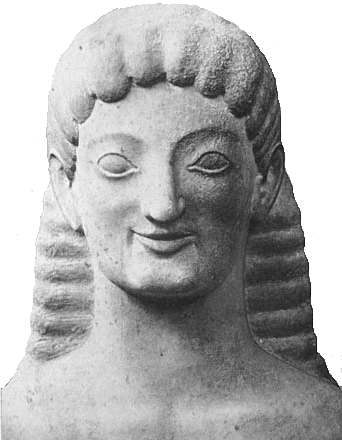
The Greeks also commonly dedicated sculptures to the gods. During the archaic period the Greeks built sculptures in the archaic style characterized by the left foot being forward and the "archaic smile"; it's a really odd looking smile, but it was on so many sculptures during this period. These weren't dedicated to the gods; they were of non-specific human beings. The classical period was different; a sculpture of Apollo was discovered from that era, although I can't find the image now. Anyway, the muscles on that statue were very well-formed in comparison to archaic sculptures, and Apollo was depicted as having a powerful, realistic stance. He also had a serious face; all of these characteristics formed this "severe style." The Greeks depicted gods doing serious, powerful things because that's just who they were. So now there's definitely this idea that the gods are powerful and should be portrayed as such, indicating at least some degree of fear.
Sacrifices are a tricky element of ancient Greek religion because they can signify love/trust, or fear, or even a combination of these elements. Homer's Iliad discussed sacrifice; before Odysseus and his men went to Troy they offered Zeus a ram (I think it was a ram; I read the text a long time ago). This was a relatively common practice. The ancient Greeks often sacrificed animals to the gods. Now, it's difficult to determine if they did this because they trusted the gods to bring them good fortune or if they feared that failing to offer a sacrifice would evoke the wrath of the gods. It's likely a bit of both.
It is evident that the Greeks had trust in the gods, though; a good example of this is the Oracle at Delphi - a religious site dedicated to Apollo on Mount Parnassus. They consulted the Oracle before many major decisions. When the Persians were making their way to Athens the Athenians consulted the Oracle who told them that they would be protected by "wooden walls"; this is of course somewhat ambiguous and they interpreted this as their ships, so they took that advice and battled the Persians on their ships (the Battle of Salamis). The Oracle at Delphi wasn't just consuted during times of war; if you - as a Greek - had to make a significant life choice, you would consult the Oracle.
Regardless of how they felt about the gods, a Greek putting himself even close to the level of the gods was heavily frowned upon. Alexander the Great did this a few times. When he fought his way to Egypt and finally arrived they hailed him as a liberator, even as a god, the "son of Anum." Alexander was happy about this and embraced it. This was considered wrong on many levels; being a hero was one thing but raising yourself to the level of the gods was problematic. Another time he did this was at a drinking party in 328 BC. His generals were bragging about him, praising him, claiming that he was better than certain gods; his friend Cleitus the Black (who had saved his life during a battle) intervened and said this was blasphemous. Alexander killed Cleitus. A Greek raising himself above the level of another Greek - much less accepting that he was even close to a god - just wasn't fine by them. So while I wouldn't say this aspect speaks to them fearing the gods, it certainly speaks volumes about their relationship with the gods. They made well sure that there was a clear distinction between a person and a divinity - their fellow humans and the beings they worshiped.
Sources: