Virtually all Mesoamerican cultures practiced human sacrifice.
Human sacrifice was part of a suite of religious practices that also included bloodletting, burning of incense, and animal sacrifice. These practices were seen as a fulfilling a kind of divine pact between mortals and the gods that involved the reciprocal exchange of vital energies. Sacrifice is frequently imbedded in Mesoamerican creation myths.
My favorite example of this comes from the Mixtec codices. Near the beginning of the current world, humans began planting crops for food. In so doing, they consumed energy from the earth (in the form of nutrients) and the sky (from rain). This angered the gods of the earth and sky because their energy was being taken. In response, the celestial world and underworld sent armies to invade the mortal plane of existence in an event known to scholars as the "War of Heaven."
The armies of "earth men" and "sky men" wrecked havoc on earth and destroyed many cities. (Oddly, the cities mentioned in the creation story were real places and appear to have been abandoned about the time this story takes place, which may mean it is at least partially based in reality). Eventually, another god Lord 9-Wind (the Mixtec equivalent of Quetzalcoatl) intervened on behalf of humanity and drove the invaders back.
A peace deal was reached between humanity and the gods. Humans could continue to farm crops and consume the energy of the gods. In return, however, they would be required to spill their own blood and make sacrifices so that the gods could eat as well. As mortals, they would also die. When their bodies were returned to the earth, they would return the energy they had taken from it.
As that example shows, human sacrifice was deeply imbedded within Mesoamerican religious beliefs. The Aztecs didn't invent it. That said, the Aztecs did "kick things up a notch." They were seen as a violent and imperialistic group by other Mesoamericans that they interacted with, but their ideology of sacrifice would have been easily understood.
EDIT:
Because why not, here are some images from different Mesoamerican cultures showing human sacrifice.
This painting from a Mixtec codex depicts a sacrificial ritual known as "arrow sacrifice." The victim is tied to a rack and shot with an arrow.
This sketch is either the first or second hieroglyphic inscription in Mesoamerica. It comes from the Zapotec site of San Jose Mogote and depicts a man with the Zapotec symbol for "heart" placed on top of his chest. Probably a sacrifice, but these kinds of carvings may also be depictions of self-sacrifice via bloodletting.
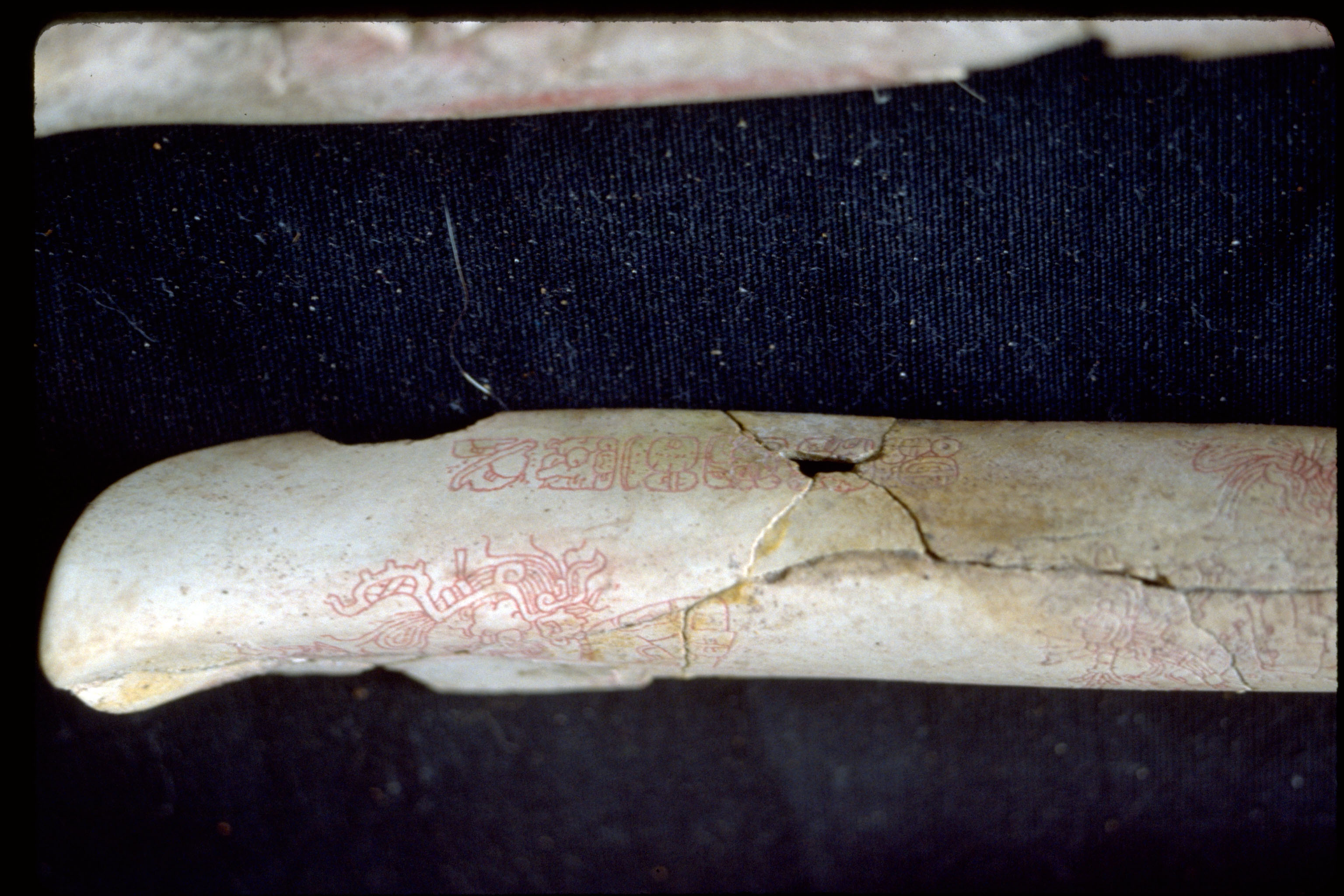
This artifact is made of human bone, probably taken from a sacrifice. It was found in a burial at the Maya city of Tikal.
Sources on Mixtec creation story:
Boone, Elizabeth (2010) Stories in Red and Black: Pictorial Histories of the Aztecs and Mixtecs University of Texas Press, Austin.
Byland, Bruce and John Pohl (1994) In the Realm of 8 Deer: The Archaeology of the Mixtec Codices.