Coventry, UK. A city that had been the capital of England multiple times in the 15th century, but was absolutely decimated in WW2 in the Coventry blitz. It lost about 3/4's of its industrial plants during ww2, also losing its famous cathedral. Following the war it focused heavily on the motor industry, but that too collapsed in the 1970's, and today there only exists one vehicle plant still functioning in Coventry. In 1942 the population of coventry was 242000, and today it is 316900, a very small growth in comparison to the rest of the UK. See http://www.british-history.ac.uk/vch/warks/vol8/pp1-23#h3-0004 for more information.
I missed some. And I was urban planner, not historian.
Galveston, TX: Once Texas' biggest city. Grew with the oil boom, but one single hurricane caused a mass exodus to Houston. New Orleans might be similar, but the decline was not as fast, and they are still trying.
The US stats count as big cities with the highest peak loss: St.Louis, Detroit, Cleveland, Pittsburgh and Buffalo with over 50% loss. Other examples listed on Wikipedia are: Donetsk, Glasgow, Kitakyushu, Turin.
Cited reasons are besides poor urban planning, natural disasters or shifting economy interestingly racial tensions: Detroit and Donetsk.
One called out Vienna: It is true that it had once over 2 millions during the huge Habsburger reich, and lost half of it until end of WW2. But now it's growing again very fast (>10.000/year) and is still one of the most attractive cities to live in. (yearly polls in management cycles)
Leipzig is another famous Detroit-like example of deindustrialization.
https://en.wikipedia.org/wiki/Shrinking_cities cites many studies.
There are a lot of answers about western cities, but what about the middle east? Beirut was destroyed during the Lebanese civil war, Bagdad, Babylon, etc. Weren't most large middle eastern cities much different before WWI?
There are numerous American cities, particularly in the "rust belt", that fit this description. Here is a census derived visualization of the changes in population of American metropolitan areas from 1680-2010. I have had the pleasure of living in two of these, Buffalo and Milwaukee, and that feeling of living in a city that is past its glory is quite palpable.
Local historian John Gurda details quite a bit of Milwaukee's history in The Making of Milwaukee, and I have seen him speak on a few occasions. Most of the information that follows is from his talks and is in his books.
Early on, it appeared Milwaukee was destined to be great. It was built on the best port on the Great Lakes, with the intersection of three rivers providing a sheltered port off Lake Michigan that was deep enough for navigation by ocean going vessels. It became so important for grain shipping that in 1880 the Milwaukee Grain Exchange was opened, and it became the world center for grain commodities trading; the price of wheat for most of the world was set in Milwaukee. German immigrants created a thriving brewing industry in the 1850s in an area whose water was supposed to be similar to Munich's, and it became home to the nations largest brewery (and first American brewery to export beer) in 1874 (Pabst). By the late 1860s, Wisconsin also produced more hops than any other state in the country, and one county in Wisconsin (Sauk) accounted for 20% of the entire world's hop production. The shipping and early beer industries were symbiotic, bringing raw materials to the area and enabling Milwaukee to dominate Chicago's beer market in the wake of the Chicago fire of 1871. In 1895, Milwaukee City Hall was completed, the tallest building in the world at the time.
According to Gurda, there were several factors that stopped Milwaukee's ascendency. First, it was in competition for regional trade with Chicago, and early on the founders believed that port superiority would be instrumental. Chicago had a poor quality port, but it was ideally situated for rail connections. When Chicago began to get more widely connected by rail it started to grow rapidly, leaving Milwaukee behind. The second big factor was two wars with Germany and prohibition. The German background was central to Milwaukee's identity, and brewing was a huge part of city industry. As a result of the temperance movement, the state Methodist convention of 1867 resulted in a resolution to persuade farmers to stop growing hops. That, combined with a downy mildew infestation and aphid infestation, completely ended commercial hop production in state by 1920. German was the most widely spoken language until WWI, when anti-German sentiment spurred the city to suppress German language instruction. My grandmother spoke only German until age 5, and then she never spoke it again in her life; this is a common story among Milwaukee Germans during that time period. Prohibition decimated the brewing industry, although Milwaukee remained number one in beer production until 1981, when Schlitz closed its doors. Like other rust belt cities, Milwaukee was hit hard by factory closings in the late 1970s and 1980s, and the population has been in decline every since.
A lot of Russian provincial cities lost population during the 1990s as state-owned industries were liquidated and the population moved to pastures new - ie, Moscow or abroad - in search of employment. It does seem to have recovered somewhat. Grozny might also qualify, since the devastation of the Chechen War.
Glasgow and Liverpool in the UK have become bywords for urban decay, especially as London has boomed, but as a native of the former I wouldn't go so far as to say it was a shadow of its former shelf, even if it is no longer "The Workshop of the World" or "The Second City of the British Empire".
I am surprised no one has mentioned Manchester. The center of the worlds cotton industry and an industrial powerhouse, with a diversifying economy right up to WWI (although certain aspects of industry started decline earlier). The interruption of the cotton markets due to WWI, the Great Depression, and finally the devastation during the Blitz in WWII helped seal the decline. The move to large seafaring container ships, the Irish bombing, and Britains de-industrialization during Thatcher all assisted with the decline. Manchester is experiencing a growing economy and population recently, but has lost its status as Britain's powerhouse. A cool book to read about the cotton industry specifically is Empire of Cotton: A history by Sven Beckert.
Another person mentioned former Ottoman cities. Aleppo I think is the best tale of a city in long-term decline, if we can expand the timeframe. Aleppo was at certain times the second most important Ottoman city after Istanbul. It was a trading hub and a end point of the silk road, and depended largely on overland trade and close access to mediterranean ports its economic vitality. Going back to the period before the Ottomans historically, it was often the seat of Dynasties and Syrian states.
The rise of ocean commerce and decline of the silk road, especially after the construction of the Suez canal sent the city into economic decline. Once the Ottoman state fell, Aleppo lost large portions of its hinterlands to modern Turkey, as well as its nearest access to ports and connections to Mosul and Baghdad.
I'm from Springfield, MA, and while most people don't think of it or think of it as the crime-ridden place it is now, it was once a bustling center of the industrial revolution and is responsible for a lot of cool stuff. Basketball, the armory, smith and Wesson, etc.
It feels like it died the way a lot of once-great eastern towns did, through the collapse of industry, but I'm having trouble finding many sources on this and other like towns (e.g. Worcester, Troy, Rochester, etc).
This is all I've dug up so far: http://www.baywood.com/books/previewbook.asp?id=978-0-89503-326-0
Any ideas, historians?
I am not a historian, but I would like to ask: does Vienna, Austria fits this description?
This one falls outside of the 100 years, but I'm gonna post it anyway because the historical significance of this city is too immense to be ignored:
Tournai in Belgium.
I've posted about this city a few times. And only because it got stuck with bad luck. It was the intellectual capital of the Belgain region for centuries before it was ever Belgium. Without Tournai the intellectual background of Belgium would not be what it is today. The entire foundation of the Belgian Labour Party came out of those educated in Tournai. It's been ruled by the Dutch, French, Spanish, Austrians and is also the only Belgian city ever to have been ruled by the British. Because it straddles the Escaut river it's always been of huge importance to rivaling empires. The constant battle for it resulted in a huge brain-drain towards Antwerp, Brugges and Ghent.
Also: The Notre Dame cathedral in the center of town is larger than the one in Paris.
Tournai: Length: 134m (440 ft) Width: 60m (200 ft) Height (max): 83 metres (272 ft) Spire(s): 5 (7 planned) Spire height: 83 metres (272 ft)
Paris: Length: 128m (420 ft) Width: 69m (226 ft) Height (max): 69m (226 ft) (2 towers) Spire(s): One Spire height: 90m (300 ft)
Wikipedia page is quite concise in terms of the information, but if you click through a few of the links you'll find some interesting details.
https://en.wikipedia.org/wiki/Tournai
My favorite is the direct link between Tournai and NYC. The man who bought the island of Manhattan from the native population was Peter Minuit. He spent a large portion of his life in the city while it was controlled by the Dutch, and it's thanks to him New Amsterdam was ever able to be established..
In the U.S., at least the northeastern U.S., I don't know if 100 years is an effective cutoff. It can be far more recent. Sixty years ago cities like Newark, Hartford, New Haven, Worcester were pretty big industrial centers. They never really recovered from the "white flight" of the 1960s.
Galveston, TX.
Galveston was hit by a category 4 hurricane in 1900 that killed ~10,000, or 20% of the inhabitants [1]. This makes it the worst natural disaster in United States History in terms of lives lost. Although within three weeks, cotton was again being shipped out of the port, the economic result was that the surviving and future industry of the region gradually shifted further inland to Houston, TX. For example, he transcontinental railroad lines and growing manufacturing sectors of the three larger Texas cities by-passed hurricane-vulnerable Galveston [2]. Another Hurricane in 1915 would only kill 275 people, each successive hurricane seems to have convinced fewer people to make significant investments in the island.
[1] Brian K. Sullivan and Tom Korosec (September 12, 2008). "Hurricane Ike Set to Slam Texas Coast; Thousands Flee (Update1)". Bloomberg. Retrieved September 11, 2008
[2] http://texasalmanac.com/topics/history/galvestons-response-hurricane-1900
Most of the major cities that relied heavily on a single industry are prime for collapse or at least a major stagnation. A lot of towns have nose-dived because their primary purpose moved on. some are trying to come back and re-invent themselves.
I'm in NE PA.
our banner example is Scranton which really rode the Anthracite Coal wave and some manufacturing... but then died out. - https://en.wikipedia.org/?title=Scranton,_Pennsylvania - it was a city built on a need for a specific natural resource, as soon as that resource demand plummeted so did the city... they are trying to bring it back but it has been dropping population for decades. In 1920 it had 137,000 people (still growing and booming) - today it has around 70k and shrinking. The last year of positive pop growth was 1930s census
an example of a city actually successfully re-inventing itself (imho) is Bethlehem PA, it grew MASSIVELY in the early 20s... (almost 300% growth by census numbers). This was primarily due to the Bethlehem Steel company. When this core industry moved out the city had enough area support (Allentown, NJ, Philly) to maintain most of its population... however the loss of such a crucial employer could have crushed the city. I think this is a pretty solid example of decent city planning and also the success of social safety nets, the vast majority of people who were laid off by Bethlehem steel were given the opportunity to return to college, get degrees in new areas of study and stay in the area. Without that type of program in place the city would have been hit pretty hard
Central Falls, Rhode Island. Child labor laws where the first blow to it's textile industry. Cheap over seas labor was the killing blow. It went from a beautiful, league of nations ciry with endless charm to a bankrupt hell hole. I deliver mail in the city and the ghosts of past lie in every dark alley and each backyard. There is not a single home that is single family aside from a 2 street neighborhood, and most of those are out of code in terms of occupancy. If you are looking for a relative unknown city of the dead. Central Falls Rhode Island is waiting for historical study.
http://www.shorpy.com/node/2168?size=_original#caption
This photo from 1912 looks much better than that same area now..
Tulsa Oklahoma.
Tulsa was home to the wealthiest black neighborhood in the country during the early 20th century and became known as Black Wall Street. Then in 1921 the Tulsa Race Riot happened burning the neighborhood completely to the ground. 40 died, 800 injured and 10,000 homeless. Needless to say Tulsa is not such a multicultural beacon of economic activity today.
Venice. An odd one this, as it's economically a success story, but I think it classes as it has gone from a fully functioning city to essentially a giant theme park/tourism resort since the 1966 floods. The Guardian called it Italy's Disneyland.
Population has gone down massively from 174000 in 1951 to 60000 in 2009 (I love the mayors reaction on that link btw). The cities football club have experienced a torrid time (they used to yo-yo between the top two divisions, they've gone bankrupt a few times in the last years and languish in the lower league playing in front of a few hundred).
On the other hand tourism has increased massively. Cruise ship visitors alone went up from 100k to 1.7million per year between 1999 and 2013. Yet this is crippling the city further as the ships are so large water displacement and tides have become an issue.
At the end of the 18th century, Britain's second city was Bristol. It had one of the largest docks in the World and one of the most active. However, failure to properly invest, building an awful floating dock rather than one further down the Severn Estuary that would remain permanently wet, and Liverpool rapidly growing in both international trade and internal logistics, Bristol growth slowed. It did improve in the 1840s with the completion of the link to London with Brunel's Great Western Railway (GWR, or God's Wonderful Railway), but the damage had been done as the cities in the North West were experiencing a boom.
I'd also argue that Crewe is now a shadow of it's former self. Up until the mid 1960s Crewe had one of the greatest and largest locomotive works in the World. It was the home of the LNER Engine works, where many trains were built, and in 1963, where thousands were decommissioned and scrapped. Following the Beaching cuts the locomotive works were slowly wound down and what had been a massive rail town fell in stature.
Whilst the population and economy is finally growing again Belfast is not the city it was 100 years ago. At the turn of the century it was the biggest and most prosperous city in Ireland based on the linen and ship building/supplies. The Titanic was built there, as were a host of other giant ships. But the Troubles greatly affected the city, as did the collapse of the shipping yard, and even though it's been growing since the ceasefire (1997) the population is still less than it was 100 years ago and it's no longer the economic capital of the island. Source
Many of the medium-to-large cities in New England, USA were textile towns in the 1800's. The textile industry was outsourced during the 1950s-1980s to places like Bangladesh.
Pawtucket and Central Falls RI, Woonsocket RI, Lawrence MA, Lowell MA, Fall River MA, Lewiston Maine are a few that I'm familiar with, but there are dozens.
New Bedford, MA is a little different, it was a whaling town, and that industry collapsed with the discovery of petroleum oil.
Dawson City, Yukon, Canada. The population of a small First Nations fishing camp exploded to over 40,000 from 1896-1898. By 1899 it was down to 8,000, and today sits around 1300. The cause? The Klondike Gold Rush.
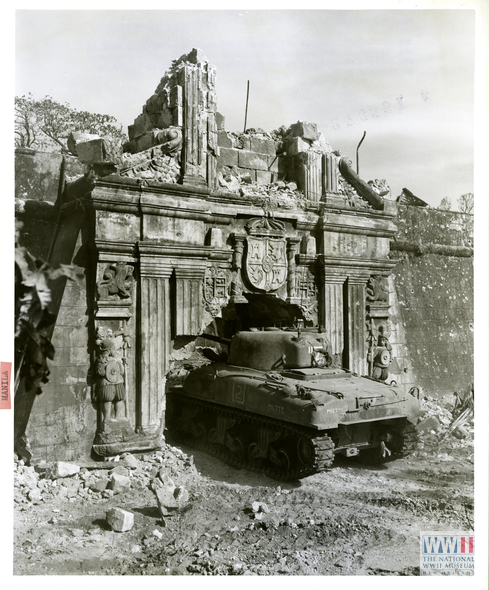
Manila and WWII.
The city was centered at a tribituary of the Pasig river. The Kingdom of Maynila was centered here and was a wealthy trading port for China and the rest of SEA hundreds of years before the Spanish arived.
Over the centuries Manila became a melting pot. First through the Chinese traders who settled a city called Tondo north of the river's mouth. Then by the Spanish who established Intramurous, a walled city south of the rivers mouth. And then by America who established it's own "city" around Intramurous. It was a mix of centuries old Chinese, Spanish and American art deco architecture. It was famously called the Pearl of the Orient before WWII.
Then the Battle of Manila occured. The Japanese refused to surrender and Manila was destroyed by American bombing. It was one of most devastated cities in WWII. Intramurous after. Here's a nice image that sums it up. A tank going through the the walls of Intramurous (the Japanese HQ located in Itramurous).
Intramourus is still there and is a national monument. Manila has somewhat recovered, there's definetly a larger population, it didn't die but has lost most of its cultural and spiritual heritage. Today Manila is now composed of slums, a tourist area, chinatown (Tondo/Binondo), red light districts, and run down buildings from Americas post war rehabilitation.
After the war people began to shift to outside Manila to what is now called Metro Manila. The seat of the philippine government moved from Intramurous to just NE of Manilas border. The financial district centered around the city of Tondo moved SE to oustide of Manilas borders (Makati). Most of the infrastructure development of modern skyscrappers, highways and malls went to these areas instead of the old Manila.
the population of Venice has declined quite a lot. http://www.venipedia.org/wiki/index.php?title=Demographics
Scranton, pa had over 140,000 residents at one point close to 100 years ago. They're under 75,000 now. The boom was started from anthracite coal, and continued to expand due to the railroad, mining, and textiles. Once these industries died so did the people moving here.
Varosha, Famagusta in Cyprus
Prior to the Turkish invasion of Cyprus in 1974, it was the modern tourist area of Famagusta. Its inhabitants fled during the invasion, when it came under Turkish control, and it has remained abandoned and under the occupation of Turkish military ever since. Entry is forbidden to the public.
I wish someone more knowledgeable could make a comment about Buenos Aires. My understanding is that it was one of the most important cities in South America at the beginning of the 20th century and, while today it's still important, when I visited the extent of the urban decay made me think it had seen much better times.
Damascus and Aleppo were once large, culturally rich cities with larger populations. War... War never changes.
I think that Iquitos, Peru would probably meet these criteria. It was one of the most populated cities in peru with a booming rubber trade and river port. But after the export of rubber seeds to places like the British colony of Malaya the rubber boom collapsed and the city has never quite recovered.
On Bell Island in Newfoundland's Conception Bay, there was a thriving iron ore mine for much of the 20th century. The main town, Wabana, had over 8,000 residents in 1961.
The mine closed in 1966, and pretty much everyone moved away. It's down to just over 2,000 people, most of whom take the ferry and commute to St. John's.
In Nova Scotia, Industrial Cape Breton - Sydney and the surrounding communities - has declined dramatically thanks to the closure of the coal mines and steel mill (the latter leaving one of Canada's most toxic cleanup sites). Even the rail link between Sydney and mainland Nova Scotia closed late last year.
Clevelander here, the population has fallen from 914,000 in the 1950's, to 505,000 in the 1990's, to 390,000 today