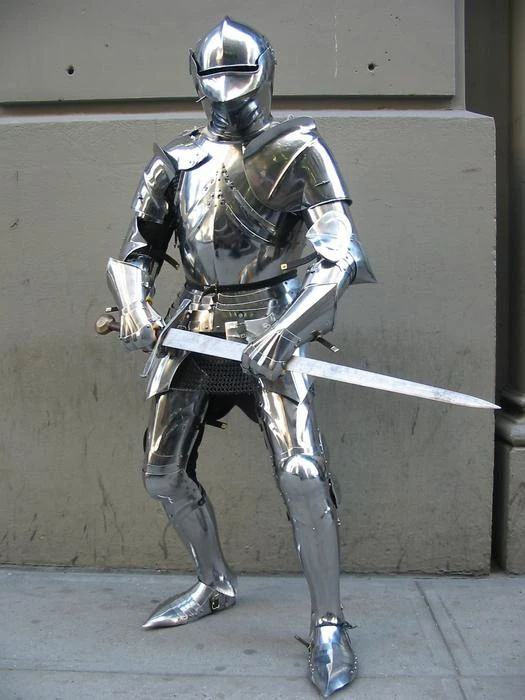
If you've seen any kind of pictures of both stereotypical European armour and Japanese armour you may have wondered essentially why Japanese armour just looks so light compared to European armour. They weren't significantly lighter, but in it you can see the main differences.
The limb protection mainly consisted of shin guards, greaves, and sleeves, but unlike European smiths who generally preferred creating these from sheets of metal, the Japanese used lamellar armour, a large number of small metal plates/scales laced together, or scale armour, many small metal plates sewn onto a backing of cloth.
Fun fact that's sort of related to this - the studded armour - (video here) that you normally see are generally plates of metal bolted on to a cloth backing, rather than actual metal studs fixed to the plate.
Reasons for a generally lighter armour could be the need for an all-weather type armour, where the user could stay comfortable in both the hot summers and cold winters of Japan whilst avoiding, as best they could, the onset of rust during humid periods.
Japanese iron was sourced from deposits of iron sand found primarily in riverbeds, however the resulting iron metal was of significantly worse quality in comparison to European iron. Consequentially, both armour and weapons were shaped by the materials and resultant smithing techniques adapted to work with lower quality metals.
Their armour was more to deal with arrows loosed from bows and spears, and later on against musket balls, whereas European armour was developed with the increasing need to provide full body protection. Weapons in both regions were developed alongside armour - in the West, heavy weapons were used due to the fact that the force of the blow from any one of those weapons would be more than sufficient to cause damage and crush the armour, rather than pierce it.
In Japan, there has been little to no evidence of mass use of those weapons, and so the armour developed was much lighter. It's worth noting that, upon contact with the west and the advent and adoption of firearms, smiths developed armour to better stop musket balls. A good idea of how this was implemented is seen in nanban gusoku, where you can see how a combination of the strong metal plate seen in Western armour is integrated with more traditional style armouring in the limb guards.
However, there are no accounts of European armour or Japanese armour faring better than each other, as both regions never truly met until the age of firearms and mass use of gunpowder weaponry.
Sources:
Arms and Armor of the Samurai - The History of Weaponry in Ancient Japan - Bottomley, I.
The Samurai - A Military History - Turnbull, S.