I know that Romans used Aquilas in the legions, but from what I've read there was never any reference to flying any flags, red or otherwise. From where does the notion that Rome had a flag, is it any way historically accurate, and why is it always red?
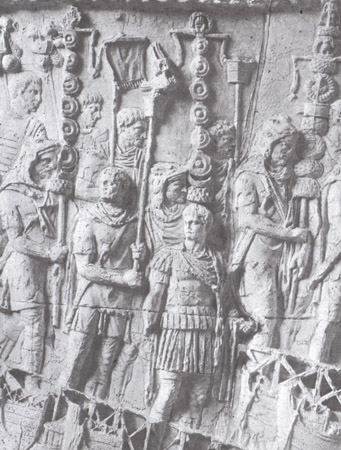
I can't say I know where the red comes from, but the little flaggy things on the standards are pretty well-attested in visual representations of the standards. Most famously, Trajan's column quite clearly depicts little square flags flying beneath standards of different kinds. It does not, however, show the eagles as having these little flaggies--see the aquilifer in the middle (he's actually in the previous picture too, again without a little flag, but his eagle's been eroded a bit and it's hard to see)? But Trajan's column isn't all that reliable as a historical source--there's a lot of stuff on it that's been idealized or clearly changed for the purposes of artistic rendition. But there are other sources for the use of flags on the standards as well--they're pretty common actually, as far as visual representations go. Sulpicius Celsus' famous tomb shows an eagle whose...pole? I dunno what you call the shaft of a standard...looks remarkably different from what's shown on Trajan's column. And there's a little square flag sitting beside it, all by itself! What are we to make of that? Some of the earliest representations of standards show them--this Parthian is returning the standards of Crassus' Carrhae legions. See the flaggy? Now, that's not necessarily an eagle (although it almost certainly is, that the eagles in particular were recovered was the whole big deal), since we can't actually see the top of it, but it clearly shows that standards could have those things. But wait...here's a coin of Germanicus that distinctly shows an eagle without one of those things, like what Trajan's column shows. This is one of the recovered Varan standards, so maybe the Germans removed the flag, or it was lost in battle or at some point, but that doesn't seem like a good explanation. So what the hell are we supposed to make of this? I dunno, I'm not a military historian and I certainly don't spend much time figuring out equipment and stuff, but it's clear that at the very least some standards could feature these little flaggies, and that maybe they were used on the eagles, at least at some point--if any of these artistic depictions, and the countless others that show eagles, are in any way faithful, the design of the eagles and their standards must've changed quite a lot during the history of the Roman army (as might be expected--they were using these things for centuries!)
EDIT: I forgot to mention that one of the words for the standards, vexillum, literally means "little sail," and is the word for a flag. The other word for the standards is to call them the signa, but that just sort of means standards in general. The vexilla are always specific types of standards, those that have flags or might be expected to--thr eagles are among these (see the quotation from Tacitus that I provided for another user who asked a question in this thread--Tacitus is obviously taking about the eagle, especially when he says that the Twentieth stormed Germanicus' house looking for one, since he uses the singular, which can only mean the eagle). Why red is always used I'm not sure--there is one surviving example of a vexillum, from the Third Century. It's red, with a picture on it, but it's also rather late, and from a period of intense social, domestic, and military turmoil, so it's hard to say whether it's really representative of much of anything
Could I ask a follow on question?
I have heard about the sacred eagles belonging to a legion, for example those lost by Publius Quinctilius Varus at the Battle of the Teutoburg Forest.
Were these eagles The ones that are usually represented at the top of the legion standards (as per the link in /u/nofreakingusernames comment), or something different?
EDIT: The article mentions the loss of the Eagle Standard which suggests they are one and the same, but Robert Graves' I, Claudius describes them as something kept in a shrine. Can any clarify, please?
You might also want to ask in /r/vexillogy