When you think of European kings, you imagine them wearing the finest clothes, ceremonial armor and jewel encrusted crowns.
What did the Caliphs wear? More specifically, the Caliphs of the Ummayyads and Abbasids? I dont think I've ever seen a crown or armor. There's also not a lot of art depicting them.
They were powerful rulers and the successor to Muhammad so you'd figure they would dress lavishly. Am I wrong?
TL;DR-- early Umayyad caliphs probably had long beards, wore purple dyed silk robes, and carried ornamented swords around their shoulder.
A less than satisfying amount of evidence survives of Umayyad court culture. This is especially problematic in terms of recreating the appearance of the caliph, who was not widely depicted in art due to Islam's condemnation of figural representation. Of the architecture, mosaics, coinage, and sculpture that have been unearthed in the Middle East, it's clear that whatever court culture that did emerge shortly after the Muslim conquests of the mid 7th century drew heavily on the fashion and trends exhibited at the Byzantine and Sassanid imperial courts.
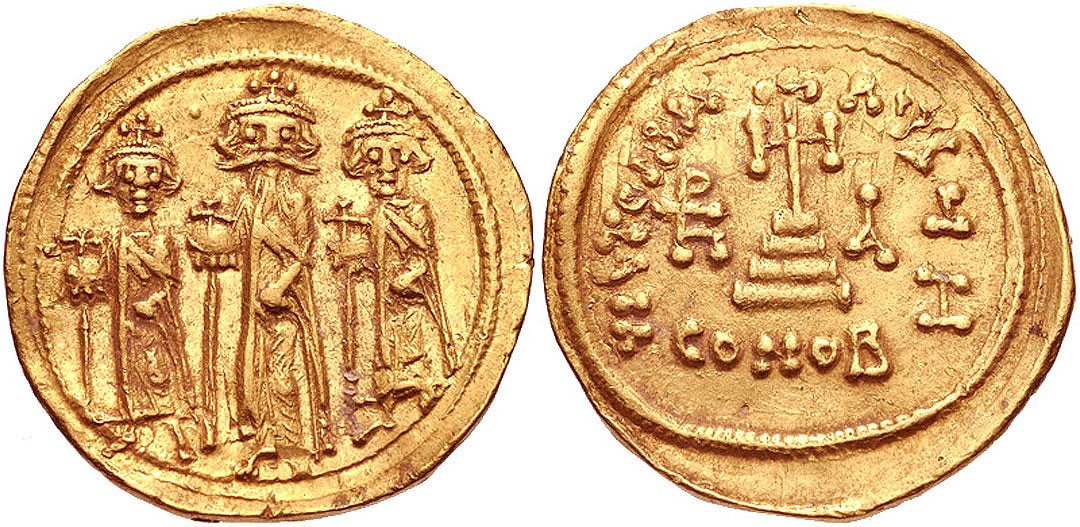
Two surviving portraits of early 8th century Umayyad caliphs exist, and it's clear from this imperial portraiture (at least in how they were depicted) that they emulated the more powerful and distinct imperial courts at Constantinople and Ctesiphon. There is even pseudo-Byzantine coinage that was minted by the caliph and the Umayyad nobility in the Levant (i.e. modern day Jordan, Syria, Lebanon, and Israel).
Since the Umayyad caliph was highly influenced by the material culture of the Byzantine Empire and was ruling over a population that until a century earlier had been under the rule of Christian Byzantines, he adapted his dress accordingly.
This Umayyad dinar of the caliph 'Abd al-Malik, minted in 695 AD, shows a formidable standing warrior wearing silk robes and a flowing beard, grasping the hilt of his ornately decorated sword. This portrait is obviously very similar to the imperial iconography of other 7th century emperors in the Levant, Phocas and Heraclius.
The earliest surviving statue of a caliph was found outside the baths of the Umayyad palace Khirbat al-Mafjar in Jordan, and is now on display at the Rockefeller Museum in Jerusalem. It may depict the caliph Walid II shortly before his reign in the 740s AD, since he is associated with the newly constructed palace complex. We essentially see the image of the pseudo-Byzantine emperor transposed onto an architectural context. He is wearing a long beard, curled hair behind his ears, perhaps some sort of headdress, a dyed silk robe with non-figural patterns (no doubt Byzantine), dyed slippers, and with his hand on an ornate sword sheath.
These two depictions are almost pseudo-Byzantine or pseudo-Sassanid, so it's dubious how accurately they depict late 7th/early 8th century AD fashion at the imperial court of Umayyad caliphs. Let me know if you have any questions!