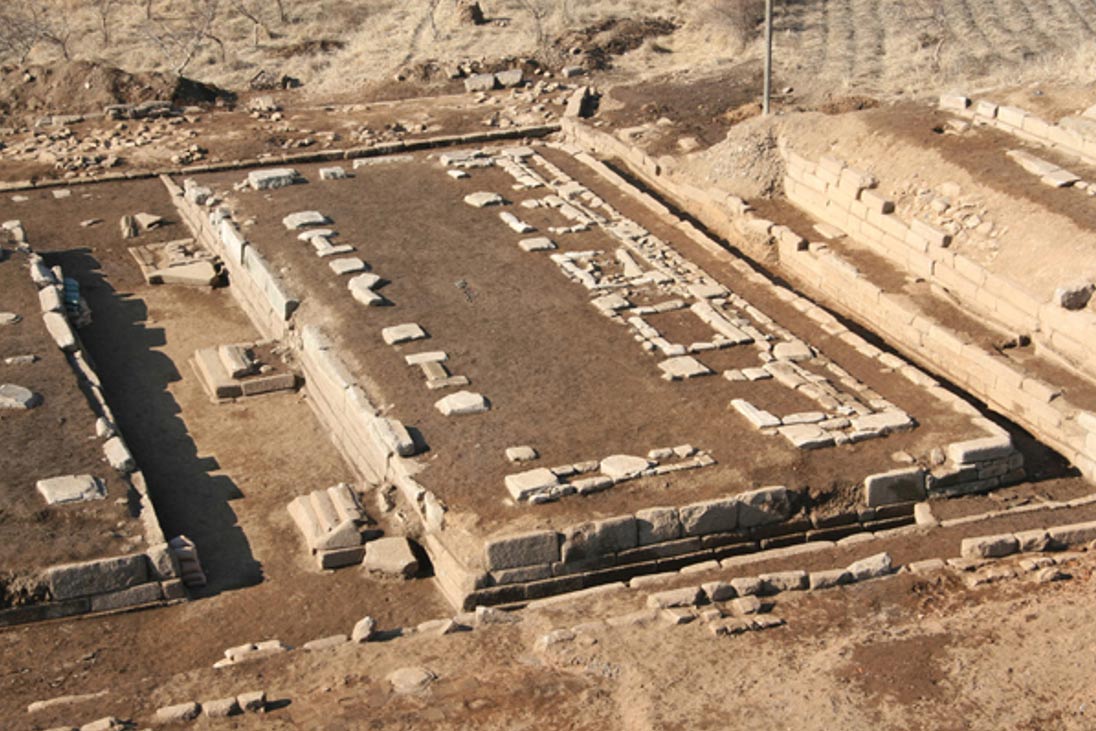
Hmmm. This is a really interesting question, but just to clarify -- what kind of historical site are you most interested in?
There's some overlap between the two, but a sizable percentage of what the government peddles as "historical sites" are what historians consider propaganda rather than history.
For example, Kim il-Sung's purported guerrilla camp on Mount Paektu is one of North Korea's holiest places. The Great Leader and Eternal President supposedly launched brilliant attacks against Japanese imperial forces from this camp, and his son, Kim Jong-il, the Dear Leader, was born there. Consequently the camp is the object of pilgrimage for the North Korean population even though the whole thing's fake from top to bottom. Kim il-Sung fought against Japanese forces as part of a Chinese-led army in Jiandao province (northeastern China), and then sat out World War II in a Soviet army camp in Khabarovsk. Jong-il was born there and not in Korea at all. Kim il-Sung didn't set foot back in Korea until September 1945.
So at face value, that "camp" has no historical significance at all. However, it's an excellent example of the lengths to which the regime went to construct a false history of Kim il-Sung's life in service to his personality cult, and how Jong-il was inserted into it when he was named heir apparent. That gave the regime the legitimacy it needed to control the country. Even when the government wasn't outright making stuff up, it had no problems using history and archaeology to its benefit by "discovering" ancient sites in oddly convenient places. Bolstering the country's claims of descent from a great civilization was largely in service to internal propaganda needs.
Are you more interested in genuine historical sites within North Korea (e.g., the Goguryeo tomb sites, Kaesong city walls), the regime's "historical" sites, or both?
Alright. There are far too many to list, but here's a short list:
North Korea has two UNESCO World Heritage Sites.
There are also many that are not World Heritage Sites but should still be mentioned.
There are lots of other sites scattered throughout the country, like in the south. But I'm guessing there aren't a lot of Daoist sites, because Daoism never really had much of a presence in the peninsula compared to Buddhism or Confucianism.
^1 A copy of the monk's portrait where he wrote his last lines at the age of eighty is displayed in the Geumgang Grotto; the poem starts with
八十年前渠是我
八十年後我是渠
Eighty years ago this was me,
Eighty years later I am this.
What does it mean? Well, I wouldn't know. I'm not a monk.
I hope this is okay; I'm going to try to ping users with relevant flairs. I'm very curious, especially where Daoism in Korea is concerned.
/u/AsiaExpert /u/Cenodoxus /u/DsagjiiggsScjjigsjsb /u/koliano /u/lukeweiss /u/MisterMomo /u/thanatos90
I visited North Korea back in 2012. Two places stick out in my mind, I'll include pictures I've taken:
The old town of Kaesong: http://imgur.com/tZFc84A. Many of the houses built here date back to the Joseon dynasty (which was from 1392-1897). The large building you see is a Children's Palace, iirc.
Pohyonsa. http://imgur.com/HMDgsOY http://imgur.com/6X1UaCq Located on Mount Myohyang, this is a temple complex with over a thousand years of history, unfortunately American forces bombed and destroyed over half of the buildings in 1951. That green temple I wish I knew more about, because I have traveled all over Asia and have never seen a building like that, and in green.
In the town of Sinchon there is a war museum. Sinchon was the place of a massacre during world war two. The site includes a burial mound/monument and some of the bunkers where people were herded into. The place is seen as a major historical site in the country.
To add on to this question:
Are there any historical sites (castles, monuments) left from the 3 Kingdoms period and Goryeo? What about military fortifications from Chosun designed to keep the Jurchen out?