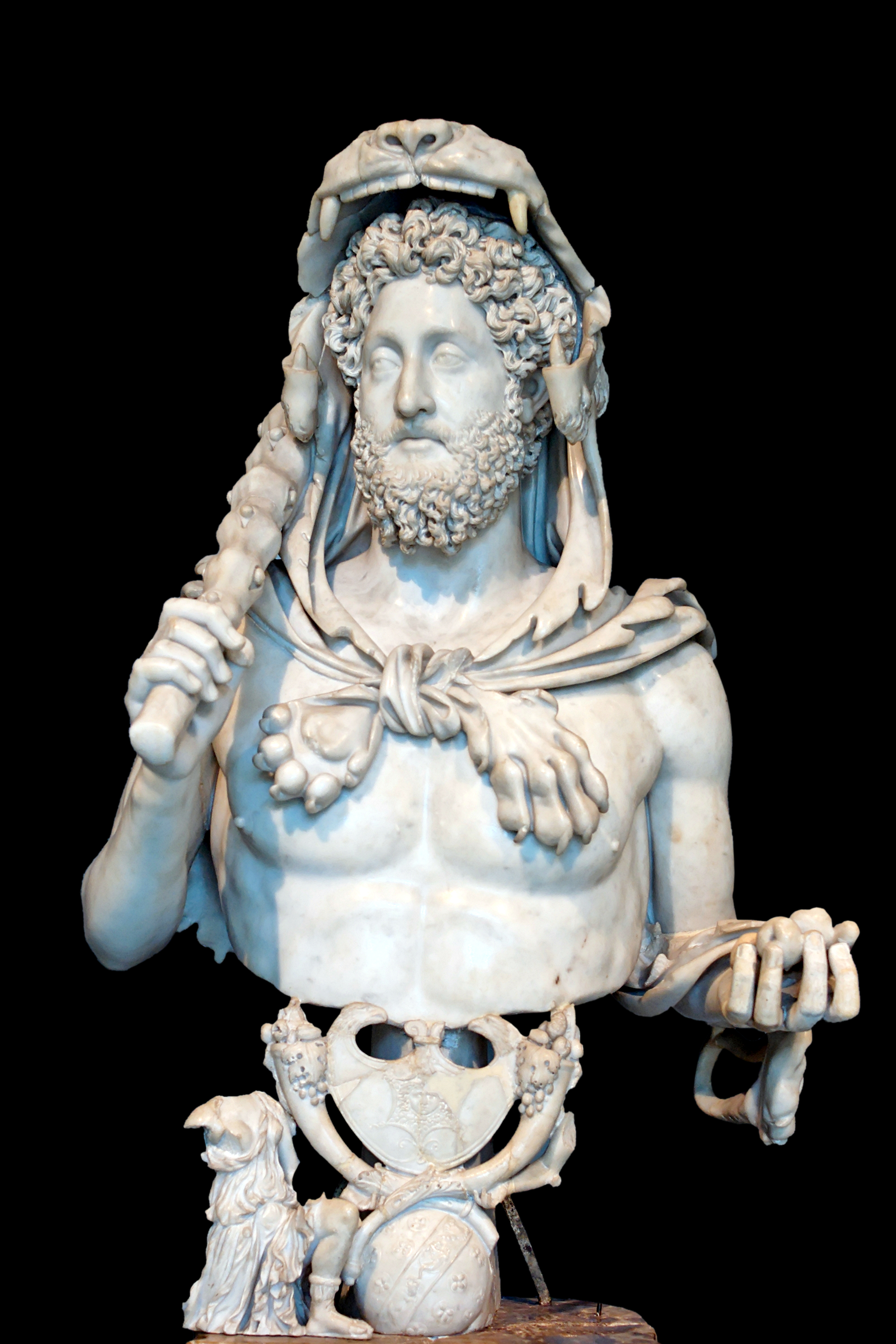
His Wikipedia page mentions:
Often, wounded soldiers and amputees would be placed in the arena for Commodus to slay with a sword.
Is there any particular reason why Commodus murdered veterans or was he simply an unchecked megalomaniac? Did the average Roman consider this a travesty or just a regular part of their culture? And lastly, did powerful Romans in positions of authority condone or frown upon this practice?
I don’t know the source of this idea that they were disabled veterans. We have this from Cassius Dio (73.20.2-3):
But of the populace in general, many did not enter the amphitheatre at all, and others departed after merely glancing inside, partly from shame at what was going on, partly also from fear, inasmuch as a report spread abroad that he would want to shoot a few of the spectators in imitation of Hercules and the Stymphalian birds. And this story was believed, too, because he had once got together all the men in the city who had lost their feet as the result of disease or some accident, and then, after fastening about their knees some likenesses of serpents' bodies, and giving them sponges to throw instead of stones, had killed them with blows of a club, pretending that they were giants.
What Commodus was supposedly doing was re-enacting some of the myths of his hero Heracles. I’m not exactly sure which myth the disabled people represented. Perhaps it is a combination of several. I know the centaurs threw rocks at Heracles, and perhaps the serpents’ bodies refer to the Hydra or maybe even the snake he was said to have strangled in his crib. Heracles had many adventures with giants, such as Geryon and Antaeus.
Cassius Dio saw Commodus fight as a gladiator and wrote about it. However, this episode with the amputees seems to be something which he didn’t personally witness. Occasionally Cassius Dio will promise that something he writes is true, implying that there were many rumours about Commodus’ shenanigans. Cassius Dio fairly obviously hates Commodus, so he should not be seen as an impartial historian. So it is conceivable that this story isn’t true, but it seems to fit with what we know of Commodus’ personality and behaviour.
Edit: And according to Cassius Dio the Romans were horrified at Commodus' behaviour, which was unbecoming an emperor. They thought he was a fool. At one point Commodus cut the head off an ostrich and waved it at the senators, implying he would kill them too. It was such a ludicrous performance that Cassius Dio told his companions to chew on laurel leaves so the emperor wouldn't notice they were laughing uncontrollably at him.
Hey! Just thought I'd clear some things up, since there are some threads to disentangle here to understand the why - /u/BaffledPlato is mostly right, but I thought I'd clear a few things up.
Is there any particular reason why Commodus murdered veterans or was he simply an unchecked megalomaniac?
The source for this, as for most things of Commodus, is Cassius Dio - which is a bit problematic, but more on that later. Now, to understand why he might have done this, we need the whole context:
After he had once assembled all the men in the city who had lost their feet as the result of a disease or some accident, he then, after fastening about their knees some likenesses of serpents, and giving them some sponges to throw instead of stones, had killed them with blows from a club, pretending that they were giants. [Dio LXXIII.20, 3]
The Giant is a common adversary of gods and demi-gods in Graeco-Roman mythology, and, iconologically, a Giant is represented as a human with snakes for feet. Here is an example from the frieze of the Pergamon-Altar. Mythologically, Heracles (Latin: Hercules) fought with the Giants along the other gods, and saved Olymp - and symbolically also the cosmic order - from their attack.
Why is this important? Because Hercules was a big part of Commodus' ideological programme. This is probably the best known bust of Commodus, which displays him with all the important attributes of Hercules: The Lion's pelt, which he won from fighting the Nemean lion, his club, and the golden Apples of the Hesperides in his left palm. There are also the two cornucopiae, symbolizing peace and riches from his reign; the kneeling Amazons and the Amazonean shield are also important in that context, strengthening the link to Hercules and his conquering aspect (Commodus was also sometimes adressed as 'Amazonius'). Symbolically slaying the Giants not only associates him with Hercules, but it also symbolizes saving the cosmic order, and bringing (paradoxically, one might say) peace, stability and plenty through conquering in the Arena. Hekster makes the point in his Commodus-biography that fighting in the Arena meant more: much as the Gladiators conquered death by fighting in the Arena, Commodus' fighting in the Arena as a Gladiator challenged death - he even made the senators come garbed as if to mourn a dead emperor, and symbolically had his helmet carried out through the gate by which dead gladiators were carried out. So in still fighting, he conquered death, as Hercules did.
Fighting in the Arena carried with it a social stigma, which may have antagonized the senatorial class, but it was not unheard of at times for equestrians, senators or even emperors. Caligula fought in the arena, and Hadrian and Lucius Verus trained as gladiators. And even though they were 'infamous', they could become the darlings of the people, gaining immense popularity among the plebs, being a successful Gladiator, beyond martial acclaim, also brought sex-appeal. It is certainly a paradoxical attraction, which the ancient authors already remarked on. The public gatherings in the Colosseum were massive, and gaining the support of the people there was not something to be trifled with.
As Hekster sums it up: "Both those fighting in the arena and Hercules fought to protect the order of society agains the chaos of nature and barbarism, very much as an emperor defended his realm against the chaos from without. They were the perfect symbols for a ruler who wanted to show his power to his subjects, who tried to rule by general acclamation rather than trying to persuade traditional institutions like the senate of the legitimacy of his reign." [Hekster, Commodus, 154] This last part is important: Even if we think of the emperor as all-powerful, he was not an absolutist monarch. Consent of the senate was something that was traditionally very important to Rome, and crucially important to the self-consciousness of the senatorial class. What Commodus did was essentially to subvert this. In his later years, while the Senators still received the traditional honorific positions, such as supreme priest, but his protegés Cleander and Perennis, lowborn people, were granted the offices of praetorian prefect and cubicularius, essentially the closest advisors to the emperor and his right and left hand. This did not sit well with the senatorial aristocracy.
Commodus was the first son born to a reigning emperor, 'born in the purple', as they say, after a period of adoptive emperors. He tried out his full powers against the Senate - a conflict that would end with his assassination. We have to see Cassius Dios text in this perspective. He had a clear agenda to paint the emperor, and his actions towards the senate in a very negative light,
While I'm personally a bit sceptical towards this particular episode, because it seems a bit over the top (how would that look in practice? a cripple with some stuff tied to his stumps is not a very intimidating foe, and I suspect such a spectacle would have looked rather ridiculous), I'm not enough of an expert on this to say whether it was likely true or not, but it certainly fits the picture Cassius Dio wanted his readers to have of Commodus - a bloodthirsty lunatic. It's not too much to say that he has succeeded, regardless of whether this captured the true nature of the emperor, or not.