Was it out of boredom? Smiled upon by officers for its morale implications? Really meant to send a messge? And was it limited to the US and Britain? Are there Soviet/German examples?
I don't know much about the American context, but I know a bit about Canadians within the British Air Force.
Nose Art was generally frowned upon in the RAF at the beginning of the war, but it began to be more widely practised and allowed by high command during the Battle of Britain. With a poor return rate for most crews - which everyone realized - nose art was seen as a valuable tool for improving morale. They authorized but regulated it, allowing art to appear on plane fuselages (hence why its mostly nose art and not.. wing art). Canadians were originally only allowed maple leafs or "Canada" markings, but eventually as more Canadians became involved in the air war these regulations also fell by the wayside. It originally began fairly small, but as the war continued (and perhaps its pilots became a bit more certain of victory) these pieces grew in size and complexity.
While a lot of nose art was just of a pretty girl or for luck, most of it had special meaning for the nose crew. Nose Art was often commissioned by the crew, and there were several very popular artists. For Canadian crews, Matthew Ferguson was one of the most popular artists. Over the course of the war, a policy of Canadianization grouped Canadian crews together. Along the way, these crews developed their own uniquely Canadian nose art, a process likely mirrored among other nationalities but I am not as certain. A lot of Canadian Nose art reflected bonds of national identity, or regional identity. A sponsorship campaign took place back home in Canada during the war, and cities would sponsor an air crew. In return, the air crew often emblazoned their craft with something relating to the city. Most popular was usually something risqué or Walt Disney cartoons. You can see some examples here.
So, in short, it was mostly a morale thing - either representing something "lucky" or a connection to home. I know nose art was popular in British and American air forces, but I have no idea about Soviet and German.
Follow up: Were there distinct styles or "movements" in nose art? Were any crews well known for their art and copied?
Nose art on aircraft predates WW2. WW1 aircraft had some amazing examples of skulls and monsters painted on them (http://on-the-step.com/wp-content/uploads/2012/11/Nose-Art-Farman-F40.jpg). Pilots have always enjoyed customising their planes as far as regulation would allow.
So this comes from a personal story, but luckily the guy who told me also wrote a book about it; "Screwball Express, A meaningful Tribute to the 8th Air Force, the 379th Bomb Group & the Screwball Express".
According to Mr. Cassens, who flew over 200 hours as the original bombardier, all the crews had nicknames and personalities for their planes, but it was the ground crews who took the most delight in decorating the plane. Mr. Cassens felt like the plane was "better than that" (he spoke very fondly of the plane as a "machine" and would wax poetic about the mechanical marvels of it), but it seemed to be a useful morale tool for the ground and air crew to bond over. Probably helped the ground guys feel more a part of the plane as well.
As I remember it, "Scewball Express" was a reference to the baseball pitch; he dropped bombs like screwballs around the German defenses.
The book is short, but a good read. His last mission reads like something right out of a movie.
We were extremely thankful for the very fine landing of Screwball Express at Kimbolton shortly after 1300 hours. I'm certain all of us said a prayer of thanks for being alive. We crawled out of Screwball Express when it came to a stop on the parking pad to survey the damage. Our Flying Fortress was a multitude of holes held together by ragged metal. Gasoline was dripping from holes in a Tokyo tank and from two of four damaged wing tanks. Two oil tanks were also damaged. The wings looked like a pair of sieves. The landing lights were missing from the wings. It was apparent the outboard engine in the right wing would have to be replaced. Our crew members, assisted by our ground crew, counted 287 flak holes in Screwball Express.
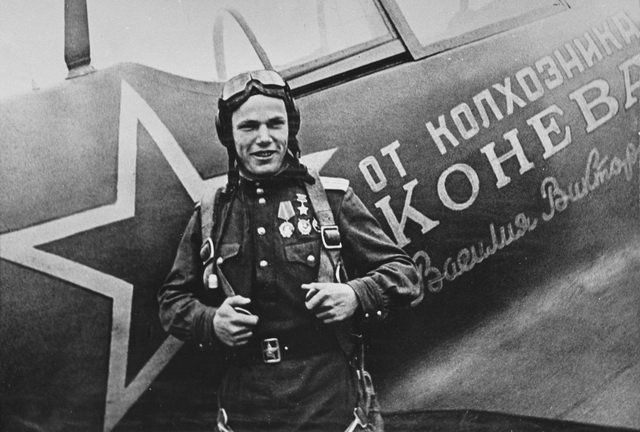
I wouldn't say nose art was popular for the Soviets, but art was normal. Usually writing with either a patriotic saying or something like 'Death to the German Invaders' (that was one of their more famous pilots...Gulayev I think, I'll have to check...) Kill marks were very common, as with the USAF/RAF and Luftwaffe.
Some examples (I'm afraid I don't speak Russian!)
Ivan Kozhedub Mikhail Baranov a few pics here
Theres quite a lot of pictures of Yaks with nose art, but most seem to have been painted up post war rather than during. this Yak 3 seems to be about the most genuine I can find with a quick search.
As for Bombers remember quite a few of the soviet designs had gunnery positions on the nose that had a lot of glass around them - theres not a lot of space for nose art on a TU-2 or Il4