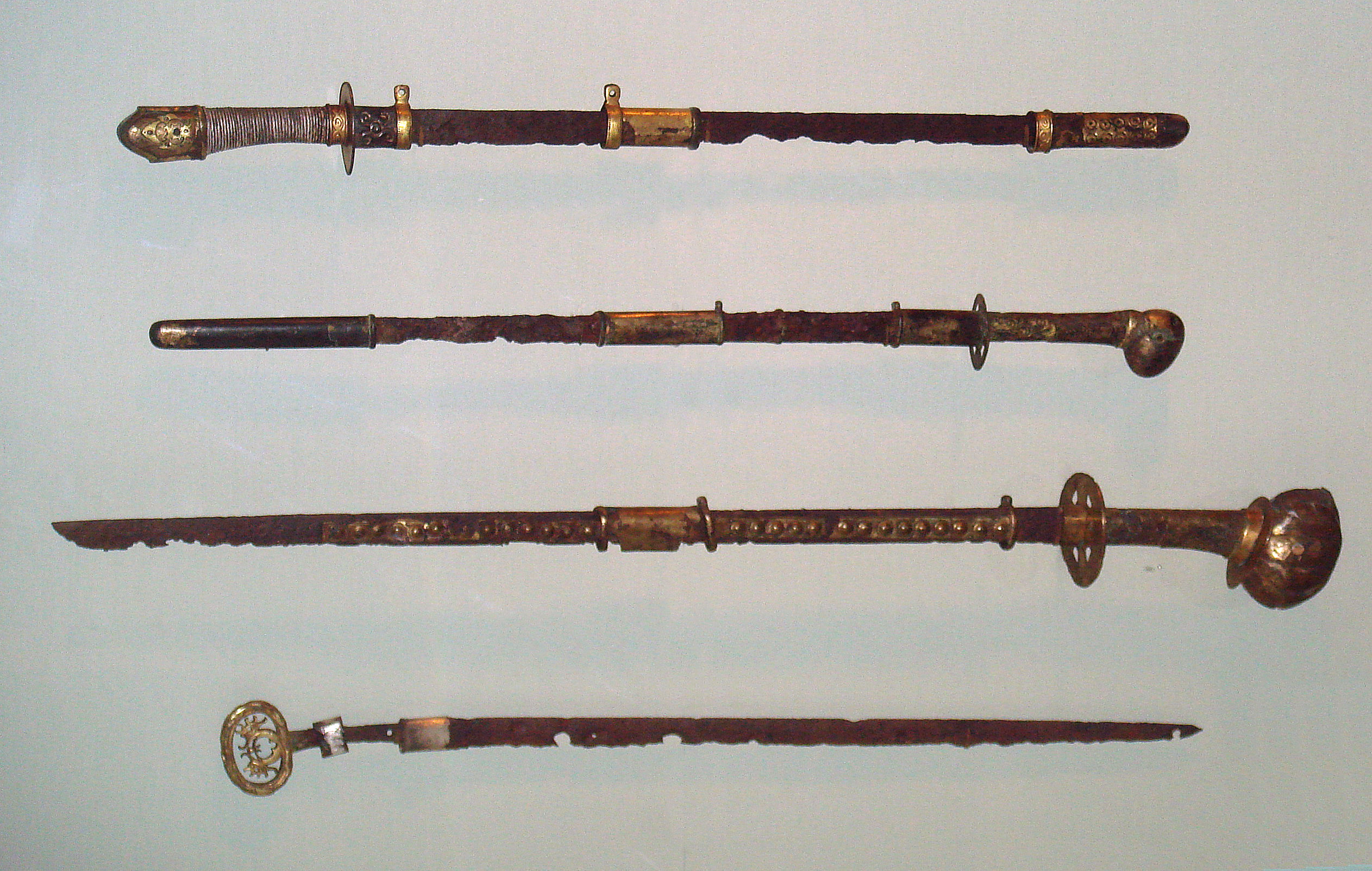
A friend and I have been talking about the samurai and their armour/weapons, and we hit on the point of both their armour and their katanas. Surely, with those large gaps, the armour would have been useless if one were to poke the holes with a katana or spear.
Another question- you see some people claiming that the katana was never really widespread, but if so, what did armies use as weapons? Why did they use those instead of katanas, which are so much more powerful?
The question I want answered is - how did these weapons and armour develop?
Another question- you see some people claiming that the katana was never really widespread, but if so, what did armies use as weapons? Why did they use those instead of katanas, which are so much more powerful?
Katana were widespread. There seems to be some sort of counter-jerk to the idea that the katana was the only weapon used by the Japanese, which has manifested itself in the idea that the katana was rarely ever used by the Japanese. Both are inaccurate.
It is also inaccurate to think that the katana was "so much more powerful" than other weapons used in Japanese armies. It was just one of many such weapons, and like all weapons, it had its uses but was not some sort of all-dominating device.
Speaking of Japanese armies during the Sengoku jidai (often called the Warring States period), so, the 15th and 16th centuries, the most common soldiers in Japanese armies were ashigaru - common foot-soldiers - rather than samurai. The primary weapons of the ashigaru were the spear (yari), bow (yumi), and arquebus (tanegashima) - a matchlock gun. The ratio of soldiers equipped with these three weapons would vary, of course. Armies used in Korea during the [Japanese invasions](https://en.wikipedia.org/wiki/Japanese_invasions_of_Korea_(1592–98%29) often featured a high amount of arquebus-equipped soldiers. In general, the amount of soldiers equipped with guns increased throughout the era.
It should be noted that samurai used all three of those weapons (yes, even guns) as well.
However, the katana was widely worn and used used by samurai and ashigaru as a secondary weapon, similar to how spearmen, archers, and musketeers in Europe at this time would often carry various sorts of European swords as sidearms.
As a side note, sometimes I've heard people claim that samurai were actually only really archers - an idea often bandied about as a counterpoint to the "katana was all that mattered" idea. This really isn't accurate, though - at least, not for all of Japanese history. Japanese armies did not remain unchanged throughout the centuries, after all. The idea that samurai were primarily archers is more accurate to the Kamakura and early Muromachi periods, but it isn't true for the Sengoku period. Of course, the bow still remained a highly esteemed weapon.
So, the katana was far from the only weapon, or the most powerful one, but it was also far from being some sort of rare device only owned by a select few.
/u/bigbluepanda covered Japanese armour (a subject I'm not that well-versed in) well.
Source: "Ashigaru 1467-1649" by Stephen Turnbull.
A large topic, though I've tried my best to cover everything.
Katana
The common curved blade katana you will see in movies/art today are produced through a method of primarily folding and differentially heating layers of steel – these katana were first really seen during the end of the Heian period or start of the Kamakura. I could expand on the actual method of creating these blades, but for now just understand that through differential heating, the blade was able to retain a sharp edge whilst being flexible enough to not break on impact. The steel itself, through the differential heating, formed two materials of different densities (due to the speed of the cooling), giving the blade its famous curve and hamon, the wavy bit you see in the middle of the blade. Bear in mind that this broad technique of quenching the steel at different speeds was not invented and used for the first time by Japanese swordsmiths – it has been seen elsewhere in the world, notably in Damascus/wootz steel.
The earlier, pre-Kamakura period swords were called chokuto, and were straight, one-handed swords, however it was soon discovered that blades with a curve were faster to be drawn, and when slicing or slashing, especially from horseback, and so new swords were designed to incorporate a larger angle of curvature in the blade. These pre-katana-esque swords however proved to be rather brittle, demonstrated first in the Mongol invasions of Japan. The Japanese found out that more often than not they would have to dismount and resort to melee than to use arrows, however due to the earlier techniques of swordsmithing (remember the different types of steel in the blade), the wider overall blade of the pre-katanas chipped soon after bashing on armour. I can’t seem to find a decent picture anywhere, however it’s important to know that the pre-katanas had much wider edges in comparison to their European contemporaries, and so they broke often, and in many places.
To compensate for the fragility, as well as the development of better technologies, smiths and warriors both began to adapt to better use these weapons. They made thinner edges whilst retaining the sharpness and hardness, at the same time maintaining the soft body of the blade to allow it to bend instead of break. From this point onwards (think 13th century onwards), these katanas were essentially the only ‘sword’ that was produced by Japan.
Following the Sengoku Jidai and Tokugawa Ieyasu’s unification of Japan and establishment of the Edo period, swords were more status symbols than anything else (however, it is important to note that swords were still never a staple of the Japanese army or samurai). Increasingly elaborate techniques were used to make the swords beautiful, decorative, but in terms of an actual sword, more useless. This isn’t all due to the fact that the swords were a status symbol – it’s also due to the fact that, throughout most of the Sengoku Jidai, katana weren’t widespread in usage, and following that, there were regulations imposed upon who could own and wield one, as well as the simple fact that for most of the Edo period there were no large-scale wars of the kind seen during the Sengoku period.
However, that being said, during the Tokugawa shogunate (following the Sengoku period), a different type of weapon rose to the forefront – the wakizashi. Think longer than a dagger/dirk, but shorter than a true sword/katana. During the Edo, regulations imposed upon katana meant that, if it ever came to combat, it was too short to be effective against cavalry, and yet in melee the wakizashi was better. The wakizashi thus became the primary self-defense weapon, and the katana essentially made into a decoration, or used in rituals.
And then, the arrival of Matthew Perry and the following Meiji Restoration spelled the end for these swords. Rapid modernisation and Haitorei, or Sword Abolishment Edict, of 1876, essentially created a blanket ban on the wielding of swords in public. Returning to the question on the development of weapons though – swords, katana, whatever, were never widespread in Japanese warfare. Before the Sengoku period, bows were more common, or otherwise the naginata, a large polearm, both of which could be used on horseback. Other swords such as nodachi, large (read: very large) swords were also seen, though were still relegated to specialised units rather than an entire army.
Naginata and various other weapons
The naginata rose to the occasion during the Gempei war of the late 12th century, seen as a good way to knock other riders of horses. During the Sengoku period, these naginata soon became replaced with the yari due to the changing of battlefield tactics, then in the Edo, it was more commonly seen as a woman’s weapon, and finally it fell out, similar to the katana, during the Meiji Restoration. Similarly, larger swords such as the nodachi are pushed into the role of decorations or rituals, rather than actual combat.
Sengoku Era weapons
Now to address the elephant in the room, which I’ve tried to avoid talking too much about so far – the Sengoku era, the Warring States period (not to be confused with the identically named period in China) which lasted throughout most of the 15th and 16th centuries of Japan. This was a time of political upheaval, with daimyo (similar to lords) all around the country vying for supremacy. All sides felt the need to field larger and larger armies, and it came to the point where numbers were better than the quality of warrior (more on this again in relation to firearms).
Ashigaru were conscripted peasants, and received the bare minimum amount of training, handed a yari (spear) or yumi (bow), and packed off to fight. Ashigaru and their weapons and armour were cheap – you didn’t need to spend years to train them to be master sharpshooters, or to best others in duels, you just needed them because the more numbers, the better. Imagine if you were a significantly superior fighter – if you saw hundreds of spears poking out at you, you would never engage them (unless all was lost, however this still supports the point that ashigaru were superior in numbers).
Firearms
However, with the first contact with the West in the form of the Portuguese, the Japanese discovered the true power of gunpowder. Whilst firearms have been said to have reached Japan previously from China, they were never widely used. The matchlock, however, was. The smiths began to develop and adapt the gun, and soon enough daimyo were fielding matchlock ashigaru alongside their armies. So much so that, in 1567, Takeda Shingen, a prominent daimyo of the Sengoku, stated that
Hereafter, the guns will be the most important arms. Therefore decrease the number of spears per unit, and have your most capable men carry guns.
Yet again however, we see during the Edo that firearms, like swords, were reduced in numbers. Like swords, in small numbers they were produced, however unlike swords, their use increased again during the Meiji Restoration and reinstated contact with the West.
Sources, and nice continued reads:
The Connoisseur's Book of Japanese Swords - Nagayama, K.
The Japanese Sword - Sato, K.
Giving up the Gun - Perrin, N. (note: only factual evidence used, not the entire idea of giving up the gun by Japanese society)
Armour - I've wrote a reply similar to your question recently here, however reddit won't let me put in that many characters in one reply so I'll continue it below.
I always wanted to ask one question about Japanese armor: Why Japanese soldiers never used shields?