Throughout history, when not under Poland or Russia, Ukraine was under some form of Turkic tribe. How is it that Ukrainians can be fair (in some parts) if dark traits are more dominant than light ones, and they were under under Turkic tribes and empires for a long time?
Just how prominent is this Turkic influence in Ukraine? They were not completely free from the ottoman empire until after more than 300 years of ruling, and before that Mongolic and other Central Asiatic tribes held large parts of the country under their control.
From a non expert, their folklore, though bright and colorful, bears heavy resemblance to Turkish folklore, as does Serbia, Bulgaria and other remnants of Ottoman conquest.
The Ukraine is very diverse.
Odessa and the Ukrainian South shares a lot with the Balkanese. For instance: "Turk" is an insult. They had a Russian dialect of their own as well with many Greek, Romanian and Turkish words not known elsewhere in Russia or in the Ukraine.
Russia has too been under a "Turkic tribe" i.e. under the Golden Horde which left a major dent in the Russian vocabulary. Ukraine, on the other hand, consists to a large part from what was taken in the meantime by the Lithuanians, so, at least in what's called the standard Ukrainian language, the influence is weaker than in Russian. That's why the standard Russian word for a treasury is the Tatar word "Kazna" whereas the standard Ukrainian word is the Polish "Skarbnica". Patrool in Russian is the Tatar "Karaul". In Ukrainian it's the German word "Varta", though in a dictionary you'll find "Karaul" as well, as it was used in the South Eastern cossack writing such as that of Kotlyarevsky.
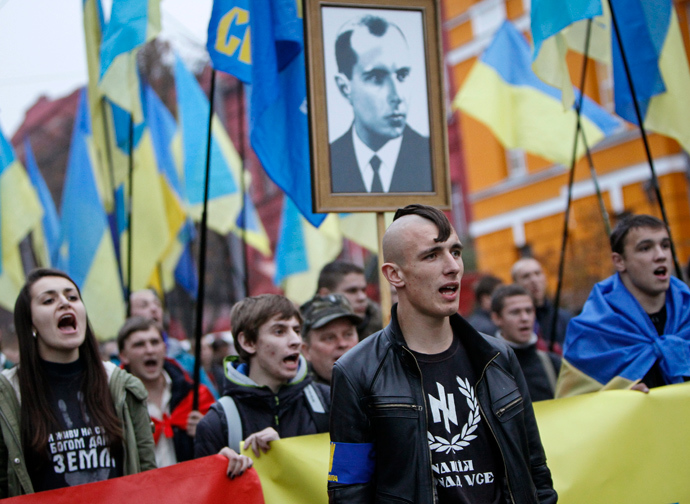
The "Turkic" haircut of the West Ukrainian neonazis has also been inspired by the South-Eastern Zaporogian cossacks. In nationalist narratives Ukrainian statehood is traced back to them which in part is indebted to Romantic nationalism of Gogol in his Taras Bulba and in part to nationalist historians regarding Cossack rebels as Bohdan Chmielnicki and Ivan Mazepa as national heroes. That's why when there is talk of the "Ukrainian" folk dress and dancing (see "hopak" in youtube. Or: "battle hopak") it refers to the South Eastern 18th century style. The other "folk" costumes and dances are refered to by the local ethnonyms - for example "Hutsul" or "Rusyn". Of course it's hard to say whether the Oseledec and the baggy pants are actually Turkic. You had the Sarmatian fashion in Poland for things of that sort and the early medieval duke Sviatoslav was described as sporting a haircut like that with an ear ring in the primary chronicle. So: maybe it's the slavs who have influenced the Tatars and the Turks and not the other way round.
source: Ukrainie is not Russia by Leonid Kuchma.
How is it that Ukrainians can be fair (in some parts) if dark traits are more dominant than light ones
No, it's contrariwise. I think people in most parts look like Germans or Dutch or Poles, in many forest-parts like Swedes. People in the southern part are always tanned.
Zaporozhian Cossacs folklore represents historical period of only a part of Ukraine, a warrior social class existed in the past.
"Reply of the Zaporozhian Cossacks":
"Zaporozhian Cossacks to the Turkish Sultan!
O sultan, Turkish devil and damned devil's kith and kin, secretary to Lucifer himself. What the devil kind of knight are you, that can't slay a hedgehog with your naked arse? The devil excretes, and your army eats. You will not, you son of a bitch, make subjects of Christian sons; we've no fear of your army, by land and by sea we will battle with thee, fuck your mother.
You Babylonian scullion, Macedonian wheelwright, brewer of Jerusalem, goat-fucker of Alexandria, swineherd of Greater and Lesser Egypt, pig of Armenia, Podolian thief, catamite of Tartary, hangman of Kamyanets, and fool of all the world and underworld, an idiot before God, grandson of the Serpent, and the crick in our dick. Pig's snout, mare's arse, slaughterhouse cur, unchristened brow, screw your own mother!
So the Zaporozhians declare, you lowlife. You won't even be herding pigs for the Christians. Now we'll conclude, for we don't know the date and don't own a calendar; the moon's in the sky, the year with the Lord, the day's the same over here as it is over there; for this kiss our arse!"
https://en.wikipedia.org/wiki/Reply_of_the_Zaporozhian_Cossacks