From Collins' History of Kentucky, in the annal section for 1751. It's discussing English relations with the Shawnee on the Ohio:
Wednesday, March 13 - Gist meets two men belonging to Robert Smith, from whom he obtained a jaw tooth, over 4 lbs. weight, which, with other teeth, and several rib bones, 11 feet long, and a skull bone 6 feet across the forehead, and several teeth which he called horns, over 5 feet long, and as much as a man could carry.
Is this a reference to mammoth bones? Or to a fossil? Or is there some other megafauna that I'm missing?
As a follow up, would the English explorers have believed that this creature was still extant, with the bones as evidence?
It certainly sounds like mammoth bones:
Jaw tooth over 4 lb in weight. That fits, elephant molars can weigh up to 5 pounds, mammoth molars would be in the same range depending on the size and maturity of the individual.
Ribs bones 11 feet long. This sounds a bit excessive, but it's possible if you measure along the outer curve of the ribs.
Skull that's 6 feet across at the forehead. This is the most unbelievable part. Mammoth or elephant skulls are large, but not 6 feet wide. Perhaps they were confused by the orientation, and measured length instead of width. Perhaps there were tusks still attached, and they counted width of tusks. Hard to say.
Several teeth which he called horns, over 5 feet long. That sounds very much like tusks.
Couple things to note. There were many animals with similar skeletal structure in the Americas - several species of mammoth, mastodons, gompotheres. It could have been any of them. The largest among them have been certain species of mammoths - for example, M. columbi, but I'm not sure they had a 6 foot wide skull either.
Second, there's the question of whether a European of the time would have recognized mammoth bones (or mistaken them as elephant bones, if he were familiar with them). Elephants were once native to Europe, but that was a very long time ago. Through the middle ages they were exotic animals who were occasionally given as gifts to kings and emperors. But that doesn't mean average people saw them or knew anything about their skeletal structure.
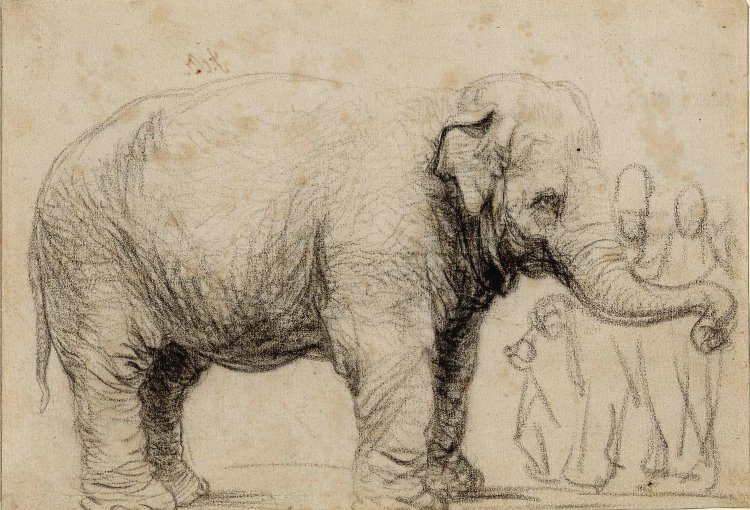
In the 1630's the public was introduced to elephants, though Hansken, a female Asian elephant from Ceylon, who was taken on tours through Europe, including Rome and Holland and shown to the public. Rembrandt did a sketch of her when he saw her in Amsterdam. But there's no way to know if the the person mentioned in your account had heard of her or seen pictures. And he probably wouldn't be able to recognize one from the skeleton anyway. Female Asian elephants usually have no tusks (Hansken didn't either), so even the most distinctive part of the skeleton may have been unknown to him.