Reading about it, it seems like there are conflicting reports about how much help the Rosenbergs actually were. Did they help the Soviet program, or was Julius' data useless?
It's hard to quantify the 'value' of the intelligence passed by any single agent, partly because we don't generally have a full accounting of what information they supplied. The Rosenberg ring certainly supplied much useful intelligence to the Soviets; some portion of that related to the Manhattan Project. But the story of the atom spies is really one of many agents all providing little pieces of the puzzle; certainly, covert intelligence gathering played a role in allowing the Soviets to achieve nuclear capabilities by 1949, but it's difficult to accurately apportion responsibility for that success to individual agents (or even to estimate how long the Soviet bomb would have taken without that intelligence.)
As an aside: The particular controversy about the Rosenberg ring, and the main reason I think it lingers in popular memory, is mostly to do with the ambiguity about Ethel Rosenberg's role in espionage, and whether her conviction and execution were legitimate. There's really very little doubt that Julius was a Soviet agent. The Rosenberg trial's role as part of the catalyst for McCarthyism/the Second Red Scare is also significant here.
Anyway: Rosenberg did provide the Soviets with a significant quantity of scientific & technological (S&T) intelligence, thanks to his position as an engineer in the Army Signal Corps laboratory at Fort Monmouth. He's also believed to have recruited several other people connected to varying degrees the US military/industrial/scientific/academic establishments — see Alfred Sarant, William Perl and Joel Barr, among others.
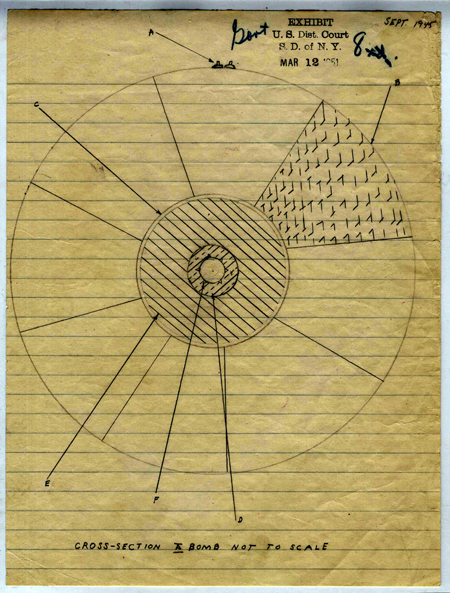
But most of their product was related to non-nuclear military technology; Rosenberg wasn't directly involved in the Manhattan Project; rather, he was a conduit from his brother-in-law, David Greenglass, to the KGB. Greenglass was a sergeant in the US Army, and a machinist at the Los Alamos National Laboratory, the epicentre of US nuclear weapons research, and did provide nuclear intelligence to the KGB.
However, the quality and significance of Greenglass' atomic intelligence is a matter of some debate. He was only one of a substantial network of atom spies operated by the KGB and GRU (Soviet military intelligence) — and was far from the most important. Klaus Fuchs, a physicist who was recruited by the GRU in 1941 while working on the British atomic programme (TUBE ALLOYS) and who transferred to Los Alamos (and KGB control) in 1943, is generally regarded as the most potent of the Soviet atom spies. The young Los Alamos physicist Theodore Hall is also regarded as having been a valuable asset — though he's most remarkable for having been just 19 years old at the time of his recruitment by the KGB.
Christopher Andrew's KGB and The Sword and the Shield offer an excellent overview of the history of Soviet foreign intelligence, and devote significant space to the atom spies, given their position as one of the great Soviet intelligence successes.
It was not considered very important by the people in the US project. The reason is because Greenglass's understanding of the processes was crude and in some ways cobbled together, and because they already knew that every single thing he told the Soviets, another spy, Klaus Fuchs, had already told them. And Fuchs was a very competent physicist with an excellent memory.
The best value of the Rosenberg spy data was that to the Soviets, it helped act as a "check" on Fuchs' data, because the Soviets know better than to trust their own spies (because, as the Germans learned so painfully, you can't always tell if your spy is still working for you). Even so, they didn't trust the spy data absolutely and used it as a "check" against their own scientists — who they did not trust, either. This is what happens when the head of your bomb project is also the head of your spy bureau (Lavrenty Beria).
But don't take my word for it. One of the juicier bits of the recently fully-declassified Oppenheimer security hearing transcripts that had been deleted at the time was from General Groves, head of the US Manhattan Project. He told those at the hearing that:
I think the data that went out in the case of the Rosenbergs was of minor value. I would never say that publicly. Again that is something while it is not secret, I think should be kept very quiet, because irrespective of the value of that in the overall picture, the Rosenbergs deserved to hang, and I would not like to see anything that would make people say General Groves thinks they didn’t do much damage after all.
You can see why they deleted it.
In the 1970s there was an attempt to reopen the case after sealed evidence was released (there was a third defendant, Morton Sobell, who was not executed). Many physicists got on the stand and said, this evidence is junk — what Greenglass gave the Soviets was so crude that it looked like a child could have drawn it, and would not at all be useful in building an actual bomb. The judge said, well, be that as it may, it was a. still highly classified information (so it is still espionage), and b. it still may have helped the Soviets as the aforementioned "check" on the other espionage data, so it is still "important."
But I think there is very little reason to think it materially advanced the Soviet program. Khrushchev later thanked the Rosenbergs in his memoirs for helping the program, but that was probably a way for him to give the US a raspberry and should not be seen as a true technical endorsement.