What sort of tactics and strategem were used during the later years of the saumrai, say, when gunpowder was coming into the scene? Or really, after that? In WWII, most of the "tactics" I hear about are surprise attacks and kamakazi pilots. There has to be more than that, right?
Thanks in advance!
Okay. There are far too many variations in military tactics in post-classical Japan, especially during the Sengoku period, so I'll just list a few more famous formations in battles. A lot of these are explored in Karl Friday's Samurai, Warfare & the State in early medieval Japan and Stephen Turnbull's The Samurai Sourcebook, as of the books I know of none deal exclusively with military formations as you might see in other eras of history.
The 4th Battle of Kawanakajima between daimyos Uesugi Kenshin and Takeda Shingen during the Sengoku period in Japan - Turnbull says that Kenshin used a "wheel" formation, where units that are exhausted are rotated to the back of the 'wheel' and replaced with a fresh unit. He realised that the troops at the front often got tired while the ones at the back waited as lines clashed, so he used this to his advantage. Once the troops in fight were worn out, they would move to the side and down through the ranks as the second unit moved up. Shingen was also known for using several supporting units to weaken the enemy line whilst trying to find a weak spot for his cavalry to pierce, as well as the typical use of mounted soldiers to flank the enemy.
The Ambush of Okehazama saw Oda Nobunaga outnumbered, by around 30 000 to 3 000, with a small force of roughly a thousand or so men in his castle. He raised more banners than what he had whilst also leaving a small garrison within, giving the impression that the castle was well fortified. With the rest of his force, he retreated into the forest and waited until the opposing army came up. When they did, he took them in the rear and caused a mass rout, effectively winning the battle. Nobunaga is also famous for his use of firearms firing in volleys with lines, another example of their effectiveness being attested in the Battle of Nagashino, whereby Nobunaga managed to repel the continual charged by Takeda cavalry.
Another famous one is the Battle of Sekigahara, what many consider to be the beginning of the Tokugawa shogunate. Looking at this picture of the assumed formations in the battle - you can see Tokugawa Ieyasu's formation in red, and Toyotomi Hideyoshi's (he was not present at this battle) coalition of retainers and supporters in light blue, orange, and blue. The light blue and orange armies are deployed in a form known as kakuyoku, or crane's wing - like a wing, the two branches aimed to envelop the front line of Ieyasu's force. Tokugawa's force is assembled in to three separate lines, allowing for the reinforcement of fresh troops whilst concentrating the majority of his forces into a single area.
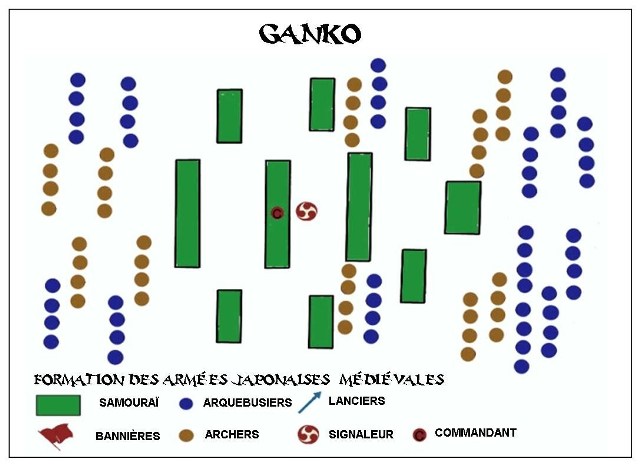
You'll also find other formations, such as the arrowhead (hoshi), with the arquebusiers used to weaken the front line for the samurai to punch through, and the ganko (birds in flight), whereby the arquebusiers and bowmen were used as both a screen and a way to weaken the enemy line, similar to the hoshi formation, and could then be adapted to the situation. Understand as well that these formations were not static, and that commands could be issues throughout a battle calling for the adaptations of formations, to charge, to retreat, as well as various other commands.
After the Sengoku period and the esablishment of the Tokugawa shogunate, Japan fell into a period known as the Edo, approximately 250 years of peace and stability. The shogunate placed restrictions and regulations upon the possession and carrying of weapons, essentially confining the ownership of weapons to nobility. This continued until resumed contact with the West, and the Meiji Restoration. I can't comment on tactics used during this period and the following centuries, though.