My rudimentary knowledge on the subject would probably encourage you to rephrase the question slightly.
For the majority of the historical past, eating out was the purview of the lower classes, and the Roman empire was no exception to this. In larger towns and cities, there would have been a number of places for people to buy and consume food - inns and taverns would have sold meals, along with street sellers and other eating establishments. This complemented a lack of cooking facilities in many insulae, essentially the Roman version of a block of flats/apartments. People would buy pre-prepared food, eating it there or taking it home. Eating out was decidedly more McDonald's than it was Michelin star in the period.
High end dining took place in the homes of the social elite, entertaining each other at dinner parties. So the closest you would find to a fine dining establishment would have been the home of a wealthy individual hosting such an event.
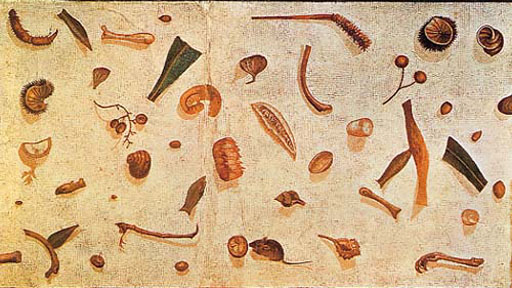
I am not sufficiently qualified to answer on the question of hygiene in the kitchen. However the practice of dropping leftovers, bones, shells and the like directly onto the floor of the dining room (as evidenced by unswept floor mosaics) to be cleaned up later by slaves would probably be an immediate failure, especially considering the mouse visible nibbling away at the bottom.
No historian, but I am a chef, so I feel at least qualified enough to talk on what goes into a health inspection and why I don't think a Roman restaurant at the height of the empire would pass.
Health inspections are actually quite difficult. You will make some violations as the rules can sometimes be a bit silly (it's a violation to have a broom touching the floor, for example). However, those violations aren't enough to get your restaurant shut down, as they're considered non critical. Critical violations are bad, costly, and dangerous. The big ones are hand washing issues, temperature danger zone issues, and cross contamination issues. Those are the three categories I'll focus on, and the focus of why I don't think a restaurant at the height of the Roman Empire could pass a modern health inspection.
First, hand washing. I had an inspector some years ago tell me that if she "Doesn't write at least three hand washing violations, I don'f feel like I'm doing my job." It's not just washing your hands, but when you do it, how often, and why. First, you have to have a designated hand washing station. Can't just be any sink, it has to be a sink specifically for washing hands. It must have paper towels and anti bacterial soap. There must be a finger nail brush, and the water must be able to exceed 160^o The soap and the water temperature are why I don't think a restaurant in the Empire would pass. Also, because I'm tired of constantly writing "A restaurant at the height of the Roman Empire", let's just give our restaurant a name. It's Vesuvius from now on.
So, Vesuvius is required to have proper hand washing stations, and there need to be enough that each sink in the kitchen, dish area, and server station, are easily accessible. It varies from state to state, but in Florida where I live, there must be a sink within 10 feet of each station (saute, grill, fry) in the kitchen. For all intents and purposes, I'm going to assume all the cooks at Vesuvius have their Safe Food Handler cards, so they know the proper procedure for hand washing. However, if Vesuvius can't get the water at each sink hot enough for long enough, they get a critical violation. Also, the anti bacterial soap thing would be tough to come by, so that's now 2 critical violations. That's not good.
Second, the Temperature Danger Zone. Anything that stays in the temperature danger zone, 41^0 - 140^0 for more than 4 hours is considered not safe to eat. This is the temperature at which bacterial growth more than doubles, which means after 4 hours bacteria have bred to unsafe levels. Keeping things above the TDZ at Vesuvius wouldn't be as big of a problem, but at some point in time during the day, the restaurant is going to close down and everyone goes home. That means there is nobody and nothing there to keep the food hot. I don't know much about Roman refrigeration, but I'm assuming that, even if it did exist, it couldn't meet modern standards. A refrigerator is required to stay at a temperature no higher than 40^0 and now lower than 32^0. This isn't difficult to maintain in reach in refrigerators, but in big walk in refrigerators it is pretty hard to keep up. So, the cooks at Vesuvius wrap up their stations, clean up, wipe down, and go home for the night. Now all the food is being held in the TDZ, which means that by morning when the cooks come back, all of it is going to be unsafe to eat. Health inspector sees this and it will likely get Vesuvius shut down on the spot. At the very best it's their 2nd or 3rd critical violation.
The third part is cross contamination, which Vesuvius could do just fine at, assuming the Romans knew anything about cross contamination, but since it's based on Germ Theory which didn't show up until the mid 16th century, I don't think they did. Cross contamination is just what it sounds like. Raw products contacting each other, which could be bad for a myriad of reasons. The biggest watch for, though, is allergens. Say some raw shrimp contact some raw chicken, that chicken is now dangerous to someone who is allergic to shell fish. This applies to how you store things, too, which is why both chicken and shellfish have to be stored on the bottom of the cooler, so they can't contact anything else. Cross contamination also occurs when raw product touches product that is ready to eat, for instance storing raw scallops above a box of lettuce (as one of my cooks did one time because he was a special breed of idiot). With proper knowledge, Vesuvius could pass this part, but because the theories that are incorporated into cross contamination won't really begin until after the fall of the Roman Empire (or, at the very least, during it's decline), it's highly doubtful that anyone there would know enough to prevent things like this from happening.
So, in short, Vesuvius is doomed to be shut down by the health department. And, on that note, I need to get cleaned up and head to work myself. Hope this shed some light on things!
Edit: Lots of positive feedback about this response, and it's the first time I've actually felt qualified enough in this sub to answer anything, so thank you! However, I noticed a lot of you have had some questions, so I'll try and clear things up as best I can. First, I have no idea if the Romans had access to imported ice block or not, and while that may alleviate some problems, ice can't keep large food storage areas cold enough long enough to be effective. I know, because I have had several walk in cooler motors blow out and we had to get hundreds of pounds of ice in there until the motor got fixed (which was normally in the same afternoon).
Several people had asked about the refrigeration issue in regards to all product being fresh every day, as that should alleviate the need to keep it cold. This is not true, so don't attempt it at home. With things that are always stored at room temperature, such as dry pasta, certain vegetables, et cetera, those would be mostly alright. However, once something drops below 41^0, it needs to stay below. Cooling something and letting it get warm again is a sure way to get someone sick (and by warm I mean room temp, not cooked). Further, even if things that are cold are brought in every day, you still only have 4 hours of something being in the TDZ until it is no longer safe to eat, so that may still not solve the problem. If something is shipped to you (or purchased in a store) at room temperature, they are still safe, as long as they don't get refrigerated. Once it gets cold, it needs to stay cold until you cook it.
Someone also asked if food would burn if kept above 140^0. No. Mostly. 140^0 isn't actually all that hot. You can get that on your bare skin and it would only be mildly irritating . The water that comes out of your tap is substantially hotter than that. Certain things can be stored just fine all night long at that temperature, mainly sauces or anything that is fairly moist. Proteins are a different story, keep fish, chicken, beef, whatever at that temp for more than about 20 or 30 minutes and it gets tough and dry. That's why proteins are done to order, while other things are typically stored hot.
There was actually one last thing I forgot about that would absolutely sink Vesuvius before they could even open their doors. Before a restaurant is allowed to open it has to pass an initial health and safety inspection, and the inspector would have nailed them for not having plastic cutting boards (wood is illegal in a lot of states) and not having stainless steel counters, which is not just the industry standard but also required by law in most states. Being that the Romans had access to neither of these materials, Vesuvius would have never even gotten the OK from the health department to open in the first place.