What was it that stopped the use of double edged swords and made single edge, curved blades become popular?
An example of this are the cutlasses pirates used in the 17th century. Why was it they didn't use double edged swords, pirates clearly would have had knowledge of them from the British empire?
EDIT:Did it have anything to do with the increasing prevalence of firearms in battle?
Cutlasses in particular are descended from Hangers, Messers, Falchions and similar short, thick curved backswords which go back centuries in European swordsmanship. For example, Messer techniques are shown in Hans Tallhoffer, among other fighting manuals.
A curved single edged blade is "optimized" for slashing or slicing. The curve makes it easy to add some lateral force to the cut, like slicing a steak rather than chopping it.
The single edged blade will be easier to produce, keep and maintain. It's also easier to use than a double edged weapon, and the single edge means the back of the weapon can be made thicker for extra durability.
Cutlasses were a common weapon among all sailors (not just pirates) because they are short enough to be well suited to a close packed boarding action. They are also simple and intuitive to use, and required minimal training. There isn't much room or time aboard ship for a common sailor to practice swordsmanship. The thick, sturdy blade could also cut ropes or cordage if necessary.
A sabre is rather different than a cutlass, being instead optimized for cutting from horseback.
Follow up question. Did it have anything to do with the increasing prevalence of firearms in battle?
Well, /u/white_light-king pointed out that single edged blades are optimized for cutting, but he didn't quite explain the physics behind it. Ultimately, it comes down to the cross-section.
The quality of a cut is determined by a wide variety of factors, but one of the most important is simple the shape of the blade. If you have a blade with an extremely fine edge and a very thin profile, you're going to face less resistance in a cut. If your blade's profile is shaped more like a wedge, the increasing surface area will result in progressively more resistance being put on the weapon during a chop. If you have a double-edged weapon, you're effectively doubling the rate at which the blade comes to an edge. This makes it thicker and more wedge-shaped, which in turn makes it less effective at a cut.
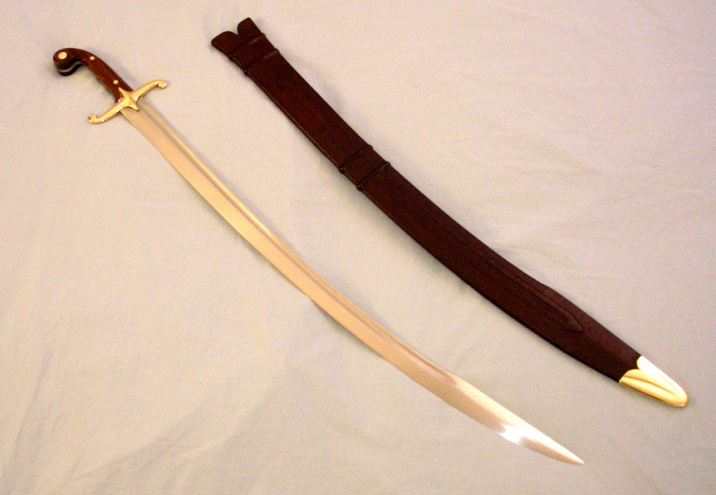
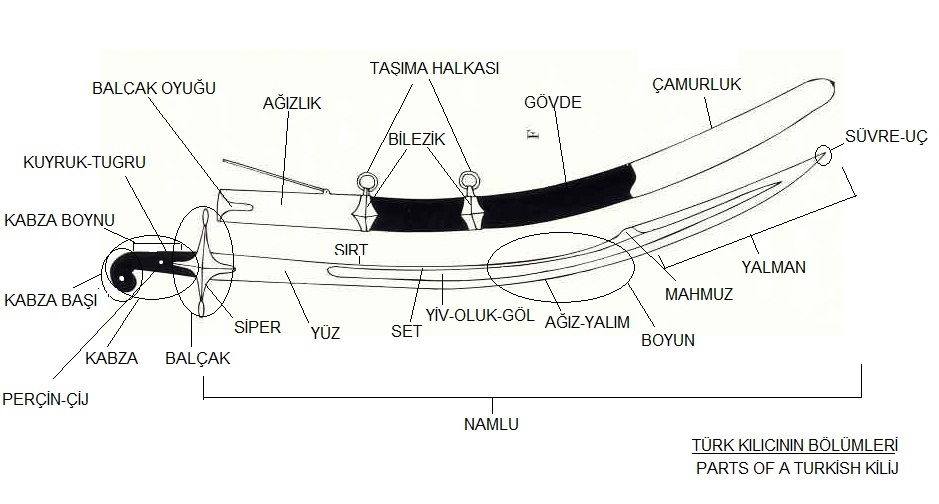
Predominantly cutting weapons usually don't have fullers. When they do, the fuller is set further back along the spine of the blade rather than in the center. This allows you to get many of the benefits of a fuller with few drawbacks. Do bear in mind that this specific example I provided is from a modern company that sells recreations. This is a diagram (in Turkish) of a Kilij and it shows you how the design eventually evolved. It features a false edge (which is basically the ideal compromise between single and double edges), a fuller, it shows how you can piece all these disparate parts together to create a fairly advanced cutting blade. The Iranian shamshir and Indian tulwar feature some notable differences, but they're effectively built the same general way.
Do note that the lack of a sharpened back means you can effectively press in on the blade with your off-hand. While half-swording double-edged blades is totally a thing, it's a lot easier to just rest your palm on the spine of an unsharpened edge and use that to facilitate fine control of your weapon. If you ever get in one of those ridiculous pushing matches that you frequently see in movies (like this, but that's obviously not a still -- it's rather hard to find a still of what I'm talking about), you could simply place your free hand on the spine of your blade, push sharply away, and force your opponent's sword out of the way. And then cut his throat open on your backswing because you cleverly brought a curved sword with a sharpened false edge.
All of that is basically to establish why single-edged swords were preferable for slashing. That most certainly doesn't mean you couldn't cut with a straight-edged, double-edged sword (European longswords are frequently defined as "cut and thrust" for a reason), but purpose-built swords do it better. The trade-off is that they're less useful against armor.
Now, the cutlass. The Royal Navy adopted the cutlass because it's short, stocky, requires very little proper training to use with a reasonably degree of efficiency, and because when they weren't being used you could just stuff them in a rack somewhere and they wouldn't get in the way of the ship's day to day operations. Additionally, the fact that the cutlass was so thick and (frankly) unwieldy helped it. If you want to chop through a rope, a cutlass is going to do a much better job than a fancy shamshir or a more conventional straight-edge sword (which an officer might still carry, depending on his preference). These reasons didn't just stop at the cutlass, mind. The Royal Navy also made extensive use of the boarding axe. In fact, the boarding axe is so ridiculously effective at what it does (mainly chopping through anything and everything between where you are and where you need to be) that it (probably) served as the basic design for the fire axe. After all, if you're dealing a fire on a wooden ship you don't have time to fuss around with hatchets. You need to break through that door right goddamn now unless you want to the magazine to go up and kill everyone.
All of this being said, it's important to remember that by the time the age of sail got into full swing and we start seeing major ship-on-ship actions, gunpowder frequently determined the outcome of fights. Major fleet actions would often devolve into wild melees where crews went up against other crews (y helo thar Trafalgar), but broadsides beat boarding parties every singe time. When the HMS Victory (Nelson's flagship) was about to be boarded at Trafalgar, the HMS Temeraire sailed up alongside the Redoutable and shot it to pieces. Totally weird fact: the Redoubtable was actually one of the Temeraire-class ships, which had been named in honor of a string of previous warships called Temeraire. The British captured one of these in the mid 18th century and then kept the name despite the fact that the French were still using it. The French also had a ship named Temeraire (well, Téméraire) earlier in the war, but it was broken up two years prior.
But I'm way off on a tangent here. As firearms became more effective (especially in maritime conflicts, where something like a firelock is just utterly useless and a flintlock can be fouled beyond use by a rainstorm), boarding actions (ie, anything where you'd use a cutlass) became less viable. They still happened (anti-piracy operations today sometimes require boarding actions), but usually only when the two sides involved had long since lost any cohesion as a fighting force. Usually around the time when the fancy naval battles involving extensive calculations devolve into the naval equivalent of a bar room brawl.
Since this was asked in your edit as well as by /u/afineguy - in Japan at least, double-edged swords were not commonly seen at all, probably due to a combination of several factors, such as the access to poorer quality iron, or simple swordsmanship techniques. Japanese iron was sourced from iron sand which meant that a larger emphasis had to be made on ensuring that blades made were flexible enough whilst retaining the sharp edge - this is a rather extreme example of why single-edged blades were preferred to double-edged blades, because (as /u/white_light-king mentioned) of the increased flexibility given by a springy 'backbone'. After the introduction of firearms, swords were almost unseen in battle (even before, their presence was not widespread).