Is there something that was game changing for paintings that made "realistic" or somewhat lifelike artwork possible, or was carving busts easier to conceptualize because it's in 3D?
This is a simple matter of perspective. Literally.
When we look at the beginnings of sculpture, back in the Egyptian times, we get work that is very stiff and not very life like, like this. It's stiff, blocky and more representational of a human being rather than what an actual human being looks like.
But as much as that carving doesn't look like an actual human being, it is far closer than the Egyptian paintings, like this. We don't get any sense of depth perception in this painting. The legs on the human beings both seem to be on the same side and nothing appears further away or closer. That's because there is no vanishing point.
When you are working on a sculpture, you can move around the entire object. It is presented to your senses in 3 dimensions, height, width and depth. When you are good enough, you can start to see when those dimensions are off and when they need to be corrected. If we jump into the future, Greece was producing sculptures that looked like this. The sculptor doesn't have to worry about a vanishing point on a sculpture since it already in 3D. They can now worry about anatomical structures (even if this one is highly exaggerated).
Drawing and painting are very different though. You have to trick your audience into seeing the illusion of depth, since all you really have to work with is height and width. This was a much slower process. You can see the eventual progressions of depth in the Greek painting on their vases. You can see in this painting, unlike the Egyptian paintings that we get some sort of illusion of depth. People are now standing behind things. Our humans are still very flat, but painters are slowly getting the hang of it.
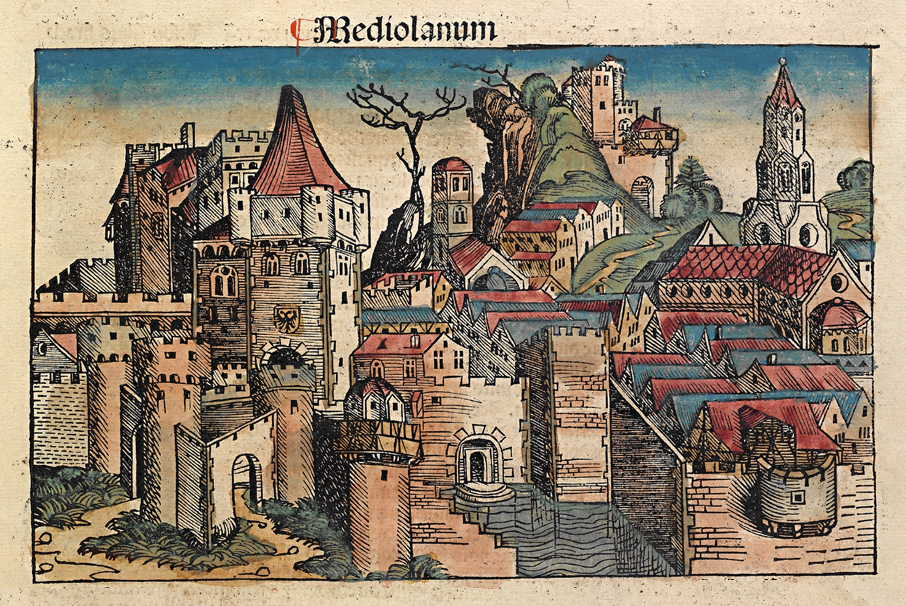
Jumping forward to the Middle Ages, skills are progressing to a point where the artists understand the need for depth, but they are not quite sure how to do it. Here is a good example. The painting seems "off" doesn't it? That's because there is no common vanishing point. The right side of the painting seem to be aligned with a vanishing point wanting to happen in the deep left of the picture. But the left side has vanishing points all over the place. Roof slants, walls and windows are places helter skelter. We're getting closer to realism though.
As far as humans go, painters are getting closer as well. Here is a young woman. Notice, we have a lot more details now than we did back with the Greeks. It's not just a side profile of the face, but now we can get it at an angle. To our eyes, things still look off. The size of her face to the size of her head is seriously out of proportion as is her head to her body. But, we have depth.
By the time the Renaissance rolled around, humans had pretty much cracked the code of proportion, depth and vanishing points. Da Vinci's famous Last Supper is one of the best uses of the Vanishing Point, drawing all of our attention to the center where Christ is. Michelangelo understood anatomy and proportion to give us convincing people in his paintings.
Now, as to why this took so long and why sculpture became real so much faster. Sculpture was easier to get the proportions right and didn't have to worry about using tricks to fool the audience. It was already in 3D and the only difficulty was getting the anatomy right. Painting relied on tricks that had to be not only learned, but passed down to the next apprentice. Since it was so much more difficult to master, it took a longer amount of time to get right, especially if a master was only teaching a few students at a time. One well timed infectious disease could wipe out several hundreds years of learning in a few short years, further delaying the process.
There is more to the process, including the political encouragements of painters in the Renaissance, but I can get to those later if anyone is interested.
EDIT Sources:
GACK! My bad. I cited that Greek Vases gave us that picture where depth was seen, but really, that's the Pista Panels, one of the very few surviving pieces of Greek Antiquity painting that we have. My bad.
hi! hopefully someone can drop by to address your specific question of the contrast between sculpture and painting, but meanwhile, you may be interested in some background info on realism in art from the FAQ (some of the posts actually ask about the apparent contrasts between sculpture and painting, but I don't recall offhand anyone addressing that specific point)
These posts will give you leads on many expert users; if you have followup questions on any of the old locked posts, just comment here and include the user's username (e.g. /u/searocksandtrees) so they may be auto-paged.
Because the corpus of Roman painting is relatively limited, the majority coming from the sites buried by Vesuvius. Plaster doesn't survive as well as marble and so it is fairly rare to have conditions neccesary for a painting to survive. But we do have plenty of examples of realistic Roman paintings.