Previous weeks' Tuesday Trivias and the complete upcoming schedule.
Today’s trivia comes to us from /u/piy9!
A nice simple theme for today! If it so pleases your majesties, kindly share interesting historical information about thrones, chairs, stools, or any other place to alight one’s bottom. And yes you can talk about potties.
Next Week on Tuesday Trivia: Tally ho! We’ll be sharing rousing speeches from history, charged battle rallies, inspirational political anthems, and anything else that got the people going. And in conclusion, may I remind you that it does NOT say R.S.V.P. on the Statue of Liberty? Thank you very much. (Snuck that one in right on the 20 year rule!)
So as someone with an avid interest in naval aviation history, I was able to get myself a tour of NAS Pensacola a few years back through one of my research contacts. My liaison that day was a retired naval aviator and met me while wearing a very distinct tie and pin with his suit. Upon asking him about his pin, I was introduced to a very unique and elite club with strict membership requirements of which my host was a member of.
Martin-Baker, is a British manufacturer of aircraft ejection seats and other aircraft safety systems. Since the widespread use and implementation of the ejection seat, Martin-Baker has been one of the foremost producers of ejection seats for a variety of aircraft, such as the F/A-18, the Sea Harrier, and the upcoming F-35 JSF. In 1957, one of the founders of Martin-Baker, Sir James Martin began what is known as the Ejection Tie Club.
The club's requirements for membership are simple. Any pilot, crewmember or passenger that has successfully used an ejection seat in a flight emergency is eligible for membership. Upon entry into the club, the inductee is presented with a tie, a patch, a pin (or brooch if the recipient is a woman), a membership certificate and card. To date, about 5800 people have been awarded membership to this club, with the first member being inducted in January 1957.
Source:
I'm going a slightly different way: talking about a seat on which the ruler was emphatically not to alight his bottom. Still, it was a stool all the same. It's the sika'dwa or Golden Stool of Asante (aka "Ashanti"), the ceremonial seat of the Asantehene as ruler of the Confederacy and Empire, meant to symbolize the entire Asanteman (the name used for the polity, in modern-day Ghana) as a single community with the Asantehene as its head.
In a sense, it's not really trivia, because it involves matters of life, death, and war; Asante was a powerful and arguably modern nation-state as of the early 18th century, one of the most sophisticated in precolonial West Africa, and certainly one of the wealthiest, sitting atop the Akan goldfields and in fact being (aside from a couple of expansion phases) a net importer of slaves from the Atlantic. They did not expand wholesale or overreach; Asante maintained a powerful bureaucracy, but also redundant systems of power-sharing and local governance alike, all connected to the Golden Stool and its occupant in the city of Kumase. The Stool itself was legendarily handed down from the heavens to the great unifier of the Akan people into the Asanteman, Osei Tutu I, through the devotions of his High Priest Okomfo Anokye. As such, it is a holy object, and it is symbolic of the spirit of the nation--but unlike other Asante stools, the Asantehene never actually sits on the Golden Stool. When he is enstooled (yes, that's the term) he is ceremonially lowered over it and raised back up.
So what's the story here? Well, it involves the ejection and then the return of the Asante royals after British "conquest" of the Asanteman in 1896. When it became clear the British intended to march in and take over protectorate in Asante, the Asantehene at the time--Agyeman Prempe I--wisely ordered his military and his vassals not to resist. He had seen what a new generation of weapons could do, and although he did not intend to surrender the independence of Asante, he wanted bloodshed even less. The British entered Kumase and, by surprise, subjected Prempe and the Queen Mother (female roles were quite powerful checks in Asante governance) to a humiliating ceremony of submission where they put their heads between the knees of the British officials and commanders. At center is the Governor of the Gold Coast Colony, W. E. Maxwell; to the right (I believe, not left) is General Baden-Powell, famous for his founding of the Boy Scouts and his engagement in other imperial wars. This was a public submission, preparatory to the expulsion of the Asantehene and the royals into exile shortly after.
The problem was that, as the effective "chief" of people, the Governor of the Gold Coast didn't have legitimacy in the eyes of Asante people and local leaders. They continued to recognize only the enstooled Prempe, even in exile, so the solution was obvious: the new Governor, Frederick Mitchell Hodgson, would demand that the remaining royals produce the Golden Stool so he could publicly sit upon it as the Queen's representative.
This went over like a ton of bricks. The stool went into hiding, buried for safe-keeping, and at a meeting the Queen Mother of Ejisu, Yaa Asantewaa, raised the call for war. The resulting war (Ashanti War, Ashanti Uprising, Yaa Asantewaa's War) nearly ejected the British from the Asanteman for a time, but ultimately they re-established de facto control after about six months. The British never however got to sit on the stool, or even take possession of it; it remained buried, so long as no Asantehene could rule.
Of course, it did not stay buried. In 1921, a non-Asante road crew found the Golden Stool's burial place while constructing a road. They stripped some of the ornaments from it, but word of its discovery quickly spread, and this defilement required a trial and likely death according to Asante law. The British colonial government, which had been virtually unable to really control Asante, now faced another new military uprising in the wake of World War I--an uprising that they could not simply put down with brutality as before the war. The Governor, Frederick Gordon Guggisberg, was a survey officer and engineer with two decades of experience in West Africa, and a great deal of contact with people in the Gold Coast and Nigeria, so he knew he could not simply impose a British solution. He also had an unusual level of respect for the attainments and capabilities of Africans, having worked with them in technical fields, and he treated the demands of culture with much greater care than governors before him. So he acceded to the Asante demand to try the accused, and paid the restoration of the Stool from the colonial treasury. (They found the road workers guilty, sentenced them to death, but agreed to let Guggisberg commute that to banishment in light of his conciliation and promise of non-interference with the Stool.) This act effectively re-opened the question of Prempe's 25-year-exile, which the people and the Asantehene himself had never dropped, and Guggisberg helped to make this a reality in 1924. When Prempe died, his successor (Agyeman Prempeh II) was enstooled in 1935 as he had been; their successors to this day (Osei Tutu II) still are lowered and raised over the Golden Stool, and Asante identity remains remarkably cohesive in the center of Ghana. The Asantehene, however, is now a fairly modern monarch, who takes his role as ceremonial but also moral, promoting education, health, and so forth--supporting the nation, not contesting its right to rule on earthly matters.
edit: preposition failure
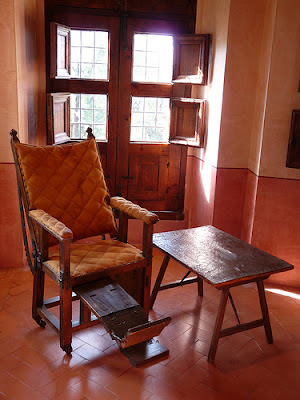
So I've written a bit about Emperor Charles V's imperious appetite. Is it a surprise that the man suffered from gout so severe that he could not ride a horse, had his hands forced at the siege of Metz, and eventually led to his early retirement?
The Emperor was perhaps able to leave behind his earthly sources of stress (Reformation, Ottomans, Mediterranean piracy, pesky Austrian Habsburg relatives, brewing rebellion in his home the Low Countries, Francis I of France, etc etc etc etc) as he went to a monastery in Yuste, in his adopted home Spain.
But gout followed him there, too. So, he commissioned a special chair with a foot stool, and some amount of articulation, to relieve pain from his gout.
Titian's equestrian portrait of Charles V shows a fit emperor on horseback, ready to charge at the Protestants / Ottomans / Dutch rebels / Mediterranean pirates / French / etc etc etc, however in reality even in that time he was already unable to ride a horse and had to be carried around the battlefield in a litter. No wonder his sister Margaret of Parma had specified to Titian exactly how the portrait was to be drawn.
And yes you can talk about potties.
The inner child within me is giggling with glee while thinking about talking about yicky bodily fluids and excrement. Poop! Pee! Chamber pots! Toilets! Oooooooh!
/inner-child
On a more serious note, today, I'm going to talk about nightstools.
Nightstools are waterproofed buckets with a wooden seat on top. I'll just quote the description of a nightstool from Beyond the Neon Lights: Shanghai in the Early Twentieth Century:
All nightstools in the city were similar if not identical: a wooden, drum-shaped bucket about sixteen inches high and a foot in diameter, with a one-and-a-half-inch-wide wooden ring on the top as a seat, an iron or brass handle fixed to the body, and a round wooden lid on which were routed two semicircular grooves by which one could grasp the lid and lift it off. A coat of tung oil was applied to both the inside and outside of the bucket to make it waterproof and durable; then it was painted purplish red or golden yellow.
It's basically a chamber pot. These were common fixtures in Shanghai in the early twentieth century, simply because most shikumen houses at the time did not not have sanitation facilities.
Nightstools were usually included in a woman's dowry because they were necessary, indispensable part of daily life. Most families owned two nightstools to be used every other day: one clean and empty and the other one in use.
Nightstools could only be emptied before 8 AM into a nightsoil cart, which came around shikumen neighborhoods at around 4 to 5 AM. Generally, the nightstool was left at the front door late at night so that the nightsoil operator (jokingly known as the "Emptying Master") could pick it up and dump it into the cart. If you forgot to take out the nightstool, and the Emptying Master didn't pick it up, you were stuck with either two full nightstools or be stuck using yesterday's nightstool for the day; this was not ideal, and pretty unhealthy (especially during the summer). The Emptying Master was generally in a hurry, and can take care of thirty households in less than ten minutes.
After the nightsoil operator has left, it was time to clean the nightstool. This job was traditionally a woman's job (and was generally done by mothers or grandmothers). The woman would take a bamboo scrub brush and scrub down whatever might be stuck to the sides of the nightstool with water and muscle power. After being cleaned, the stool would be left outside to dry in the air, and be taken back inside before noon. This was generally a rather noisy job, and although the din of cleaning the nightstool subsided in half-an-hour, by then the rest of the city had woken up, and people were out and about getting ready to cook breakfast and purchase foodstuffs for the day. As such, the nightsoil operator served as like an alarm clock, waking up the residents of the city of Shanghai to start a new day.
Citation:
Hanchao Lu, Beyond the Neon Lights: Shanghai in the Early Twentieth Century. University of California Press, 1999
Let me tell you a little about Glenn Gould (1932 – 1982) and his companion.
Glenn Gould was a Canadian pianist, among the most eccentric musicians of the 20th century. Some people think he was within the autism spectrum.
He had some strange "habits." He was kind of a hypochondriac, at some point he was keeping records of his blood pressure. He would not shake hands and would wear gloves most of the time (to protect his hands). He would soak his hands in very hot water before starting to record. He was super obsessive about his recordings, and super obsessive about the condition of each note in his piano. He spent YEARS trying to find a proper piano for himself, and once he found it he asked for the most bizarre regulation (adjustments to the keys).
Now, his chair... It was a folding chair, part of a set. Glenn Gould's father, Bert, cut four inches off each leg and added some screws (so Glenn could adjust the height of each leg individually). It was at least six inches shorter than a normal piano bench (that is very, very weird). Glenn Gould had the strangest posture and technique, and he really liked his arms to be "a little below" normal playing height.
He used that chair for almost thirty years, until he died. He would take it everywhere, he would refuse to perform on any other chair or bench. The chair was BARELY in one piece, and it squeaked when Glenn moved.
Look at the condition of the chair, it's amazing it didn't collapse.
See Glenn Gould himself about his companion. If you think he is being funny or something, I really doubt it. That's how he talked, he was very peculiar.
The chair is now on permanent display at the National Arts Centre in Ottawa. His beloved piano is also there.
Glenn Gould made the weirdest possible decisions, and used his hands in the strangest ways. He used to murmur and sing while playing, he would conduct himself (using his free hand like a conductor in front of an orchestra), and his crazy raggedy short chair would occasionally squeak. Even with, or perhaps BECAUSE OF, all that, Glenn Gould gave us some of the most original interpretations ever.
As usual, I'd like to post some recordings. You can see the chair in these two videos:
His 1981 take on the Goldberg variations is greatest thing ever. Here's the whole thing, but it's only the audio, so no chair action. Turn off the lights, listen to this, and forget about all that is wrong in the world.
Question: traveling with a friend a few years back, he identified a rose-colored tile in St Peter's Basilica as the precise location of Charlemagne's coronation a millennium ago. Is there any truth to that claim?
Are there any truly "famous" toilets? Notable moments while going to the bathroom (GOT style, haha)?